Get Full Government Meeting Transcripts, Videos, & Alerts Forever!
Get email alerts on the Access To Science topic
No spam. Unsubscribe anytime.
Senate committee takes public testimony on bill to study state access to peer‑reviewed journals
Summary
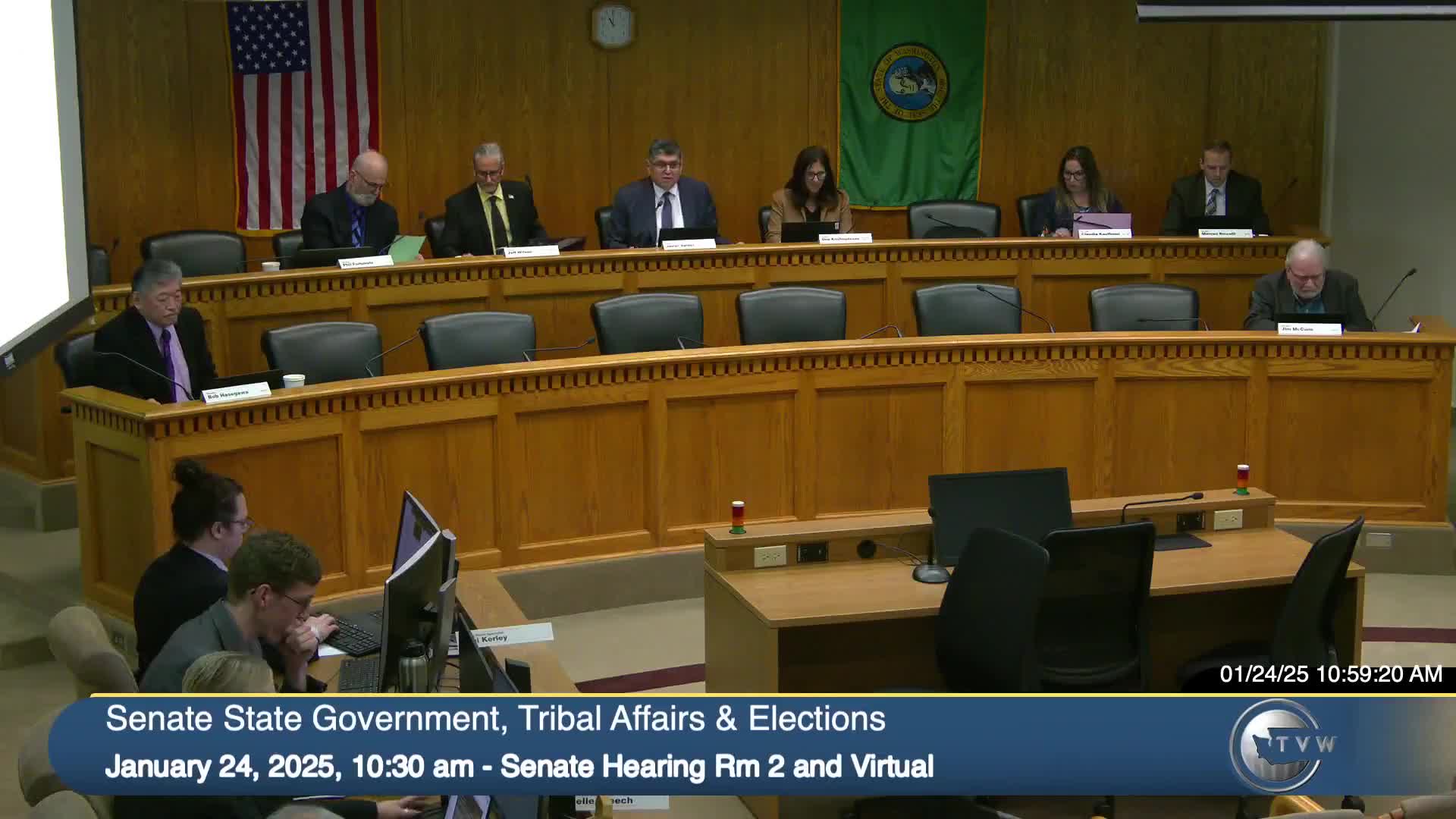
Senators heard public testimony Jan. 24 on Senate Bill 5152, which would require the Washington State Institute for Public Policy to study options for providing state employees electronic access to peer‑reviewed journals.
Senators heard public testimony Jan. 24 on Senate Bill 5152, a measure that would require the Washington State Institute for Public Policy to study ways to provide state employees with electronic access to peer‑reviewed journals.
Danielle Kreech, staff to the committee, briefed members that “the bill before you requires the Institute for public policy to conduct a study addressing at minimum potential funding, organizational structure and policy mechanisms that would provide state employees with electronic access to peer reviewed journals,” and that the study must be completed by Dec. 1, 2026.
Senator Judy Warnick, sponsor of SB 5152, told the committee the bill would help agencies use “best available science” without incurring high costs. “I think the study is going to be a low cost amount but the benefit, the high benefit will be worth the amount that we spend on the study,” Warnick said, adding she hoped the study would reduce duplication and expense across state agencies.
Supporters at the public hearing described everyday obstacles state researchers face when accessing journal articles and said a centralized approach could save money and improve policy-making. Natalie Marshall, a member of the Washington Ag‑Forestry Leadership Program, said state employees currently have uneven access because each institution has different subscriptions and budgets. “For policy development,” Marshall said, “our state needs to be the caliber that Washingtonians deserve.”
Carrie Anne Yetzer, coordinator for the Washington State Sentencing Guidelines Commission, said agencies previously relied on shared access through the state library and that most journal articles are now behind paywalls charging roughly $10–$25 per article. She told senators the Commission used appropriated funds in 2018 to buy temporary access to journals to complete a mandated review, and that ongoing access is “imperative” for commission work.
Other supporters included members of the Ag‑Forestry Leadership Program and state employees who said other states’ consortium models have produced savings. Cody Lervier testified that earlier proposals estimated a $200,000 study cost and the group reduced that to about $83,000; Paul Dagnolo, a state employee, said centralized purchasing would leverage the state’s bargaining power to save taxpayer dollars.
Committee members questioned the fiscal note. Senator Fortunato cited numbers in the fiscal note showing an allocation to Evergreen State College tied to Washington State Institute for Public Policy support, asking why the same dollar total appeared with different FTE estimates. Kreech replied Evergreen State College provides fiscal and administrative support to WSIPP and that the committee would defer to the Institute for a fuller explanation.
Testimony totaled hundreds of electronic responders: the vice chair noted 414 responses in the hearing record (40 pro, 373 con, and 1 other) though multiple testifiers present expressed the opposite (support) in person; the committee record shows several in‑person supporters. The committee did not take a committee vote on SB 5152 during the Jan. 24 hearing.
Why this matters: State agencies frequently rely on peer‑reviewed literature to develop regulations, policy and program evaluations. A centralized, negotiated approach could reduce per‑article costs and duplication across agencies, potentially improving evidence‑based decision-making.
What the bill would do: Direct WSIPP to study funding options, organizational structures and policy mechanisms to provide electronic access to peer‑reviewed journals; deliver the study to the Legislature by Dec. 1, 2026.
Fiscal and implementation notes: Committee staff said Evergreen State College would provide fiscal and administrative support to WSIPP for the study; the fiscal note included one‑time funding roughly in the $82,000–$86,000 range and referenced part‑time FTE estimates that staff said they would clarify with WSIPP.
Public testimony (selected): Natalie Marshall (Washington Ag‑Forestry Leadership Program); Carrie Anne Yetzer (coordinator, Washington State Sentencing Guidelines Commission); Cody Lervier (Yakima); Paul Dagnolo (state employee, Bellingham); Stacy Rasmussen (Ag‑Forestry Leadership Program); Francisco Santiago Avila (science and advocacy director, Washington Wildlife First).
No final committee action was recorded on SB 5152 on Jan. 24.