Get Full Government Meeting Transcripts, Videos, & Alerts Forever!
Get email alerts on the House Bill 1199 topic
No spam. Unsubscribe anytime.
Committee hears bill to let insurance commissioner order restitution, raise fines for insurers; industry urges guardrails
Summary
House Bill 1199 would authorize the state insurance commissioner to order restitution to harmed consumers and increase certain fine limits; supporters say the change would help make consumers whole without litigation, while insurers and trade groups sought narrower language and procedural safeguards.
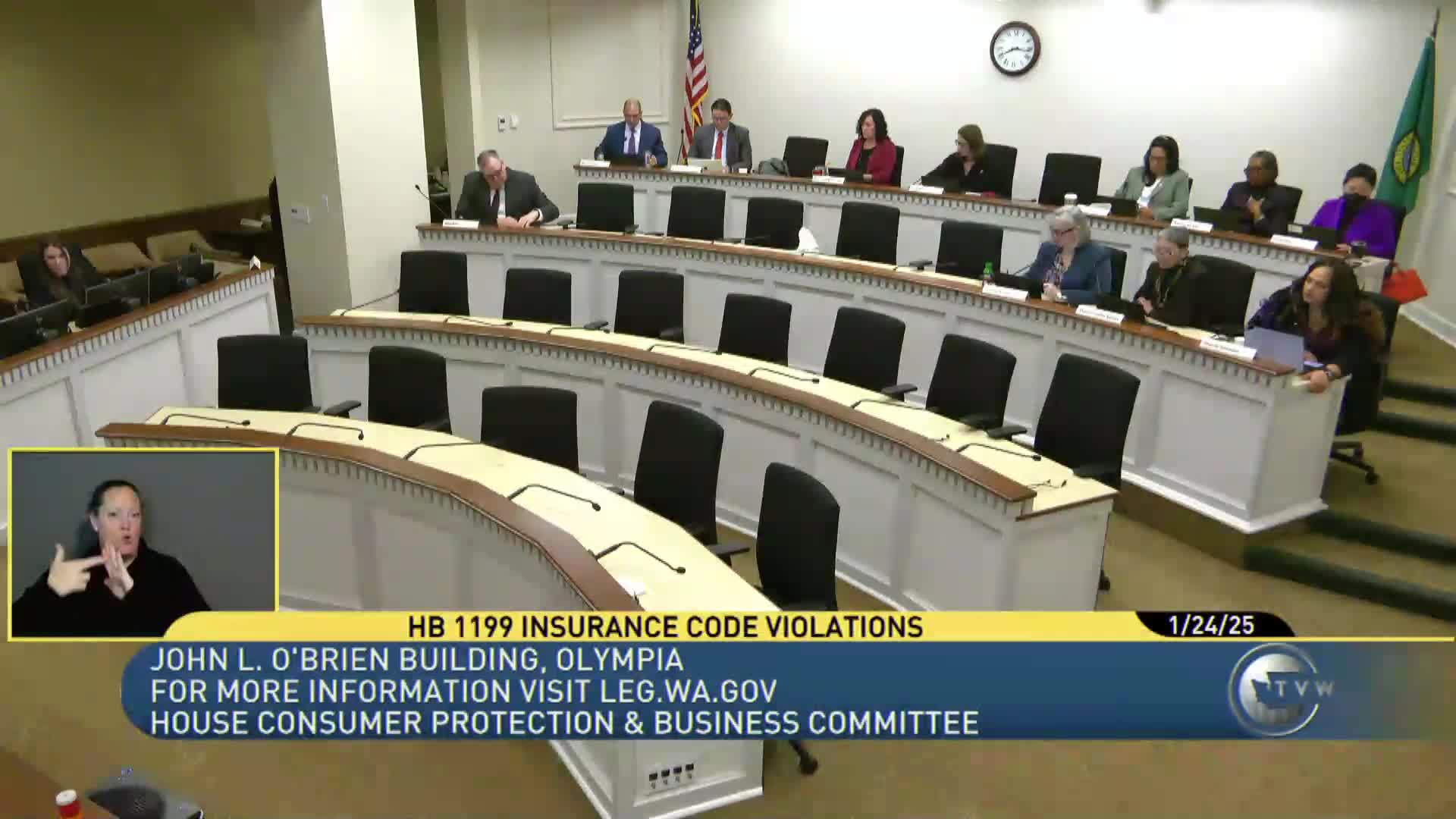
The Consumer Protection & Business Committee held a public hearing Jan. 24 on House Bill 1199, a legislative request from the Office of the Insurance Commissioner that would allow the insurance commissioner to order restitution for consumers and amend existing fine authority for insurers.
Under the bill as presented to the committee, the insurance commissioner could order a person regulated by the insurance code to pay restitution when the person possesses or controls money or property that belongs to another, either after a hearing or with the person's consent. Restitution under the bill would carry 8% simple interest from the date the obligation arose and must be paid within 30 days of the commissioner's order. The bill also would amend a current fine (noted in testimony as $250) to a maximum of $10,000 and specify that the fine can be assessed per violation.
Patty Kuderer, Washington State insurance commissioner, told the committee the proposal is an agency-request bill designed to address a "foundational fairness to the consumer." Commissioner Kuderer said the authority would let the office make injured insureds whole without forcing every consumer to pursue separate lawsuits or obtain counsel for small-dollar matters: "This legislation is for the bad actors," she said, and it would "streamline the process to allow the insured to be made whole."
Brian Welch, with the Office of the Insurance Commissioner, described current practice: "The fines that the OIC does collect currently go to the state general fund," he said, and consent orders often include negotiated remediation such as reprocessing claims. Welch and Rory Payne Donovan, the commissioner's legislative director, told the committee the change is targeted at situations where companies refuse consent agreements and the administrative law judge process lacks explicit statutory authority to order restitution.
Committee members raised due-process and market-impact questions. Representatives asked whether restitution orders could be appealed, if restitution costs could be incorporated into insurers' future rate filings, and whether the measure would deter insurers from doing business in the state. Commissioner Kuderer said insurers may appeal adjudicated orders and that OIC rate-review processes would limit the ability to pass unanticipated costs into rates. OIC staff also agreed to follow up with members on how restitution authority interacts with other remedies available in court, such as claims under IFCA and other statutes.
Industry witnesses generally said they support making consumers whole but asked for narrower language and procedural safeguards. Bill Stofiker of the Independent Insurance Agents and Brokers of Washington and John Mangan of the American Council of Life Insurers said the OIC already achieves restitution in many consent orders and noted the new authority is principally needed for a subset of contested cases. Kenton Bridal, president of the Northwest Insurance Council, asked that the bill be limited to cases where current statute prevents restitution (for example, in contested ALJ proceedings), to separate willful from negligent conduct, and to consider an aggregate cap on per-violation fines. Brandon Vick of the National Association of Mutual Insurance Companies urged that the statute explicitly reference the Administrative Procedure Act hearing process and limit restitution to actual damages.
Premera Blue Cross said it supports the bill in principle but asked for technical changes, including a narrower definition of the class of persons who may receive restitution orders (to avoid overly broad liability) and limiting restitution to benefits owed to policyholders.
OIC staff and insurers agreed to continue technical discussions. Advocates for the agency said at least a dozen states already authorize similar restitution by insurance regulators, and OIC staff said most fines collected by the office go to the state general fund rather than remaining at the agency. No committee vote was taken; the item was a public hearing and staff and stakeholders said they would work on clarifying language before further action.