Get Full Government Meeting Transcripts, Videos, & Alerts Forever!
Get email alerts on the Tax Administration topic
No spam. Unsubscribe anytime.
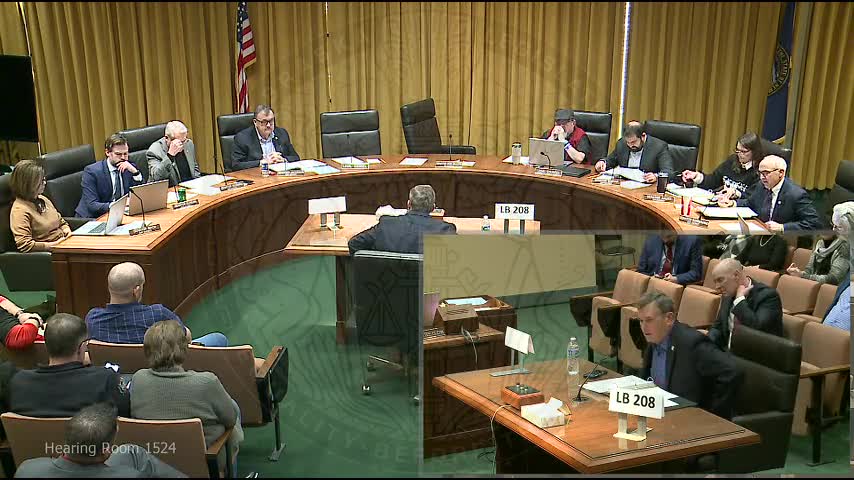
Revenue Committee hears LB 208 to tighten tax administration, protect confidentiality and change credit distributions
Summary
Sen. Brad Von Gillern introduced LB 208 before the Revenue Committee, a Department of Revenue cleanup bill that the agency says would save about $1.27 million through the 2026–27 fiscal year, expand confidentiality penalties, adjust sales‑tax defaults for incomplete addresses and change how several tax credits are distributed.
Senator Brad Von Gillern, chair of the Revenue Committee, introduced LB 208 at a committee public hearing as a Department of Revenue cleanup bill that, the bill’s fiscal note projects, will save roughly $1,270,000 through the 2026–27 fiscal year.
The bill bundles several technical changes that the Department of Revenue told the committee it needs to avoid revenue losses and to simplify administration. "The major selling point of LB 208 is the fiscal note which projects around $1,270,000 in savings," Senator Von Gillern said in opening remarks.
Nebraska Tax Commissioner James Kam testified in support and described the bill as a set of harmonizing and corrective changes. He told the committee the bill would prevent certified service providers (CSPs) who handle sales and use tax for so‑called model 1 sellers from collecting duplicate fees and would change the default method the state uses when sellers provide only a five‑digit ZIP code for online sales. "If a model 1 seller's sales and use tax functions are performed by a CSP, that CSP is compensated by the state of Nebraska through a contract," Kam said. The bill would remove a second fee that some CSPs collect and would default to the highest combined sales tax rate in a ZIP code where only a five‑digit ZIP is provided; if a nine‑digit ZIP is provided, the bill applies the lowest combined rate.
Kam also summarized statutory confidentiality changes in LB 208 that would expand the criminal prohibition on disclosing taxpayer information in Nebraska Revised Statute 77‑2711(7) to "any other person," bringing sales‑tax confidentiality into alignment with state income‑tax confidentiality. He said the change would subject former DOR employees who improperly use confidential sales‑tax information to civil and criminal penalties.
The bill would also: clarify that the refundable child care tax credit enacted in 2023 is limited to Nebraska residents; convert distribution of the nonrefundable food pantry and the refundable biodiesel tax credits from a pro rata distribution to first‑come, first‑served if the $1,500,000 annual cap is reached; and ratify the streamlined sales and use tax agreement through Dec. 31, 2024.
Tim Keiger, a registered lobbyist for the Nebraska Petroleum Marketers and Convenience Store Association, opposed the first‑come, first‑served change for the biodiesel credit, saying large retailers could capture the credits and disadvantage smaller members. Keiger asked the committee to leave the proration language in place or work with the DOR on an alternative method.
Committee members asked no formal questions of the tax commissioner after his testimony; no committee action or vote occurred at the hearing. Senator Von Gillern closed by saying he would continue to work with interested parties on the biodiesel‑credit language and other technical concerns before further action.
Discussion points: the projected fiscal savings; the confidentiality expansion; the sales‑tax default for incomplete addresses after the creation of Good Life Districts; and the change from pro rata to first‑come, first‑served for two capped credits. No formal motion or vote was recorded at the hearing.