Get Full Government Meeting Transcripts, Videos, & Alerts Forever!
Get email alerts on the Water Law topic
No spam. Unsubscribe anytime.
State official outlines Washington water-rights framework and legal limits on new uses
Summary
Rhea Burns of the Department of Ecology briefed the Agriculture and Natural Resources Committee on Washington's prior-appropriation water-rights system, types of water rights, permit-exempt wells, the role of instream flow rules, and key court decisions that constrain approval of new or changed water uses.
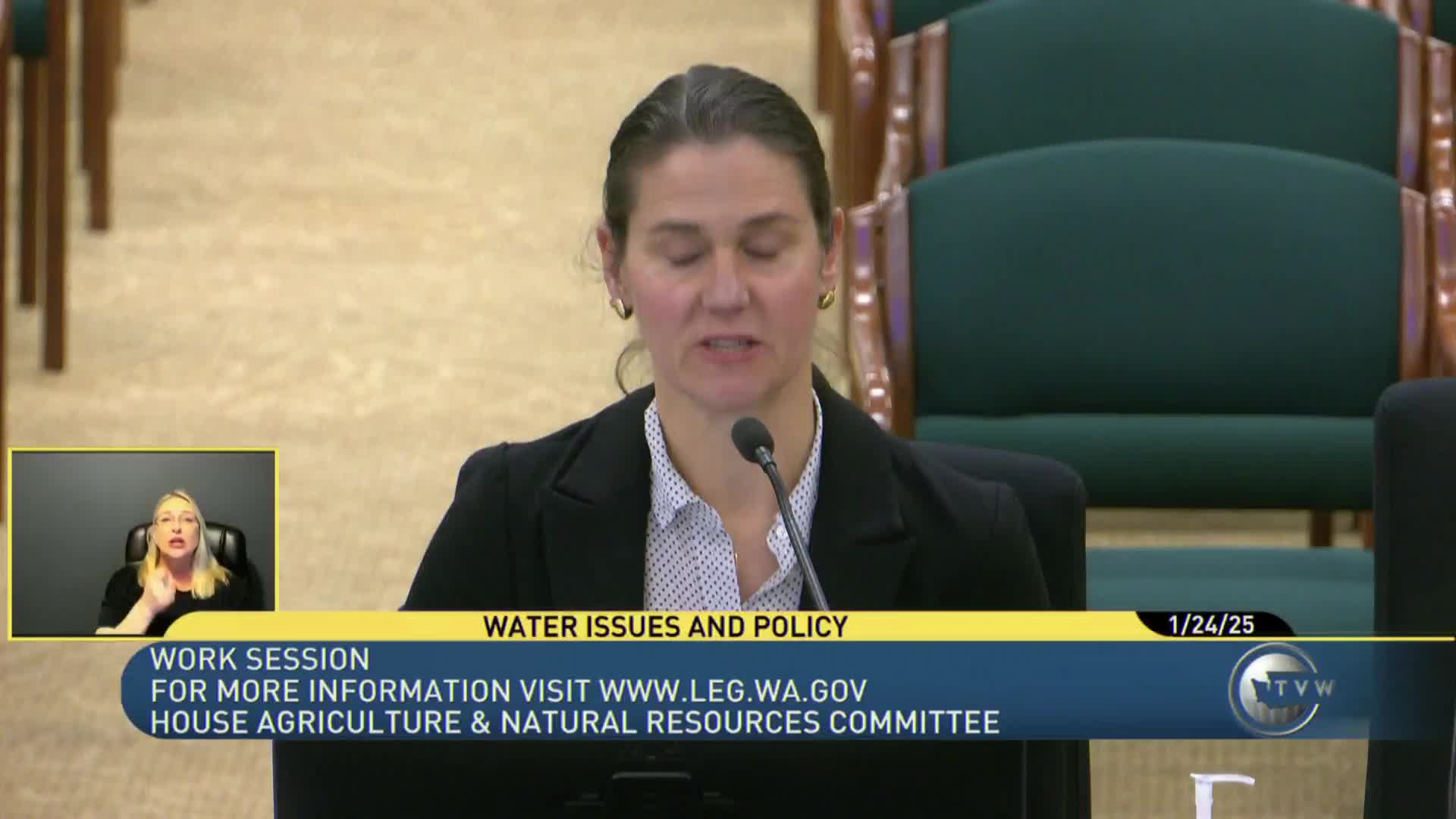
Rhea Burns, program manager for the Washington Department of Ecology's Water Resources Program, told the House Agriculture and Natural Resources Committee on Jan. 24 that Washington uses a prior-appropriation water-rights system: water "belongs to the state," is permitted for beneficial use, and rights are determined by seniority — "first in time, first in right." Burns explained the four core tests for new appropriations and described four categories of rights, including pre‑code claims, permits and certificates, permit‑exempt groundwater uses and tribal reserved rights.
Burns said Washington's surface and groundwater statutes first established prior‑appropriation in state law (Surface Water Code, 1917; Groundwater Code, 1945) and that the state enforces a general relinquishment rule for nonuse after five years, with limited exceptions. She described the limited permit exemption for some groundwater uses (domestic and small‑scale noncommercial uses) and cited the Hirst decision and subsequent policy and legislative responses that have shaped rural permitting practices.
The Ecology manager explained that instream flow rules adopted under the state's minimum‑instream‑flow authority function as water rights with a priority date equal to the rule adoption date. Those rules are administered within the prior‑appropriation seniority system; rights issued later from the same source are interruptible when flows are not met. Burns said two Washington Supreme Court decisions — Postema (2000) and Foster (2015) — tightened the impairment standard for new or changed rights. She summarized Foster as requiring mitigation that is "in time, in kind, and in place" (often called perfect mitigation) and said that doctrine has sharply limited Ecology's ability to approve changes where perfect mitigation cannot be shown.
Burns also described adjudication as a court process that can establish final extent, validity and priority for rights on a source; Ecology may make tentative determinations during change processes but only courts issue final decrees. She said Ecology has completed dozens of adjudications historically and that the agency continues pre‑adjudication work in parts of the state.
On practical availability, Burns said most basins are fully appropriated and few areas legally can receive new water rights. She said changes that move point of diversion or otherwise risk impairment to senior users — including instream flow rights — face substantial legal barriers.
The presentation concluded with a brief overview of climate impacts and storage options: declining snowpack reduces the state’s natural storage and complicates the timing of supply and demand, while the Foster decision remains a legal constraint on many mitigation strategies Ecology might otherwise consider.
Burns cited Ecology guidance, case law and the state’s statutory framework in answering committee questions about where the "extent and validity" analyses are rooted and where appeals can be brought (appeals are to the Pollution Control Hearings Board).