Get Full Government Meeting Transcripts, Videos, & Alerts Forever!
Get email alerts on the Conservation Easements topic
No spam. Unsubscribe anytime.
House committee advances bill to let farmers donate conservation easements without state purchase
Summary
The House Agriculture Committee voted to advance House Bill 1234, which would create a framework for farmland owners to donate or bequeath agricultural conservation easements; the measure does not include a state appropriation and would allow the Indiana State Department of Agriculture or local land trusts to hold easements.
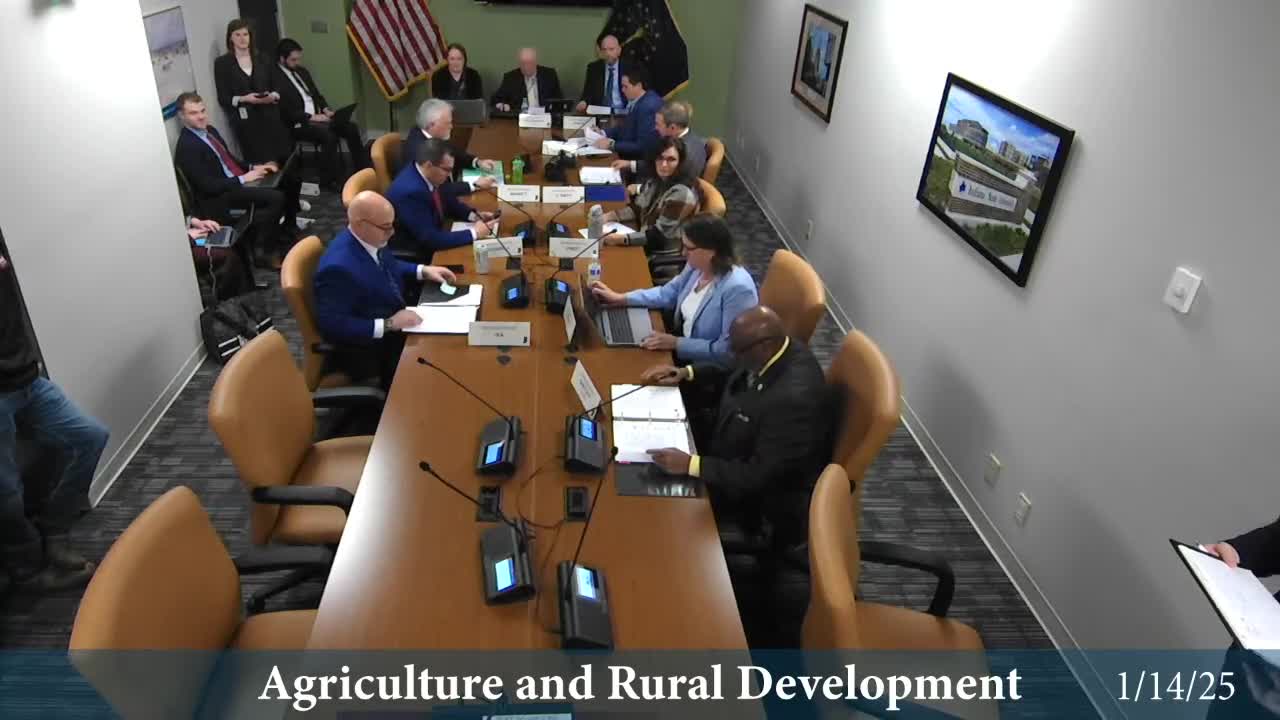
At a House Agriculture Committee hearing, members voted to pass as amended House Bill 1234, a bill that would create a statewide framework allowing willing farmland owners to donate or bequeath agricultural conservation easements to preserve land for farming.
The bill’s author, Representative Randy Culp, told the committee, “This bill creates a framework for willing farmland owners to donate their conservation easements, if they choose to protect their farms for future generations to utilize to grow food.” He said the proposal responds to a recent state inventory documenting acres of farmland loss.
The measure would establish an agricultural land protection program and an Ag Conservation Easement Fund. It does not appropriate state dollars to buy easements; instead, it would let the Indiana State Department of Agriculture (ISDA) accept or hold donated easements and would permit counties to create their own local programs that could pursue federal or private matching funds. Chris Reynolds, Midwest regional director for American Farmland Trust, said the bill “lays the vital groundwork to give farmers and landowners the option to protect their land for future generations.”
Proponents cited the state’s inventory of lost farmland, released in 2023, which the testimony described as finding roughly 345,000 acres lost between 2010 and 2022—about 29,000 acres per year. Reynolds and other witnesses said that rate of loss, and projections of additional loss by 2040, justify creating a mechanism that helps landowners secure federal matching funds available through USDA programs and other sources.
Several witnesses explained program mechanics. Toby Day, sustainable agriculture director for the Hoosier Environmental Council, described how a conservation easement reduces a parcel’s development value: “When the appraisal goes through for these conservation easement, they'll take the full value of that land, and then they'll decrease it by what that development cost is … and that's what that land will be assessed at.” David Harden, a sixth-generation Hendricks County farmer, told the committee the easement tool would help with estate planning and make farmland more affordable to future farmers.
ISDA’s legislative director, Quentin Hayes, said the department would implement and assist counties with the program if the law passes but that doing so would require additional staffing and resources. Hayes told the committee, “If ISDA were provided some additional staffing and resources … we would be able to implement this program.” He and other witnesses noted that land trusts already can hold easements and that owners could choose those organizations instead of the state.
Committee discussion addressed governance of any oversight board, with members raising the possibility of amending the board’s makeup to ensure political balance. Representative Bartlett and others said they would support changes to membership rules if the bill’s author agreed.
The committee moved to pass the bill as amended. The motion was approved by committee voice vote after members voiced support; at least one member announced a “no” vote and explained concerns on the record. The committee chair said technical amendments would be worked before the bill’s next stop.
Supporters argue the bill creates a low-cost framework that lets landowners voluntarily protect agricultural land and leverage federal funds. Opponents or hesitant members asked for clearer language about board membership, staffing for ISDA if the department accepts easements, and how local land trusts and counties would interact with a state program.
The bill will move to the next stage in the legislative process with the possibility of further amendments on second reading.