Get Full Government Meeting Transcripts, Videos, & Alerts Forever!
Get email alerts on the Agricultural Land Conservation topic
No spam. Unsubscribe anytime.
House panel hears bill to let Indiana farmers donate conservation easements; no state buyouts proposed
Summary
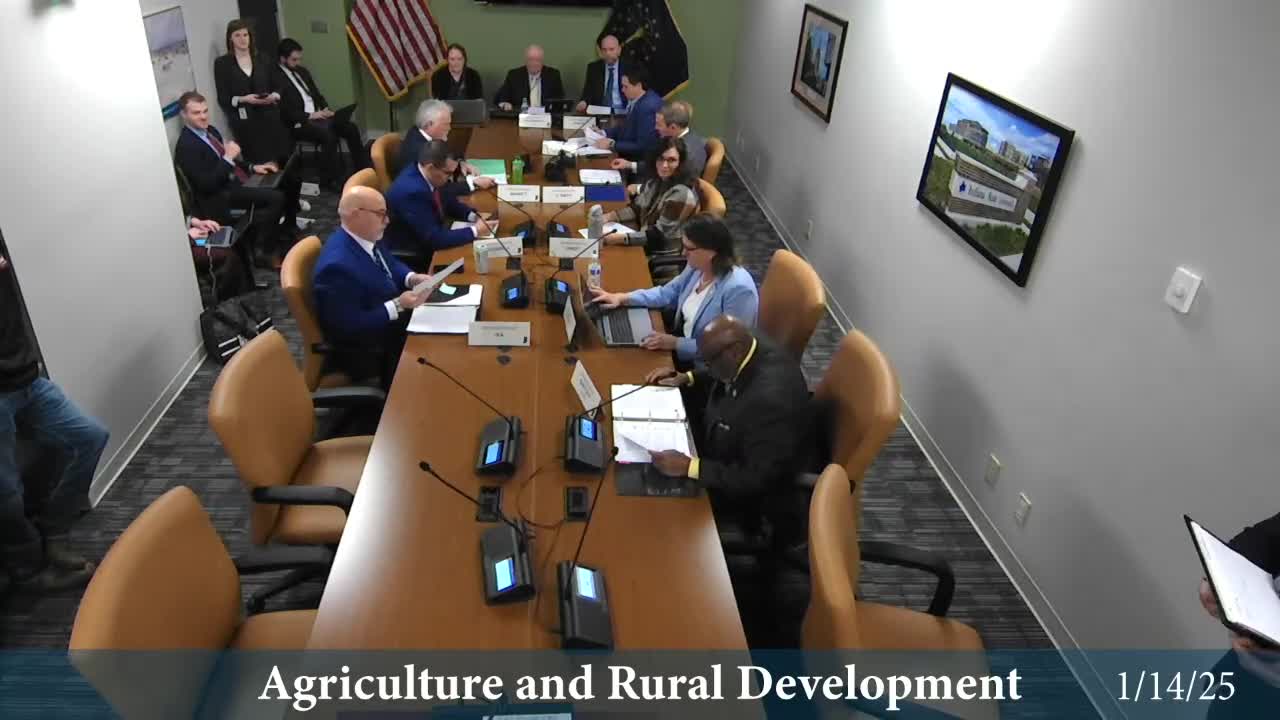
The House Agriculture Committee on Wednesday heard testimony on House Bill 1234, which would create a framework for farmland owners to donate or bequeath agricultural conservation easements to protect farms for future generations.
The House Agriculture Committee on Wednesday heard testimony on House Bill 1234, which would create a framework for farmland owners to donate or bequeath agricultural conservation easements to protect farms for future generations.
Representative Culp, sponsor of the bill, told the committee, “This bill creates a framework for willing farmland owners to donate their conservation easements, if they choose to protect their farms for future generations to utilize to grow food.” The proposal would authorize the Indiana State Department of Agriculture (ISDA) to accept and hold easements, allow counties to create local programs, and make protected landowners eligible to apply for federal funds to purchase easements or parts of easements.
Why it matters: Committee members and several witnesses framed the bill as a non‑appropriations approach to slowing farmland loss. Testimony cited the ISDA inventory showing roughly 345,000 acres lost in Indiana between 2010 and 2022 and warned that continued loss could jeopardize farm succession and rural economies.
Supporters said the bill is voluntary and does not ask the Legislature to fund purchases. Chris Reynolds, Midwest regional director for American Farmland Trust, urged backing, saying HB 1234 “lays the vital groundwork to give farmers and landowners the option to protect their land for future generations.” Caitlin Smith of the Indiana Farm Bureau testified in support and summarized the stakes: “Food security is national security.”
Quentin Hayes, legislative director for ISDA, described the agency’s role if the bill passes and cautioned that implementation would require added staff and resources. “If House Bill 1234 were enacted, ISDA would be responsible for implementing the conservation easement program in coordination with the newly created protection board,” Hayes said. “We are confident in being able to implement this program if we were provided additional staffing and resources.”
Other witnesses included farmers and conservation advocates who said donated easements can lower the purchase price of farmland for beginning farmers and aid estate planning. David Harden, a sixth‑generation farmer, said an easement could allow a family to retain farmland for agriculture while using the easement value in estate arrangements; Toby Day of the Hoosier Environmental Council said easements typically “sell off the development rights” and can make land more affordable to new farmers.
Committee discussion touched on program governance and political balance on the proposed protection board. Representative Bartlett and others asked that the board membership not be composed entirely of one party; the bill’s author said he was open to that change. The bill’s drafters and witnesses also noted existing land trusts — for example, the Benjamin Harrison Land Trust — can already hold easements in Indiana, and that the proposed state framework would make landowners eligible for matching federal or philanthropic dollars.
Formal action: The committee moved to pass House Bill 1234 as amended. The committee recorded a roll‑call vote with the result appearing on the record as eight votes in favor and two opposed. The committee chair announced the motion carried.
What’s next: If advanced by the committee, the bill would proceed to second reading and the full House for further consideration. Supporters said state matching or staffing could be addressed later in the process; ISDA reiterated it would need additional resources to operate a state program.