Get Full Government Meeting Transcripts, Videos, & Alerts Forever!
Get email alerts on the Farmland Conservation topic
No spam. Unsubscribe anytime.
Panel reviews bill to let Hoosier landowners donate farmland conservation easements
Summary
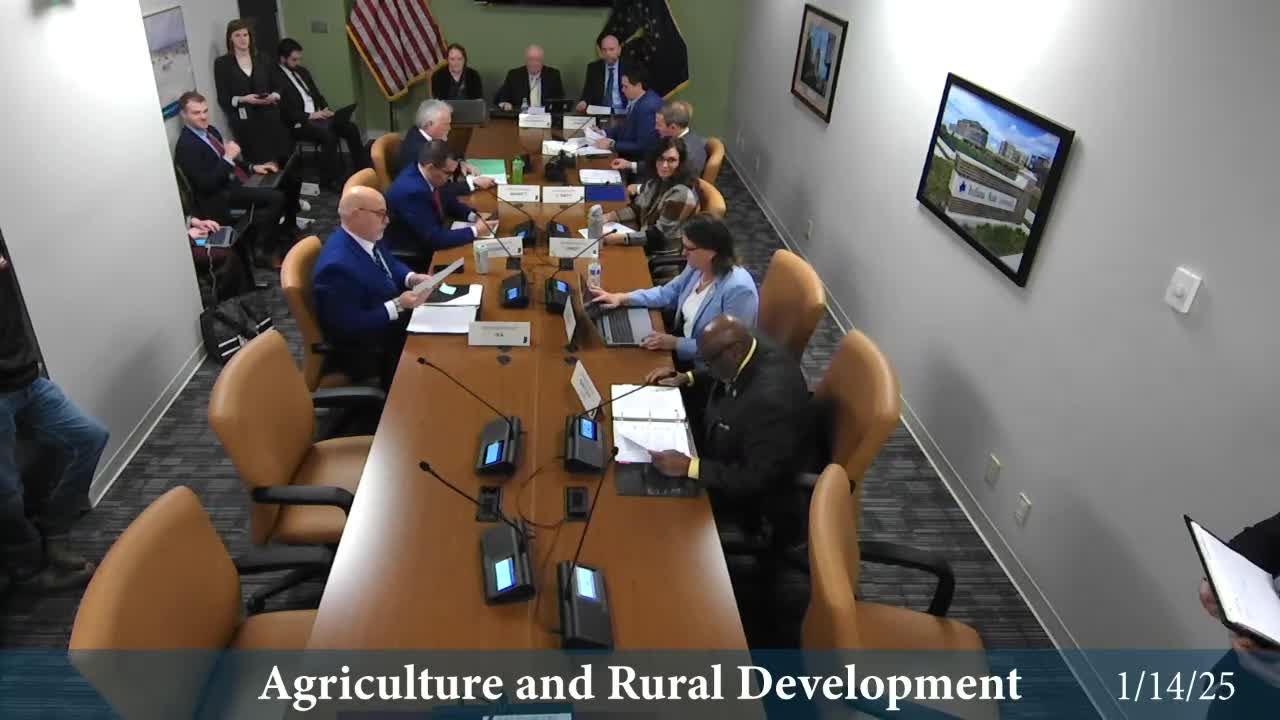
Representative Culp presented House Bill 1234 to the House Agriculture Committee, proposing a voluntary state framework to accept or hold donated or bequeathed agricultural conservation easements so landowners can permanently limit nonagricultural development of their farms.
Representative Culp presented House Bill 1234 to the Indiana House Agriculture Committee, saying the bill "creates a framework for willing farmland owners to donate their conservation easements, if they choose to protect their farms for future generations to utilize to grow food." The bill would establish an agricultural land protection program that accepts donated or bequeathed conservation easements and allows counties to set up local programs.
Supporters told the committee the bill is intended to preserve productive farmland amid rapid loss. Chris Reynolds, Midwest regional director for American Farmland Trust, said the measure “lays the vital groundwork to give farmers and landowners the option to protect their land for future generations.” Reynolds and other witnesses cited the Indiana inventory of lost farmland released in July 2023, which the presenters said showed roughly 345,000 acres lost between 2010 and 2022.
Witnesses and committee members emphasized the voluntary nature of HB 1234 and that it does not request state appropriations for purchasing easements. Quentin Hayes, legislative director for the Indiana State Department of Agriculture (ISDA), testified that ISDA would implement the program "in coordination with the newly created protection board" and could assist counties, but that implementation would require additional staffing and resources if the department were to hold easements. Hayes said the bill, as drafted, provides for an appropriation only if the legislature chooses to fund it.
Other supporters said the bill would make landowners eligible for federal matching funds—through USDA and related programs—and philanthropic grants. Caitlin Smith of the Indiana Farm Bureau told the committee the legislation is a voluntary tool to help with succession planning and to keep land in agricultural use. Toby Day of the Hoosier Environmental Council described conservation easements as "selling off the development rights to that land," while noting owners retain possession and farming rights.
Farmers who testified gave personal context: David Harden, a sixth-generation farmer from Hendricks County, described easements as an estate-planning tool that could let a next-generation farmer access land at a lower price and allow nonfarming heirs to be compensated. Several witnesses pointed to other states with similar programs and urged Indiana to qualify for federal funds by establishing a state framework.
Committee members asked technical questions about board composition and whether members should be from different political parties; Representative Culp indicated openness to adjustments as the bill progresses. At the hearing end, a motion was made to "move to pass as amended," and a roll-call was taken; the transcript records multiple aye votes (including the chair) and some members announcing no votes, but the final tally is not specified in the provided transcript.
Why it matters: Witnesses said the program could help preserve agricultural land, support rural economies, and make federal funds available to Hoosier landowners. Supporters cited the ISDA inventory and national examples showing matching funds can leverage federal grants for easement purchases.
What’s next: Committee discussion ended with the motion and recorded roll-call; the transcript includes a recorded roll-call on the motion but does not show a final, complete tally in the provided excerpt. The bill will proceed through the legislative process if reported out of committee.