Get Full Government Meeting Transcripts, Videos, & Alerts Forever!
Get email alerts on the Farmland Protection topic
No spam. Unsubscribe anytime.
House panel advances bill to create voluntary agricultural conservation easement program
Summary
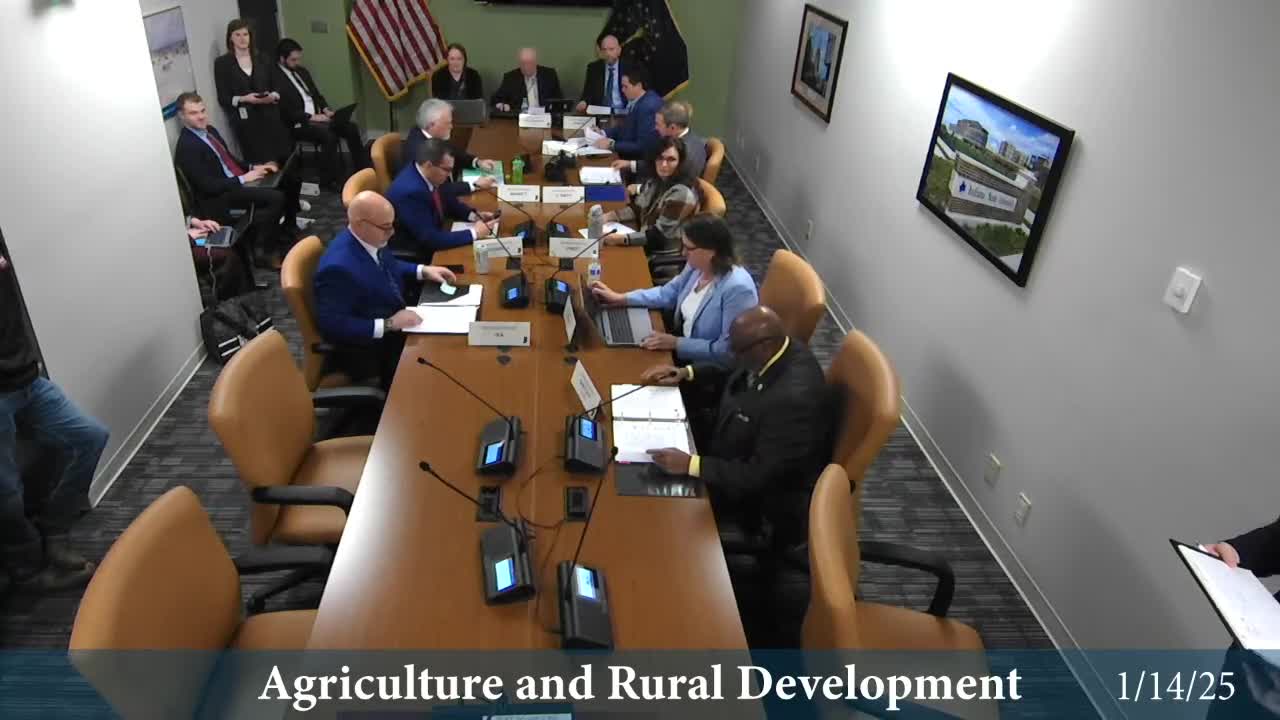
The Indiana House Agriculture Committee heard testimony supporting House Bill 1234, which would let farmland owners donate or sell conservation easements to protect land for agricultural use and allow the State Department of Agriculture or qualified land trusts to hold those easements. Committee members voted to pass the measure as amended.
Representative (last name not specified in transcript) presented House Bill 1234 to the Indiana House Agriculture Committee, saying the bill would create a framework for willing farmland owners to donate or bequeath conservation easements to protect farm acreage for future agricultural use.
The bill, as explained by the author and several witnesses, would allow the Indiana State Department of Agriculture (ISDA) to accept and hold conservation easements, permit counties to establish their own farmland-protection programs, and make landowners eligible to apply for federal or other matching funds. The proposal does not include a state appropriation to purchase easements; donors could convey easements voluntarily or landowners could work with existing land trusts.
In testimony supporting the bill, Chris Reynolds, Midwest regional director for American Farmland Trust, said the measure would join Indiana with roughly 29 other states that have formal farmland-protection programs and noted data showing the state lost roughly 345,000 acres of farmland between 2010 and 2022. Caitlin Smith of the Indiana Farm Bureau and David Harden, a sixth-generation farmer from Hendricks County, also testified in support, saying the program could help succession planning and make land more affordable for beginning farmers by removing development rights.
Quentin Hayes, legislative director for the Indiana State Department of Agriculture, told the committee ISDA released the inventory of lost farmland in July 2023 and that ISDA could implement the easement program but would need additional staffing and resources if the department were to accept easements directly. Hayes said counties and private land trusts are alternative holders of easements under existing state law.
Witnesses and proponents described how easements are valued by comparing the appraised value of land for agricultural use versus commercial development; the difference is the easement value. Supporters pointed to federal funding opportunities through the Farm Bill and programs administered by USDA’s Natural Resources Conservation Service and noted that some states use state matching funds to leverage federal grants.
After discussion, the committee moved to pass House Bill 1234 as amended and recorded a roll-call vote. Multiple members voted yes; a smaller number said they would vote no for now but left open the possibility of changing their vote on the floor. The committee indicated technical amendments and possible chair’s amendments could be added in subsequent consideration.
The bill’s backers said the measure is meant to be voluntary, to preserve farmland without imposing new restrictions on unwilling owners, and to provide a mechanism for landowners who want to permanently restrict development while keeping the land in agricultural production.
Supporters asked that the committee consider ensuring board composition and appointment language provides balanced representation; some members said they wanted any political or party-balance language addressed on second reading or via a chairman’s amendment.
The committee advanced the bill for further consideration, with sponsors and ISDA staff continuing to work on technical language about board makeup, staffing and the interplay with county programs and existing land trusts. The measure, as discussed, does not itself appropriate funds for easement purchases but would make landowners eligible for outside matching funds if available.