Get Full Government Meeting Transcripts, Videos, & Alerts Forever!
Get email alerts on the Hoosier Homestead Program topic
No spam. Unsubscribe anytime.
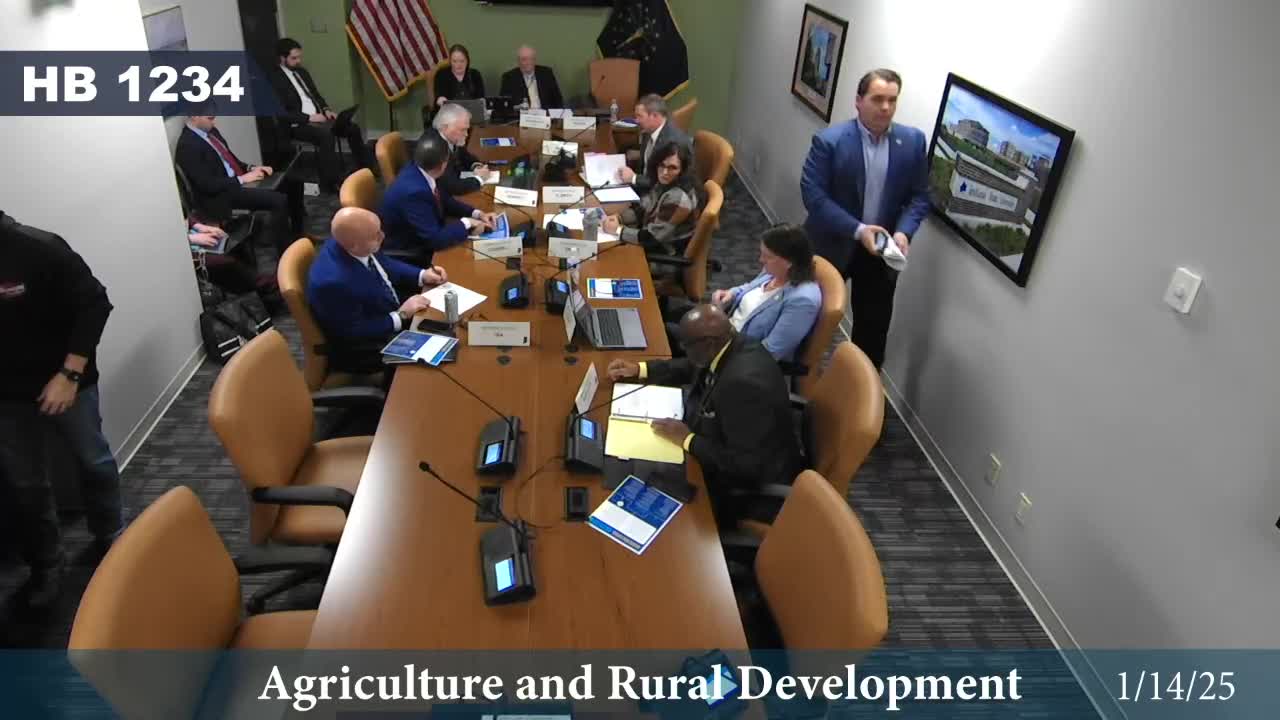
Committee hears bill to codify Hoosier Homestead program and add remonstrance for century farms; ISDA neutral, bill held for amendment
Summary
House Bill 1265 would put the Hoosier Homestead Award program into statute, create an electronic registry, and provide a local remonstrance step for homestead farms facing fee-simple condemnation; the Indiana State Department of Agriculture testified neutral and the bill was held for technical amendments.
Indiana House Agriculture Committee — Members heard testimony on House Bill 1265, which would codify the Hoosier Homestead Farm program, require ISDA to maintain an electronic registry of qualifying homestead farms, and create a limited local remonstrance process when a fee-simple taking of a homestead farm is proposed under eminent domain.
Representative Greene, speaking in support of 1265, said the bill would formalize a program that has operated largely administratively since 1976 and would give multi‑generational homestead farms “one final appeal to their local legislative body” when a fee-simple condemnation is proposed. Greene said the process is limited and does not apply to easements, leases, voluntary sales or good-faith negotiations in eminent-domain proceedings.
Linda Norton and Jason Abel testified in support. Norton described her family’s farm, which she said is an eighth-generation farm in Johnson County and eligible for Hoosier Homestead recognition; she asked for statute-level recognition so the program and its records remain current. Jason Abel, a fourth‑generation farmer and county commissioner, said the statute would be another tool to balance growth pressure and agricultural preservation in counties experiencing rapid development.
Quentin Hayes, legislative director for ISDA, testified the department was neutral on the bill. Hayes explained the program’s current administrative features, the eligibility criteria (including 100, 150 and 200-year ownership thresholds and a 20-acre minimum or $1,000 gross income threshold for smaller parcels), and suggested adding statutory language to require property-tax compliance and to clarify which parcels qualify for protection. Hayes said ISDA would maintain the registry if the program is codified.
Representative Greene said he would work with ISDA on technical changes. Committee members discussed possible amendments and technical edits; Representative Green indicated the bill may return with changes on the committee agenda the following week. The committee did not take a final vote on HB1265; the bill was held pending technical amendments and further committee consideration.