Get Full Government Meeting Transcripts, Videos, & Alerts Forever!
Get email alerts on the Agriculture Farmland Protection topic
No spam. Unsubscribe anytime.
House agriculture committee advances bill to allow donation of farmland conservation easements without state purchase funds
Summary
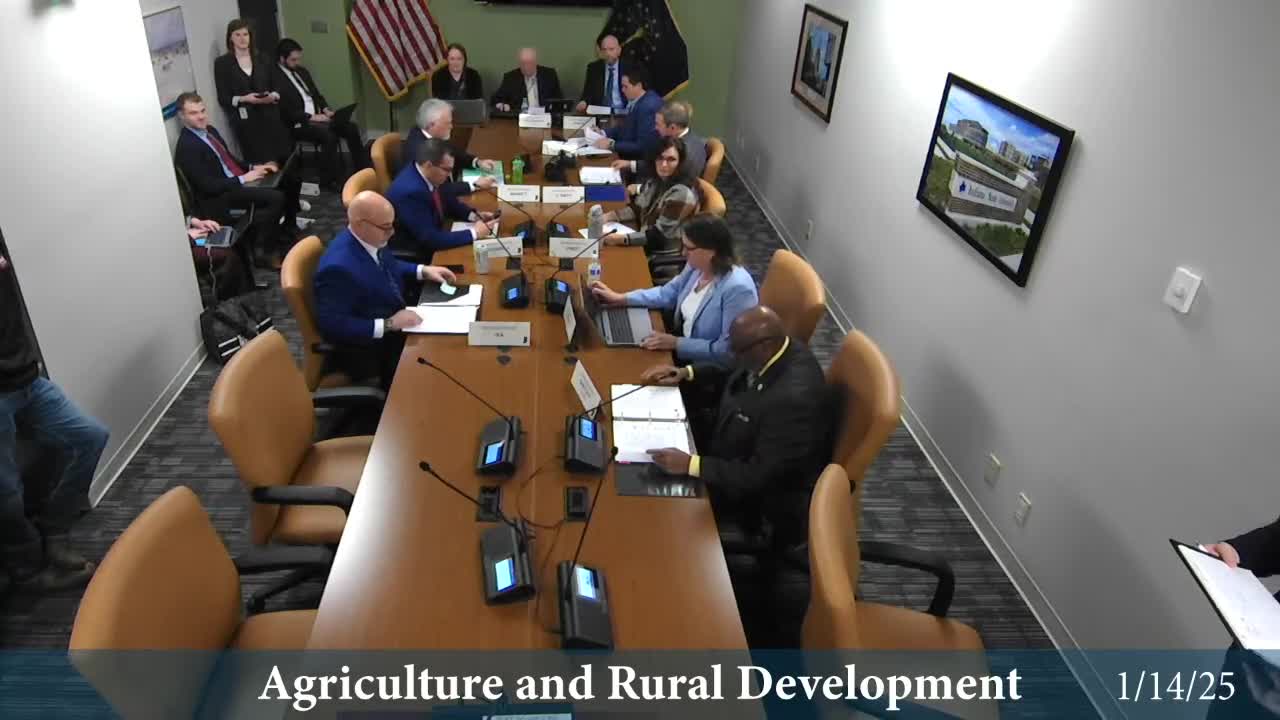
Indiana House Agriculture Committee — Chairman Aylesworth led a committee hearing and a later committee vote that advanced House Bill 1234, a measure to create a framework for farmland owners to donate or bequeath agricultural conservation easements and for the state to receive and hold those easements if owners choose.
Indiana House Agriculture Committee — Chairman Aylesworth led a committee hearing and a later committee vote that advanced House Bill 1234, a measure to create a framework for farmland owners to donate or bequeath agricultural conservation easements and for the state to receive and hold those easements if owners choose.
The bill would authorize the Indiana State Department of Agriculture (ISDA) to accept donations or purchases of agricultural conservation easements, allow counties to create their own farmland protection programs, and permit private land trusts to hold easements. The legislation does not include a state appropriation to purchase easements, and supporters said the statutory framework is intended to help landowners access federal and philanthropic matching funds.
Supporters told the committee the measure is a response to an inventory of lost farmland released in July 2023 that found Indiana lost roughly 345,000 acres between 2010 and 2022, or about 29,000 acres per year. Chris Reynolds, Midwest regional director for American Farmland Trust, said the loss places Indiana’s agricultural base at risk and that the bill would let landowners “protect their land for future generations” while retaining ownership and equity. Reynolds added that the bill “does not give the state control over private land.”
Caitlin Smith of the Indiana Farm Bureau said the bill gives farmers an additional voluntary tool for estate planning and succession by allowing a willing landowner to place a permanent easement on farmland, which reduces development potential while allowing continued farming activity. Toby Day, sustainable agriculture director for the Hoosier Environmental Council, testified that placing easements “sells off the development rights” and can lower purchase prices for beginning farmers.
Quentin Hayes, legislative director for ISDA, told the committee the department could implement the program but would need additional staffing and resources to accept and hold easements. Hayes confirmed the bill’s language does not request a state appropriation; instead, it creates eligibility for federal programs and outside matching funds. “If House Bill 1234 were enacted, ISDA would be responsible for implementing the conservation easement program in coordination with the newly created protection board,” Hayes said, adding that the department would assist counties that choose to acquire easements.
Representative Culp, the bill’s sponsor, said the proposal is designed for willing owners and that it would make property eligible to seek federal funds available through the farm bill and other sources. Supporters cited studies and figures presented in testimony: 73% of Indiana’s nearly 18 million acres of farmland is classified as productive, and American Farmland Trust estimates Indiana could lose an additional 602,000 acres by 2040 absent action.
Committee members asked about governance and operations. Some members pressed for a change to the proposed protection board’s membership to require political balance; Representative Bartlett and others said they would support the bill if the author agreed to an amendment ensuring members were not all from a single party. Representative Culp said he was open to changes and noted the bill is intended to create a small oversight board rather than a large new bureaucracy.
After discussion, a motion “to pass as amended” was made in committee. The committee recorded roll-call responses including: Chairman Aylesworth (Aye), Representative Green (Yes), Representative Barrett (Yes), Representative Smith (Yes), Representative Baird (Aye), Representative Criswell (Yes), and several other “Yes” responses; two members registered “No.” The committee vote result recorded eight yes and two no votes; the motion carried and the bill was advanced out of committee.
The bill’s supporters said the program is voluntary and would not prohibit private land trusts from holding easements. Representative Culp and multiple witnesses emphasized the program’s goal is to leverage federal and philanthropic funds rather than commit state purchasing dollars. ISDA and land-trust representatives noted that existing local and private partners — for example, the Benjamin Harrison Land Trust — can hold easements if landowners prefer not to use a state program.
Next steps: HB1234 was advanced by the committee and will go to second reading on the House floor. The sponsor indicated willingness to consider committee amendments to the protection board’s composition and other technical changes before further floor action.