Get Full Government Meeting Transcripts, Videos, & Alerts Forever!
Get email alerts on the Farmland Conservation topic
No spam. Unsubscribe anytime.
Committee advances bill to let owners donate agricultural conservation easements
Summary
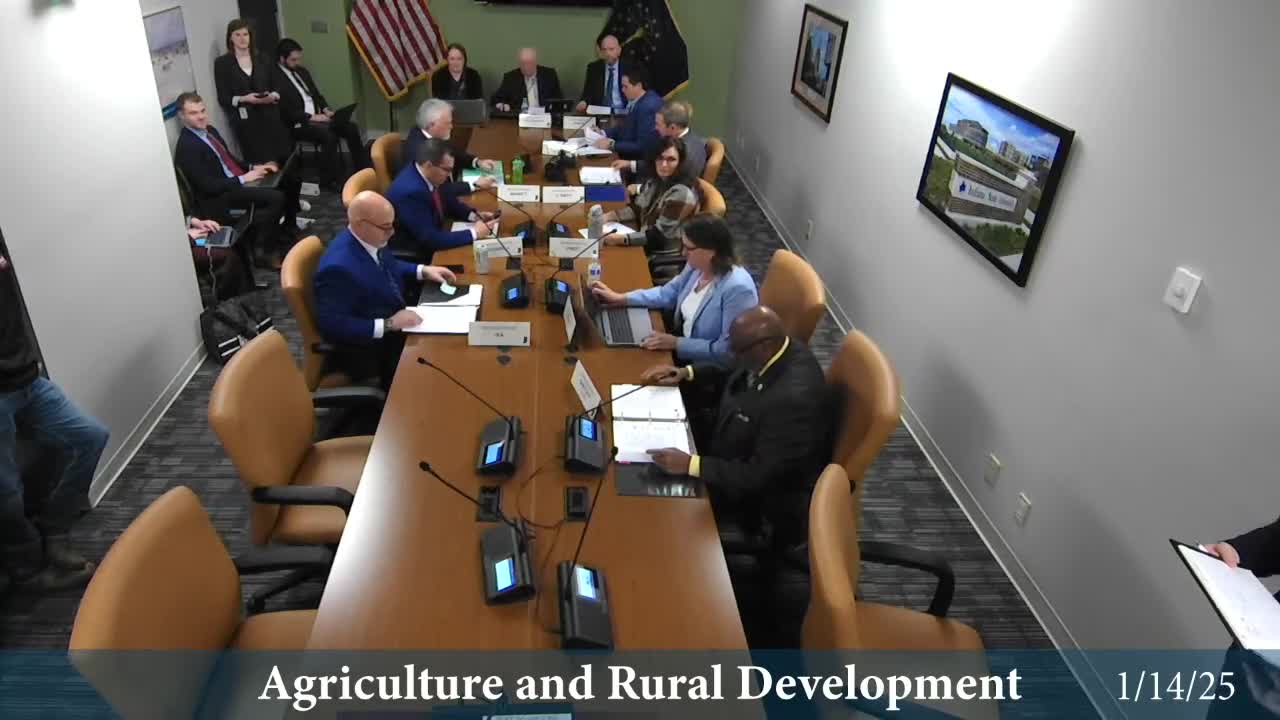
Representative Culp, the bill’s sponsor, told the House Agriculture Committee that House Bill 1234 would create a framework enabling willing farmland owners to donate or bequeath conservation easements to preserve land for agricultural use.
Representative Culp, the bill’s sponsor, told the House Agriculture Committee that House Bill 1234 would create a framework enabling willing farmland owners to donate or bequeath conservation easements to preserve land for agricultural use.
The measure drew broad support from agricultural groups and conservation organizations at the committee hearing, and the committee voted to pass the bill as amended after testimony and questions.
The bill would authorize the Indiana State Department of Agriculture (ISDA) to receive and hold agricultural conservation easements and would also allow counties to establish their own farmland‑protection programs. Representative Culp said the proposal seeks to preserve farmland “for future generations to utilize to grow food” and noted that the bill does not include a state appropriation to purchase easements.
Chris Reynolds, Midwest regional director for American Farmland Trust, told the committee that the bill “lays the vital groundwork to give farmers and landowners the option to protect their land for future generations.” Reynolds and other witnesses cited the ISDA inventory showing the state lost roughly 345,000 acres of farmland between 2010 and 2022 — about 29,000 acres per year — and warned that continued loss could make land less affordable for the next generation of farmers.
Caitlin Smith of the Indiana Farm Bureau said the bill “gives a nod” to the concept that food security is national security and described the proposal as a voluntary tool that would allow landowners to retain ownership while permanently restricting development rights. Toby Day of the Hoosier Environmental Council said easements effectively “sell off the development rights” while allowing owners to keep and farm their land, and argued the program could aid succession planning and beginning farmers by lowering the price of land that has an easement.
ISDA legislative director Quentin Hayes testified the department would implement the program and assist counties if the legislature enacts the bill, but he said implementation would require “additional staffing and resources” if ISDA were to accept and hold easements directly. Hayes confirmed the bill as drafted does not include a direct state appropriation for purchasing easements; proponents said that lack of state funds would not prevent landowners from donating easements or from partnering with existing land trusts.
Witnesses and the sponsor described how appraisals would work: appraisers would value the parcel as if developed and as farmland, and the difference between those values would represent the conservation‑easement value. Supporters said an Indiana program could make projects eligible for federal funds through USDA programs and other sources; witnesses cited the 2023 inventory and national examples where state matching funds leverage additional federal and private investments.
Committee members discussed board composition and whether the program’s oversight board should require political balance; the sponsor said he was open to changes and committee members said amendments could be made on second reading. Following debate, a motion to pass the bill as amended carried in committee (recorded tally: yes 8, no 2). Several members who voted no said they supported the idea in principle but sought changes before final passage on the House floor.
The bill will proceed to the next stage of the legislative process, with sponsors and ISDA staff preparing technical amendments recommended during the hearing.