Get Full Government Meeting Transcripts, Videos, & Alerts Forever!
Get email alerts on the Farmland Protection topic
No spam. Unsubscribe anytime.
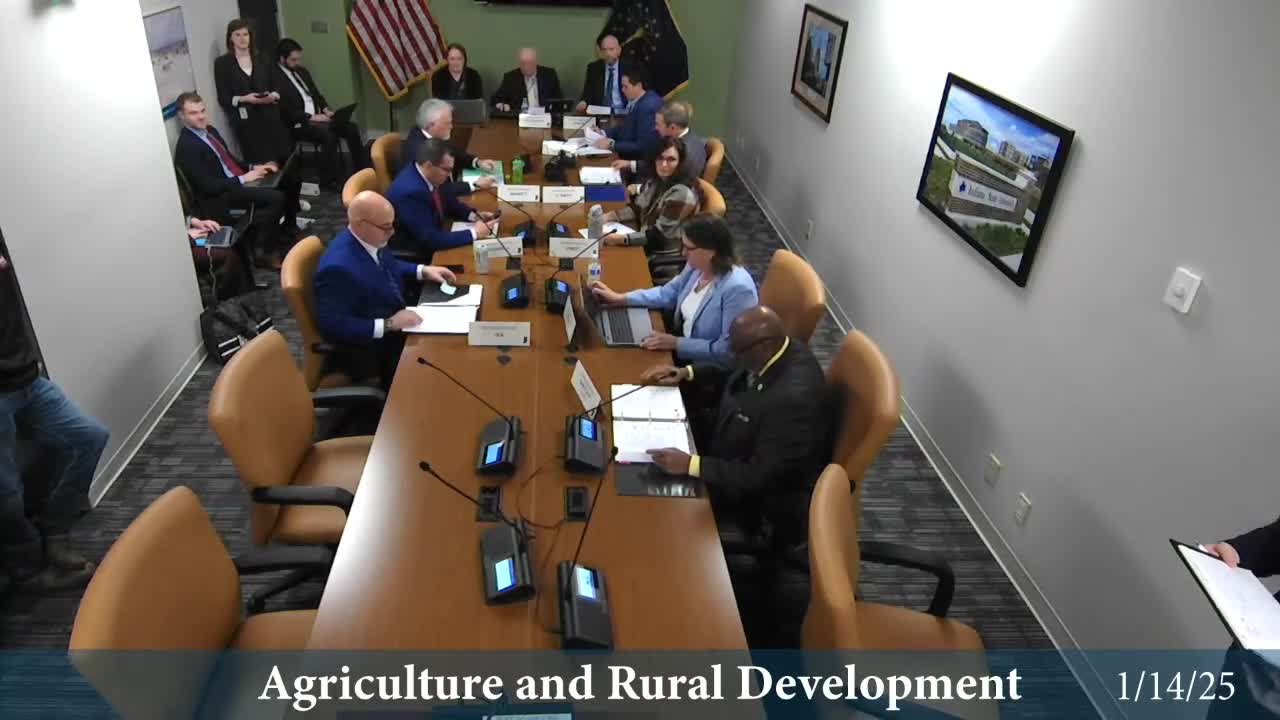
Committee advances bill allowing Hoosier landowners to donate agricultural conservation easements
Summary
The House Agriculture Committee voted to advance House Bill 1234, which would create a voluntary framework for farmland owners to donate agricultural conservation easements.
The House Agriculture Committee voted to advance House Bill 1234, which would create a voluntary framework for farmland owners to donate or bequeath agricultural conservation easements to preserve land for farming.
Representative Culp, the bill’s author, told the committee the measure would “create a framework for willing farmland owners to donate their conservation easements, if they choose to protect their farms for future generations to utilize to grow food.” He said the bill does not include state funding to purchase easements but would allow owners to qualify for federal matching dollars.
That testimony was supported by Chris Reynolds, Midwest regional director for American Farmland Trust, who said the bill would enable Indiana to join roughly 29 other states that have programs to stabilize agricultural land. “This bill lays the vital groundwork to give farmers and landowners the option to protect their land for future generations,” Reynolds said, noting Indiana’s inventory showed the state lost about 345,000 acres of farmland between 2010 and 2022.
Caitlin Smith, representing the Indiana Farm Bureau, and Toby Day, sustainable agriculture director at the Hoosier Environmental Council, also testified in favor. Smith said the measure “gives a farmer the voluntary option to opt into an easement and gives assurance that the land will continue to be utilized for production.” Day emphasized easements reduce the market price by removing development rights, which can make land more affordable for beginning farmers.
Quentin Hayes, legislative director for the Indiana State Department of Agriculture (ISDA), testified the department released the inventory of lost farmland in July 2023 and would implement the easement program “in coordination with the newly created protection board” if the bill is enacted, but he said ISDA would need additional staffing and resources to accept and hold easements. Hayes said the bill’s text does not request a specific appropriation and that existing local land trusts could also hold easements.
Supporters, including a 6th‑generation farmer who spoke in favor, said donated conservation easements would help with estate planning and succession by preserving farms for future generations and enabling landowners to access federal matching funds through programs administered by USDA and the Natural Resources Conservation Service.
Committee discussion included the proposed governance structure for a small oversight board and whether members should reflect partisan balance; the bill’s author said he was open to amendments on that point. After discussion the committee moved the bill out as amended. Recorded votes in committee show the motion carried; the committee recorded multiple ayes and at least two no votes on the motion to pass as amended. The bill will proceed to the next steps in the House for consideration and possible further amendment.
Details recorded in committee testimony: the ISDA farmland inventory found roughly 345,000 acres lost between 2010 and 2022; proponents said some analyses project additional losses by 2040 if trends continue. The bill would (1) authorize ISDA to accept and hold donated conservation easements, (2) allow counties to create local farmland protection programs, and (3) establish eligibility for federal matching funds where available. The bill text, as discussed, does not itself appropriate state funds to purchase easements.
Votes at a glance: committee motion to pass HB 1234 as amended — outcome: approved in committee (recorded ayes and recorded nos).