Get Full Government Meeting Transcripts, Videos, & Alerts Forever!
Get email alerts on the Hoosier Homestead Program topic
No spam. Unsubscribe anytime.
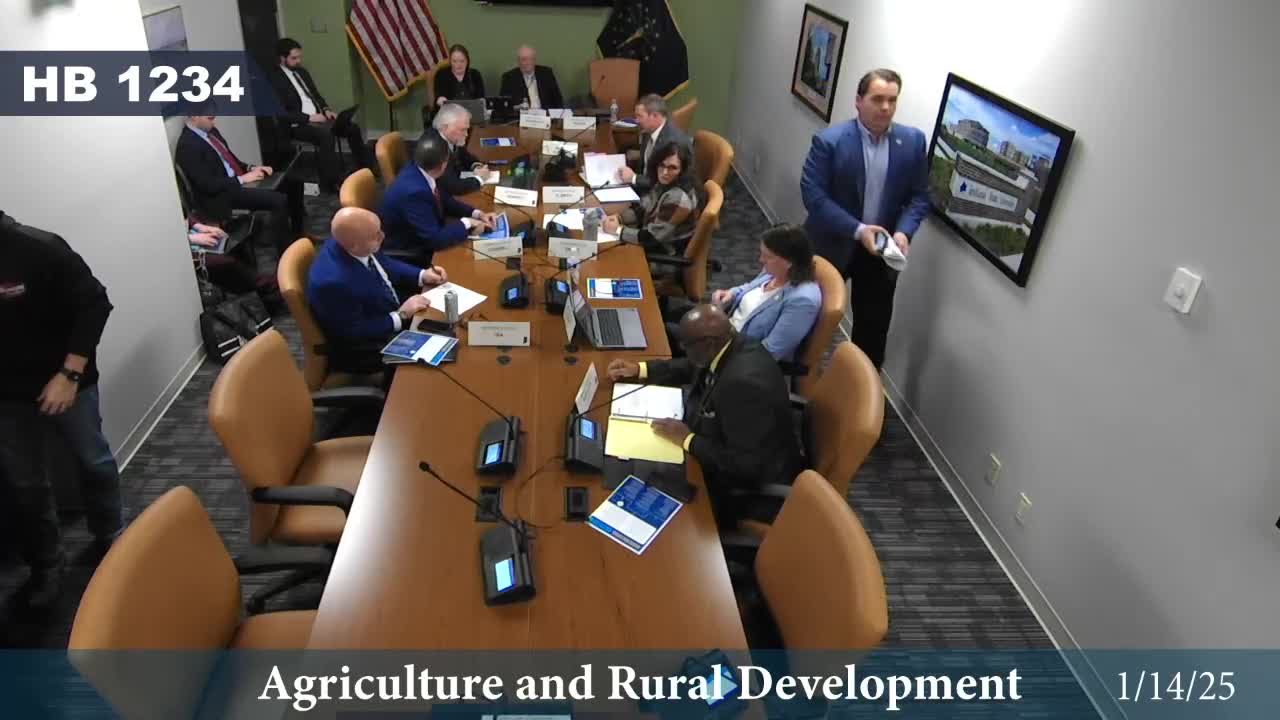
Committee hears bill to codify Hoosier Homestead program and add remonstrance against eminent domain
Summary
House Bill 1265 would put the Hoosier Homestead Farm recognition into statute, create a registry and a local remonstrance process for fee‑simple takings affecting eligible multi‑generation farms; ISDA testified neutrally and the committee held the bill for technical amendment.
Representative Green presented House Bill 1265, which would codify the Hoosier Homestead Farm program in statute, maintain an electronic registry of homestead farms, and give qualifying farms a limited process to remonstrate locally against fee‑simple condemnation actions.
The bill’s author said the Hoosier Homestead Award—created in 1976 to recognize family farms owned continuously for at least 100 years—has been largely ceremonial and that putting the program into statute would help preserve multi‑generational farms and provide a formal record. "House Bill 1265 simply gives a homestead farm the right to make one final appeal to their local legislative body to review the potential condemnation," the author said, describing the remonstrance as limited to fee‑simple takings and not applicable to easements, leases, voluntary sales, or good‑faith negotiations.
Multiple witnesses representing families and rural communities testified in support. Linda Norton, who said her family farm will reach bicentennial status in 2029, described the Hoosier Homestead award as ‘‘a symbol of generational grit’’ and urged codification. Jason Abel, a fourth‑generation farmer and county commissioner, said the proposal complements other farmland preservation efforts and helps communities facing development pressure.
Quentin Hayes, legislative director for the Indiana State Department of Agriculture, testified neutral on the bill and described the program’s current ceremonial nature and enrollment criteria: continuous family ownership for 100, 150, or 200 years, with a typical threshold of 20 acres or, for smaller operations, minimum gross income of $1,000 per year. Hayes told the committee the department recommends considering statutory language to require property taxes be current and to define which parcel(s) would receive protection under the statute.
Committee members asked technical questions about the registry and the scope of the remonstrance process. The sponsor said staff and the department are working on technical amendments; Representative Green said the bill will be held until those changes are drafted and placed on a future agenda.
Why it matters: Backers said the measure recognizes farms with deep family roots and adds a limited procedural check for homestead farms facing fee‑simple condemnation; supporters framed the bill as complementary to other farmland protection tools. Opponents or those with concerns primarily sought technical clarifications about application criteria, the precise legal effect of a remonstrance, and whether the notice should specify parcels or tax status.
Outcome: The committee did not vote on HB1265 during this hearing; the author said technical amendments were expected and the bill would be held for a future meeting.