Get Full Government Meeting Transcripts, Videos, & Alerts Forever!
Get email alerts on the Agriculture Conservation Easements topic
No spam. Unsubscribe anytime.
House committee approves framework allowing voluntary farmland conservation easements
Summary
The Indiana House Agriculture Committee voted to pass House Bill 1234, which establishes a voluntary framework for landowners to donate or sell agricultural conservation easements and allows the Indiana State Department of Agriculture or local entities to hold those easements; no state purchase appropriation is included.
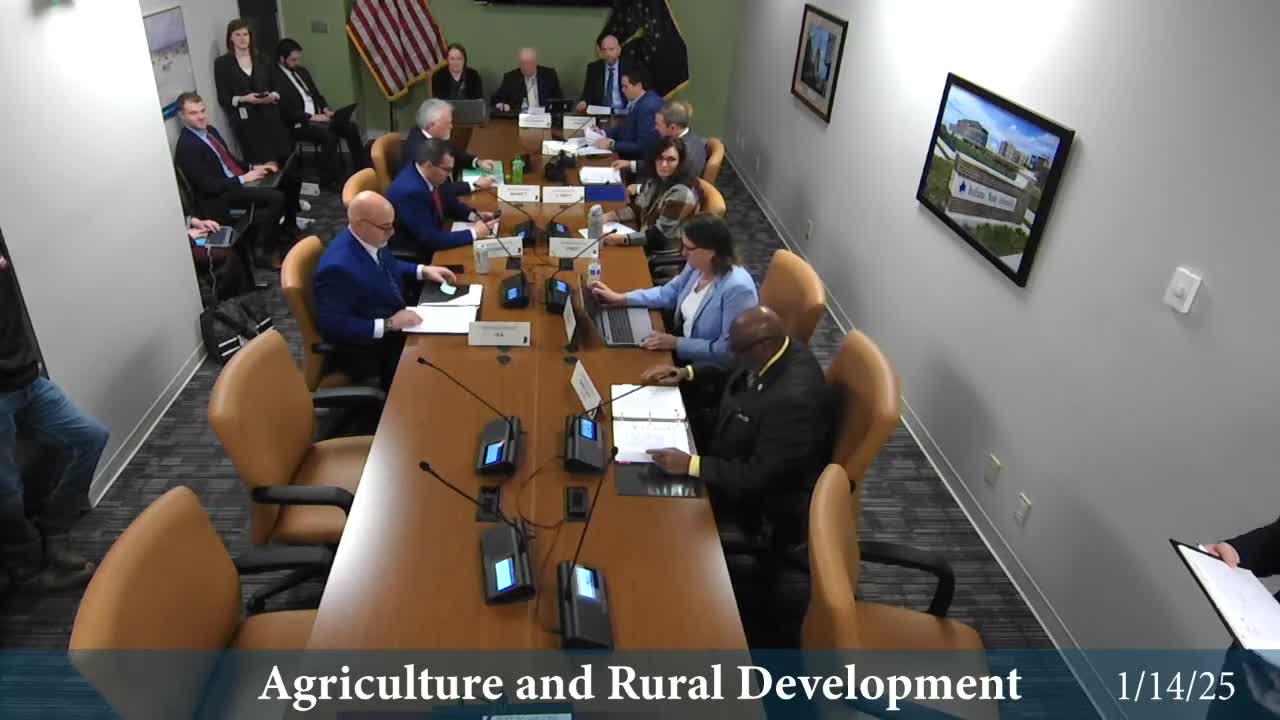
House Agriculture Committee members voted to pass House Bill 1234 on a committee voice/roll-call vote after witnesses from conservation and farming organizations urged lawmakers to adopt a voluntary program to protect Hoosier farmland.
The bill, presented by Representative Culp, would create an agricultural land protection program that accepts donations or bequests of agricultural conservation easements, allows the Indiana State Department of Agriculture (ISDA) to hold easements, and authorizes counties and private land trusts to establish local programs. The proposal does not include a state appropriation to purchase easements.
The committee heard multiple supporters who said the measure offers a tool for landowners who want to keep land in agricultural production while retaining ownership and equity. Chris Reynolds, Midwest Regional Director for American Farmland Trust, told the committee that the state’s lost-farmland inventory showed about 345,000 acres of farmland were converted from 2010 to 2022, and that similar programs in other states have leveraged federal and private dollars to preserve farmland. "House Bill 1234 lays the vital groundwork to give farmers and landowners the option to protect their land for future generations," Reynolds said.
Caitlin Smith, representing the Indiana Farm Bureau, said the bill "gives a nod" to the concept that food security is national security and that the proposal is a voluntary tool to help preserve land used for crop and livestock production. Quentin Hayes, legislative director for ISDA, testified that ISDA would implement the program in coordination with a protection board if provided additional staffing and resources and that the bill, as drafted, does not require the department to accept easements if the legislature declines to appropriate funds for staffing.
Several landowners and advocates described how easements typically work: an appraisal establishes the full market value and the value for commercial development; the difference represents the value of the easement, which permanently restricts development rights but allows continued agricultural use and sale with the easement attached. "When you put an easement on that land that restricts development, therefore that land would decrease in value because you wouldn't be able to utilize it for all purposes," said Toby Day, sustainable agriculture director for the Hoosier Environmental Council. David Harden, a sixth-generation farmer, said an easement could help with estate planning and enable a next-generation farmer to access land at a lower price.
Representative Culp and panelists emphasized that the bill would enable farmers who choose to donate or sell easements to be eligible for federal matching funds—such as USDA programs and funds made available through the Inflation Reduction Act—but that the state program itself requests no purchase appropriation. The bill text also permits counties to set up their own programs and notes that private land trusts in Indiana already accept and hold some agricultural easements.
During committee questions members discussed board composition and whether political diversity should be required for the oversight body. Representative Culp said he was open to adjustments but noted the board in his draft was small and intended to avoid creating a large new entity. After discussion, the committee moved to pass the bill as amended; the committee recorded multiple affirmative votes and a small number of dissenting votes, and the motion carried.
Votes at a glance: The committee moved to "pass as amended." Recorded yea votes included Chairman Knoesworth (aye), Representative Green (yes), Representative Barrett (yes), Representative Smith (yes), Representative Baird (aye), and Representative Criswell (yes); the committee recorded additional affirmative votes and at least two recorded no votes. (The transcript does not name every voter for each recorded "yes" or "no.")
Why it matters: Proponents said the measure creates a voluntary, low-cost mechanism for preserving farmland that can leverage federal and philanthropic funding. Opponents and questioners sought clarity about governance, staffing, and whether the oversight board should include political diversity. The committee-approved framework now proceeds through the legislative process where members said technical amendments and funding questions can be addressed.
The bill text and committee amendment will be available when the legislative service agency posts the docket for the next step; proponents said several states (29, by one witness’ count) have similar programs that combine state, federal, and local funds to preserve agricultural land.