Get Full Government Meeting Transcripts, Videos, & Alerts Forever!
Get email alerts on the Agriculture Conservation Easements topic
No spam. Unsubscribe anytime.
House panel advances bill to let farmers donate agricultural conservation easements
Summary
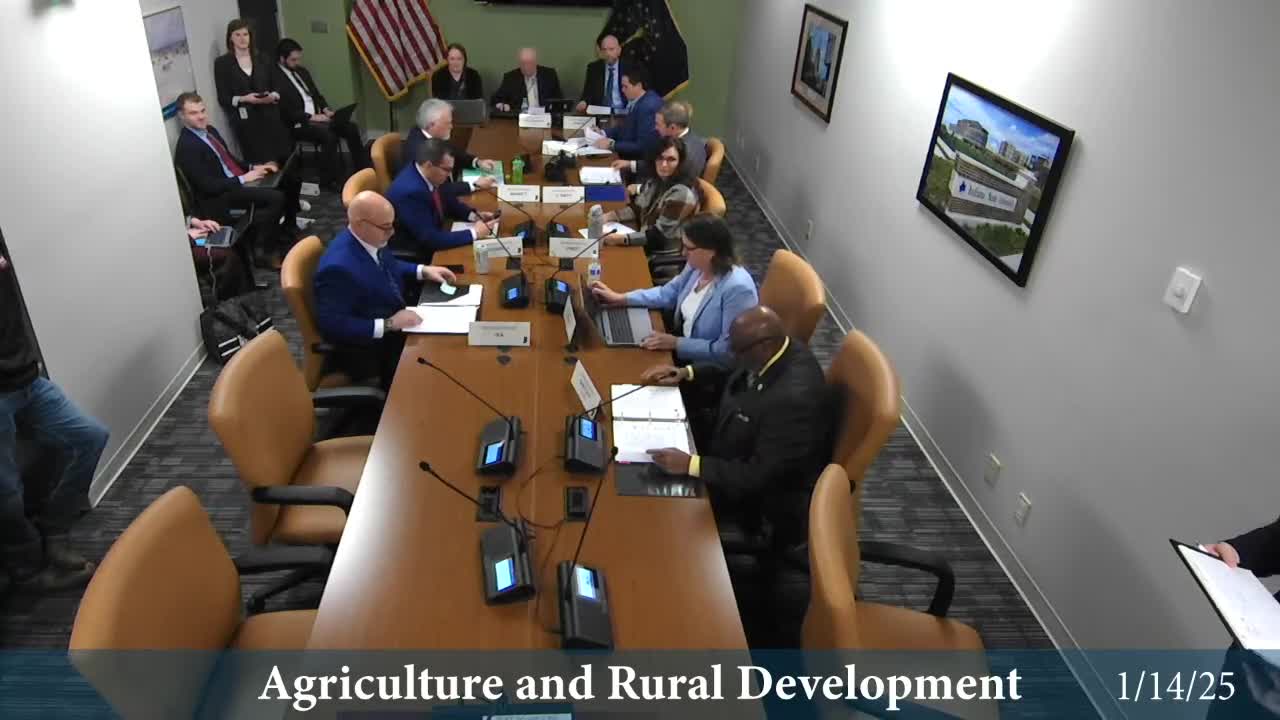
The House Agriculture Committee moved House Bill 12-34 forward after testimony from farmers, conservation groups and the Indiana State Department of Agriculture about a voluntary program to accept donated or purchased agricultural conservation easements and to make landowners eligible for federal matching funds.
Rep. Culp presented House Bill 12-34 to the House Agriculture Committee, proposing a voluntary program that would allow farmland owners to donate or bequeath conservation easements to protect land for continued agricultural use.
The bill would authorize the Indiana State Department of Agriculture (ISDA) to receive and hold conservation easements and would allow counties to set up their own farmland protection programs. "This bill creates a framework for willing farm land owners to donate their conservation easements, if they choose to protect their farms for future generations to utilize to grow food," Rep. Culp said in his opening remarks.
Why it matters: witnesses and written data presented to the committee emphasized recent measured losses of farmland and the potential to leverage federal programs. Chris Reynolds, Midwest regional director for American Farmland Trust, told the committee that "House Bill 12-34 lays the vital groundwork to give farmers and landowners the option to protect their land for future generations," and cited research showing substantial acreage at risk. Reynolds said the bill would make landowners eligible to combine state, federal and philanthropic funding to purchase easements and that similar programs exist in roughly 29 other states.
Supporters, including the Indiana Farm Bureau and the Hoosier Environmental Council, described easements as a voluntary tool for succession planning and for lowering the purchase price for beginning farmers. Caitlin Smith of the Indiana Farm Bureau said the measure "gives a nod" to food-security concerns and "allows a farmer to voluntarily opt into an easement and gives insurance to that farmer that the land will continue to be utilized for production." Toby Day, sustainable agriculture director for the Hoosier Environmental Council, noted that "80% of the land that is farmed in Indiana is rented, leased ground," and argued easements can assist both renters and owners with succession planning.
ISDA's role and resources: Quentin Hayes, legislative director for ISDA, said the agency would implement the program in coordination with a protection board and assist counties seeking to acquire easements, but made clear implementation would require staffing and resources. "If House Bill 12-34 were enacted, ISDA would be responsible for implementing the Conservation Easement Program in coordination with the newly created Protection Board," Hayes said, adding that ISDA would need additional staff to administer the program.
Farmers who testified described easements as an estate-planning tool. David Harden, a sixth-generation Hendricks County farmer, said an easement could let landowners provide for nonfarming heirs while keeping land in agricultural production. "Something like this agricultural conservation easement would be a useful tool for our estate planning," Harden said.
Committee action: a committee motion to give the bill a "do pass, amended" recommendation was made during the same hearing. The motion was put to roll call; several members recorded affirmative votes during the roll call. (The committee transcript shows Chair McMasters, Rep. Green, Rep. Barrett, Rep. Smith, Rep. Beard and Rep. Heine recorded as voting in the affirmative.) The committee moved the bill forward with an amended recommendation and discussed the opportunity to consider additional technical changes on second reading.
What the bill does not do: the measure does not appropriate state funds for purchasing easements in its present form; proponents said landowners could work with existing land trusts or pursue federal matching funds. Rep. Culp and witnesses repeatedly described the program as voluntary and not as a state takeover of private land.
Next steps: committee members signaled willingness to consider amendments, including on the composition of the oversight board, as the bill proceeds through the legislative process. Proponents asked the legislature to consider matching funds to leverage USDA and Inflation Reduction Act opportunities, but the committee did not approve a state appropriation as part of the bill at this hearing.
Ending: Supporters said the proposal would add Indiana to the growing number of states that use conservation easements to stabilize farmland and support rural economies, while ISDA cautioned that the agency would need resources to administer a statewide program.