Get Full Government Meeting Transcripts, Videos, & Alerts Forever!
Get email alerts on the Agriculture Conservation Easements topic
No spam. Unsubscribe anytime.
House committee advances bill to create voluntary agricultural conservation easement program
Summary
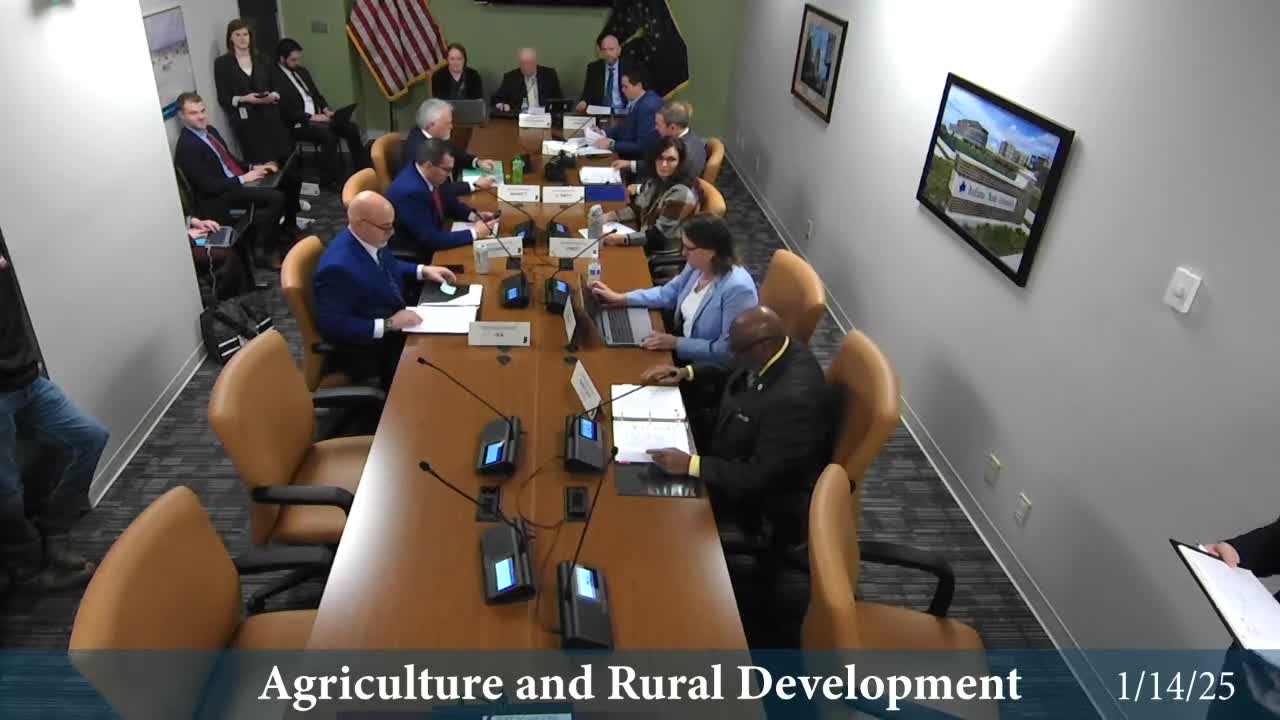
The Indiana House Agriculture Committee voted to pass House Bill 1234 as amended, a measure that would create a voluntary program allowing farmland owners to donate or sell conservation easements to preserve farmland for continued agricultural use.
The Indiana House Agriculture Committee voted to pass House Bill 1234 as amended, a measure that would create a voluntary program allowing farmland owners to donate or sell agricultural conservation easements to preserve farmland for continued agricultural use.
Representative Adam Culp, the bill’s sponsor, told the committee the proposal “creates a framework for willing farmland owners to donate their conservation easements, if they choose to protect their farms for future generations to utilize to grow food.”
The bill would authorize the Indiana State Department of Agriculture (ISDA) to accept and hold conservation easements and would create an Ag Conservation Easement Fund to help leverage federal, local and philanthropic dollars. Chris Reynolds, Midwest regional director for American Farmland Trust, urged support and said the bill “lays the vital groundwork to give farmers and landowners the option to protect their land for future generations.” He said the proposal would make Indiana eligible to pair state support with federal programs administered by USDA and the Natural Resources Conservation Service.
Testimony and committee discussion emphasized the scale of farmland loss in Indiana. Witnesses cited the state’s inventory of lost farmland released in 2023, which the committee heard showed roughly 345,000 acres lost from 2010 to 2022; a later, more precise figure cited in committee testimony was 345,682 acres. Proponents said that loss—driven largely by residential construction and conversion near urban areas—creates urgency to provide landowners tools to protect agricultural use.
Supporters and testifiers from farm and conservation organizations said the bill does not appropriate state money to purchase easements. Caitlin Smith of the Indiana Farm Bureau said the bill “allows a farmer to voluntarily opt into an easement and gives insurance to that farmer that the land will continue to be utilized for production.” Quentin Hayes, legislative director for ISDA, said if enacted “ISDA would be responsible for implementing the conservation easement program in coordination with the newly created protection board,” but added the department would need additional staffing and resources to perform that role if the legislature does not appropriate funds.
Witnesses described other implementation options: local land trusts could hold easements and counties may establish their own programs under the bill. Representative Culp and others noted other states pair modest state programs with federal funding to purchase easements, and that the bill’s framework would qualify landowners to seek such federal dollars.
Committee members questioned board composition and oversight. One line of questioning addressed whether the protection board’s membership should include bipartisan representation; the bill’s author said he was open to technical amendments to address those concerns.
After testimony and discussion the committee took the motion to pass the bill as amended. The roll call included recorded “aye/yes” votes for Chairman Knoesworth, Representative Green, Representative Barrett, Representative Smith, Representative Baird and Representative Criswell; at least two members stated they would vote no at that time. The committee motion was moved and called to pass as amended.
The committee also discussed next steps for technical edits and an expected chairman’s amendment to address board composition. Proponents said the bill’s immediate effect is to create the legal structure and eligibility to pair state or local actions with federal funds; no direct state appropriation was required in the bill as presented.
With committee passage, HB 1234 will proceed to the next floor and committee steps in the legislative process. Committee members indicated they expect additional amendments and technical language to appear before final votes on the House floor or in the Senate.