Get Full Government Meeting Transcripts, Videos, & Alerts Forever!
Get email alerts on the Farmland Protection topic
No spam. Unsubscribe anytime.
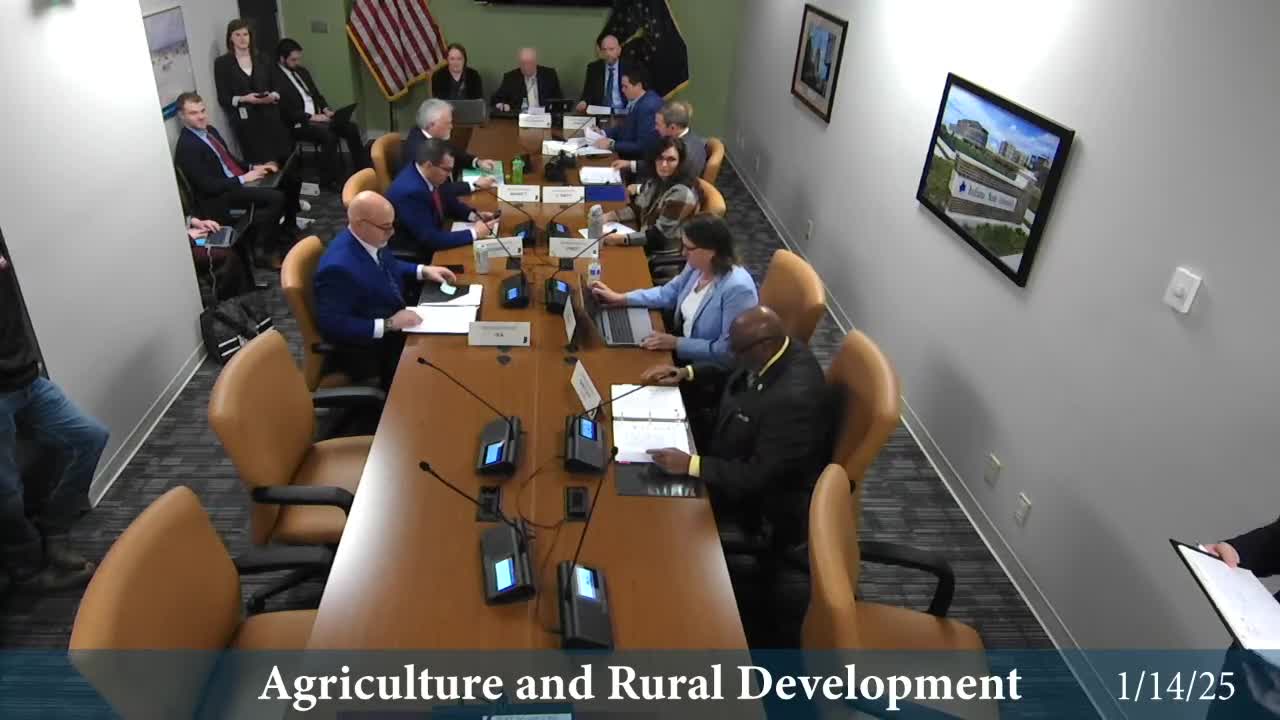
Committee advances bill to let Hoosier landowners donate conservation easements
Summary
The House Agriculture Committee advanced House Bill 1234, which would create a voluntary framework allowing farmland owners to donate or sell conservation easements to preserve agricultural use. The bill does not request state appropriation; supporters said it would help landowners access federal matching funds.
Representative Culp introduced House Bill 1234 to the Indiana House Agriculture Committee, saying, "I'm pleased to be here today to present to you House Bill 1234," a proposal to create a framework for willing farmland owners to donate conservation easements.
The measure would authorize the Indiana State Department of Agriculture (ISDA) to accept and hold agricultural conservation easements, allow counties to establish local easement programs, and make landowners who donate easements eligible to seek federal matching funds. Supporters told the committee the bill requests no state appropriation and is voluntary: landowners would choose whether to place an easement on their property.
The bill's supporters cited the state's inventory of lost farmland. Chris Reynolds, Midwest regional director for American Farmland Trust, told the committee the state's 2023 inventory showed a loss of roughly 345,000 acres between 2010 and 2022 and said HB 1234 "lays the vital groundwork to give farmers and landowners the option to protect their land for future generations." He argued similar programs in other states have leveraged federal, state and philanthropic dollars to preserve farmland and help beginning farmers access affordable land.
Quentin Hayes, legislative director for the Indiana State Department of Agriculture, said ISDA would implement the program in coordination with a protection board and "would be responsible for assisting counties with acquiring their own easements." Hayes added that ISDA could implement the program "if we were provided additional staffing and resources." He and other witnesses noted existing land trusts (for example, the Benjamin Harrison Land Trust) also can and do hold easements.
Testimony from the Indiana Farm Bureau, the Hoosier Environmental Council and several family farmers emphasized succession planning, preserving farmland value for future agricultural use, and leveraging federal programs administered by USDA and the Natural Resources Conservation Service. Toby Day of the Hoosier Environmental Council explained that placing an easement removes development rights and typically reduces the market price of the parcel because it restricts nonagricultural uses.
Committee members asked about governance and board composition for any new protection board. Representative Bartlett and others urged political balance on the three-member body; Representative Culp said he was open to changes and expected the bill to undergo amendment as it proceeds through the legislative process.
Votes at a glance: The committee moved to pass HB 1234 as amended. Roll-call statements on the record included recorded "yes/aye" responses from Chairman Knoesworth, Representative Green, Representative Barrett, Representative Smith, Representative Baird and multiple other committee members; several members said they would vote "no" for now and reserved the right to change their vote on the floor. (Names and counts recorded in the committee transcript: yes — 8; no — 2.)
Next steps: Committee members said technical and composition amendments are likely on second reading and in subsequent committee work so that ISDA can refine implementation language and staffing expectations.