Get Full Government Meeting Transcripts, Videos, & Alerts Forever!
Get email alerts on the Agriculture Conservation Easements topic
No spam. Unsubscribe anytime.
Panel advances bill letting Hoosier landowners donate agricultural conservation easements
Summary
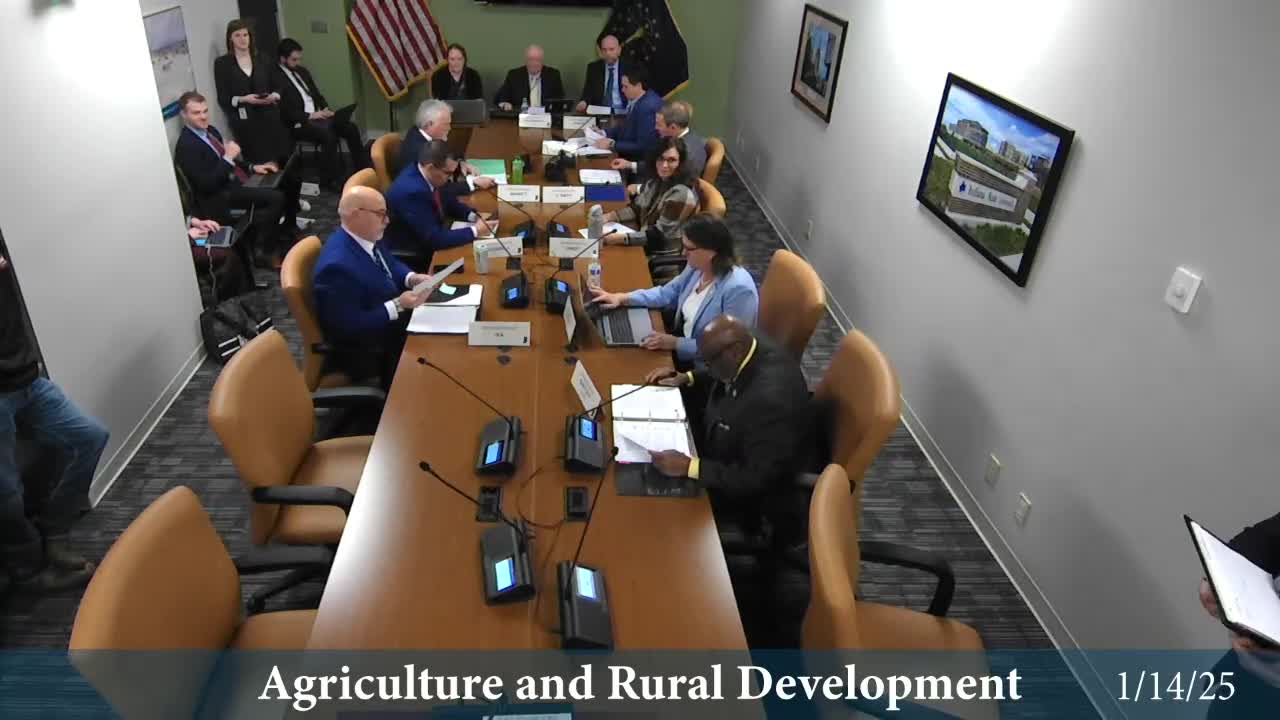
The House Agriculture Committee advanced House Bill 1234, which would create a voluntary framework allowing farmland owners to donate or bequeath conservation easements, enable counties to run local programs, and permit the Indiana State Department of Agriculture to accept and hold easements without a required state appropriation.
Representative Culp introduced House Bill 1234 to the House Agriculture Committee, saying, "This bill creates a framework for willing farmland owners to donate their conservation easements, if they choose to protect their farms for future generations to utilize to grow food." The committee voted to pass the bill as amended at the hearing.
The measure would establish an agricultural land protection program that accepts donations or bequests of conservation easements and creates an Ag Conservation Easement Fund to help landowners leverage federal, local and philanthropic dollars. Chris Reynolds, Midwest regional director for American Farmland Trust, testified in support and said the bill "lays the vital groundwork to give farmers and landowners the option to protect their land for future generations." Reynolds noted that 29 other states have similar programs and said Indiana’s 2023 inventory of lost farmland documented roughly 345,000 acres lost from 2010 to 2022.
Supporters said the bill does not require state funding to take effect. Representative Culp and witnesses stressed the program is voluntary: landowners would retain ownership and equity while conveying the development rights to preserve agricultural use. Quentin Hayes, legislative director for the Indiana State Department of Agriculture (ISDA), told the committee ISDA could implement the program "provided additional staffing and resources," and confirmed the bill does not itself appropriate funds.
Testimony described how easement valuation would work: appraisers would value a parcel for continued agricultural use and for hypothetical commercial development; the difference between those values is the conservation-easement value. Witnesses said that landowners eligible under the state program could then apply for federal matching funds administered through programs such as those at USDA and the Natural Resources Conservation Service. Caitlin Smith of the Indiana Farm Bureau and Toby Day of the Hoosier Environmental Council also testified in support, saying easements can aid succession planning and make farmland more affordable for beginning farmers.
Committee members questioned governance and staffing. Representative Bartlett and others sought political diversity on the small oversight board described in the bill; Representative Culp said he was open to amendments addressing party balance. Representative Quentin Hayes noted LSA advice that existing state statute already permits land trusts to hold easements, and Representative Culp cited local land trusts (for example, Benjamin Harrison Land Trust) as alternatives to state holding.
The committee recorded multiple yea votes and at least two members explained they voted no during the roll call; the motion recorded in committee was "move to pass as amended." Committee members agreed technical or drafting amendments may be offered on second reading and during subsequent stages in the process.
Why it matters: Committee testimony framed the bill as a tool to slow farmland loss and preserve agricultural production and family farm legacies. Advocates cited ISDA’s inventory and federal funding opportunities as reasons to establish a state framework now, while opponents and some members pressed for clearer safeguards on governance and staffing before final approval.
Ending: The bill will continue through the legislative process with possible chairman’s amendments and additional technical edits; supporters asked lawmakers to consider matching strategies that would help Indiana leverage federal and philanthropic funds to protect farmland.