Get Full Government Meeting Transcripts, Videos, & Alerts Forever!
Get email alerts on the Agriculture Farmland Protection topic
No spam. Unsubscribe anytime.
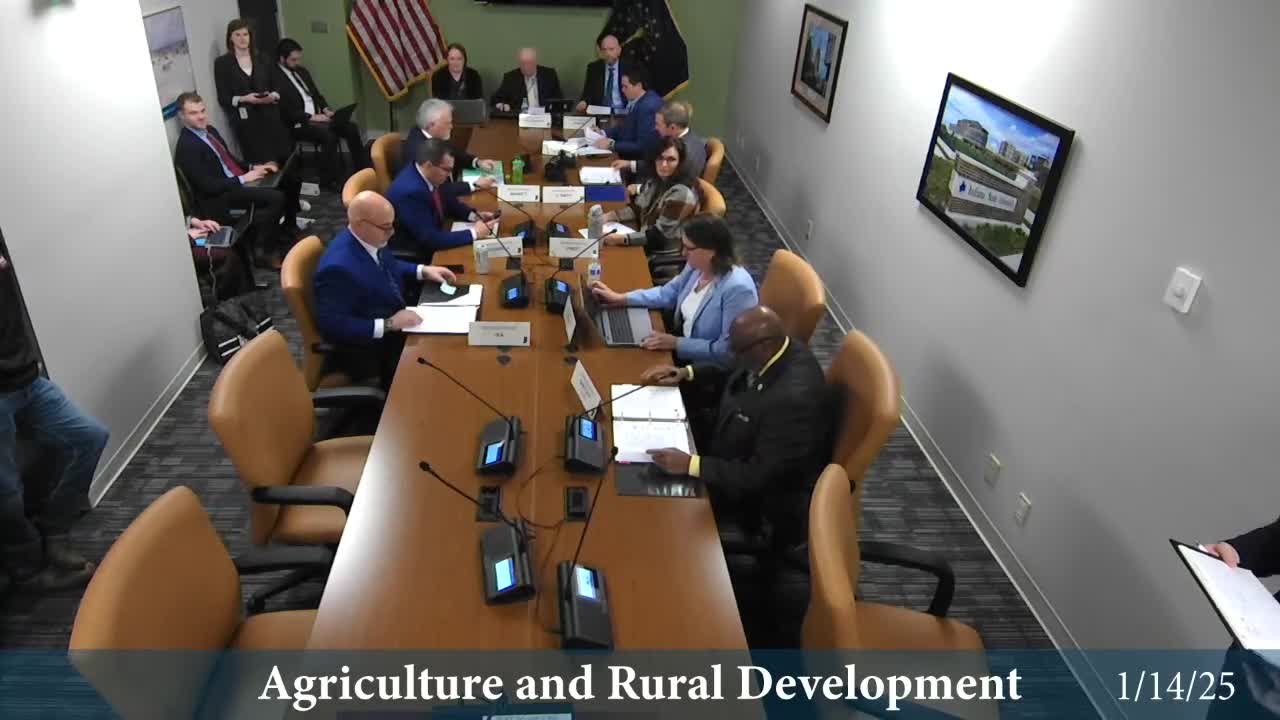
Committee hears bill to create voluntary farmland conservation easement program
Summary
A bill to create a voluntary farmland conservation easement program drew broad support and questions about implementation at a House Agriculture Committee hearing.
A bill to create a voluntary farmland conservation easement program drew broad support and questions about implementation at a House Agriculture Committee hearing. Representative Culp introduced House Bill 1234, which would authorize the Indiana State Department of Agriculture (ISDA) to accept donations or purchases of agricultural conservation easements and allow counties to set up their own local programs.
Supporters said the measure provides a tool for landowners to preserve farms for agricultural use without requiring a state appropriation. Chris Reynolds, Midwest regional director for American Farmland Trust, told the committee, “House Bill 1234 lays the vital groundwork to give farmers and landowners the option to protect their land for future generations.” He said similar programs exist in 29 states and that federal funding opportunities such as USDA and IRA sources make the framework timely.
Quinn (Quentin) Hayes, legislative director for the Indiana State Department of Agriculture, said ISDA would implement the program in coordination with a protection board and could assist counties seeking easements, but that the agency would need additional staffing and resources to accept and manage easements. “If we were provided some additional staffing and resources,” Hayes said, ISDA could implement the program.
Indiana Farm Bureau representative Caitlin Smith said the bill is voluntary and would give farmers another tool for succession planning. “This language allows a farmer to voluntarily opt into an easement and gives insurance to that farmer that the land will continue to be utilized for production,” she said. Farmers and conservation advocates also described how appraisals would calculate the easement value as the difference between full market value and the value limited to agricultural use.
Several farmers and conservation groups testified in support. David Harden, a sixth-generation farmer from Hendricks County, said an easement could help with estate planning and give a path for a next-generation farmer to afford land. Toby Day, sustainable agriculture director at the Hoosier Environmental Council, said easements reduce the price of land for beginning farmers by removing development rights.
Supporters repeatedly cited ISDA’s July 2023 inventory of lost farmland, which the witnesses described as showing roughly 345,000 acres lost in Indiana between 2010 and 2022. Witnesses said that, absent action, farmland loss threatens rural economies and access to affordable farmland for new farmers.
Committee members discussed governance of the program’s oversight board and whether appointments should reflect political balance; the bill’s author indicated openness to adjustments. Committee members also asked whether the legislation requests state funds; witnesses and the author said the bill does not require an appropriation but would make landowners eligible to apply for federal matching dollars.
The committee recorded a motion to pass the bill as amended and held a roll call. The roll call in the transcript shows votes recorded verbally as follows: Chairman Knoesworth — Aye; Representative Green — Yes; Representative Barrett — Yes; Representative Smith — Yes; Representative Baird — Aye; Representative Criswell — Yes. Several members spoke afterward explaining their votes, with at least two members saying they would vote no at that time. The transcript does not include a final numerical tally attached to a recorded clerk’s tabulation in the excerpt provided.
Why it matters: Proponents said the bill would create a permanent legal path for landowners to preserve farmland without obligating state purchase funds, enabling Indiana to leverage federal and private matching funds. Opponents or skeptical members asked for clarity about staffing, the oversight board composition, and whether statute changes should be made to the Hoosier Land Resources Council or other existing bodies before creating new structures.
Next steps: Committee members discussed technical amendments and coauthor changes; the author said there would be opportunities to amend the bill on second reading and in later committee stages.