Get Full Government Meeting Transcripts, Videos, & Alerts Forever!
Get email alerts on the Farmland Protection topic
No spam. Unsubscribe anytime.
House committee advances bill to let farmers donate conservation easements without state purchase funds
Summary
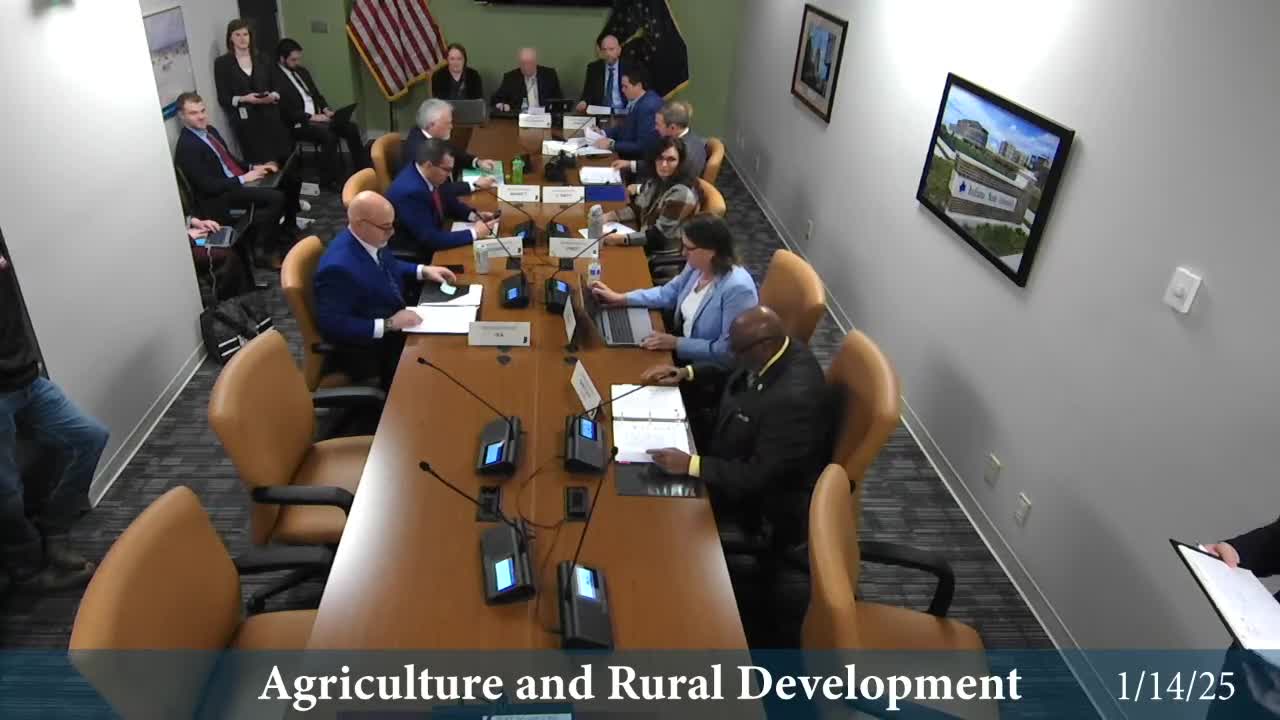
Representative Culp presented House Bill 1234 to the Indiana House Agriculture Committee, proposing a statewide framework that would allow farmland owners to donate or bequeath agricultural conservation easements to protect land for continued farming without a state appropriation to buy those easements.
Representative Culp presented House Bill 1234 to the Indiana House Agriculture Committee, proposing a statewide framework that would allow farmland owners to donate or bequeath agricultural conservation easements to protect land for continued farming without a state appropriation to buy those easements.
The bill matters because state officials and witnesses told the committee that Indiana has lost hundreds of thousands of acres of farmland in recent years and that a donation-based easement program would let landowners preserve agricultural use while seeking federal and philanthropic matching dollars.
Representative Culp described the proposal as a voluntary program to “accept donations or bequeaths of a conservation easement from farmland owners,” and said it would not include a state appropriation to purchase easements. Chris Reynolds, Midwest regional director for American Farmland Trust, urged support and said the bill would “lay the vital groundwork to give farmers and landowners the option to protect their land for future generations.”
Witnesses cited a state inventory showing large farmland loss: the committee heard that the Indiana inventory of lost farmland found roughly 345,000 acres were lost from 2010 to 2022; at a later point a presenter cited a specific figure of 345,682 acres. Reynolds and other witnesses said that continuing that rate would put more land at risk and that an easement program could make owners eligible for federal programs administered by USDA and the Natural Resources Conservation Service.
The bill would authorize the Indiana State Department of Agriculture (ISDA) to accept and hold donated easements, but it also allows counties to establish local farmland protection programs and does not require landowners to use the state program. Quentin Hayes, legislative director for ISDA, told the committee the department could implement the program “if we were provided additional staffing and resources,” and said the legislation would place ISDA in a coordinating role with a newly created protection board.
Testimony from agricultural stakeholders supported the voluntary nature of the proposal and the potential for matching federal funds. Caitlin Smith, representing Indiana Farm Bureau, said the bill gives farmers another “toolbox” option and framed farmland protection in terms of food security. Farmer David Harden described easements as a tool for estate planning that could help keep family farms in production for future generations. Toby Day, sustainable agriculture director at the Hoosier Environmental Council, said conservation easements lower the market price of land by removing development rights and can help beginning farmers buy property at a lower cost.
Committee members discussed board composition and partisan balance for the proposed protection board, and Representative Culp said he would be open to adjustments during later stages of the bill.
Action: a committee member moved to pass House Bill 1234 as amended. The committee recorded yea votes from the chair (recorded as “Aye” by the chairman), Representative Green, Representative Barrett, Representative Smith, Representative Baird and Representative Criswell during the roll call on the motion; several members said they intended to vote no or to withhold until later explanations. The motion was advanced in committee (passage recorded in the committee proceeding), though the committee transcript does not include a final numeric tally in a single consolidated line. Notes: the bill, as presented, does not include state funding to purchase easements; ISDA said staffing and resources would be required for the department to accept and hold easements; land trusts may also hold donated easements under existing state law.
The committee discussion signaled bipartisan interest but also requests for technical changes and clarity on the protection board’s makeup. Representative Culp said he expects the bill to be amended as it moves to second reading and through the legislative process.
The committee heard multiple practical clarifications about how easements are valued: appraisers would value land for both agricultural and potential commercial development; the difference in those valuations is the value of the easement. Witnesses emphasized that a donated conservation easement is permanent unless the law is later changed.
House Bill 1234 will proceed in the legislative process with committee amendments to be worked out, and proponents urged lawmakers to adopt the framework so landowners can access federal and philanthropic matching funds.