Get Full Government Meeting Transcripts, Videos, & Alerts Forever!
Get email alerts on the Hoosier Homestead Eminent Domain topic
No spam. Unsubscribe anytime.
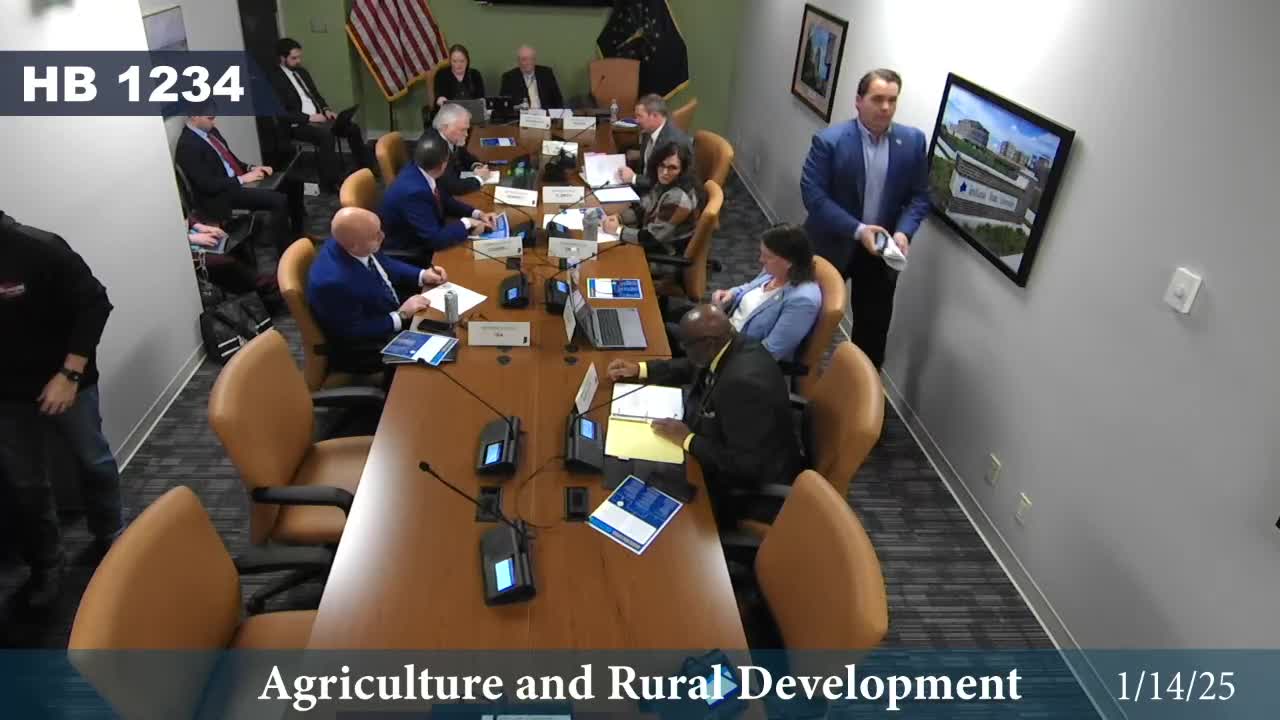
Committee hears bill to put Hoosier Homestead program into statute and add limited remonstrance for eminent domain
Summary
House Bill 1265 would codify the Hoosier Homestead award program and create a limited local remonstrance process before fee-simple condemnation of registered homestead farms. The committee heard testimony and the author said technical amendments will be prepared; the item was held for further work.
Representative Michael Greene introduced House Bill 1265 to the committee as a companion measure to farmland-protection efforts, proposing to codify the Hoosier Homestead Farm Program in statute and to create a limited, local remonstrance process for eligible farms facing fee-simple condemnation.
The bill would require ISDA to maintain an electronic registry of homestead farms (those with continuous family ownership for 100, 150 or 200 years, per the program criteria) and would trigger a notice to the local legislative body when a fee-simple taking is proposed that affects a registered homestead farm. That local body (typically the county commissioners or municipal council) would review the proposed condemnation; the statute would not create a blanket exemption, and the local body must still determine whether a feasible and prudent alternative exists.
"House Bill 1265 simply gives a homestead farm the right to make one final appeal to their local legislative body to review the potential condemnation," Representative Greene said, describing the change as a balance between public projects and multi-generational farms.
Linda Norton, an 8th-generation farm owner who received a Hoosier Homestead award in 1996, and Jason Abel, a fourth-generation farmer and Shelby County commissioner, both testified in support, describing the program’s ceremonial importance and the role such recognition plays in preserving agricultural heritage.
Quentin Hayes of ISDA testified neutrally and suggested technical changes, including statutory clarifications on application requirements and a note that parcels must have property taxes paid up to date to be registered. Hayes said the program has operated ceremonially since 1976 and that codifying it would allow better tracking and clarity on the land parcels that would receive remonstrance rights.
Committee members asked questions about the contours of the remonstrance process and whether the protection would extend to easements or only fee-simple takings. Witnesses and the author clarified the remonstrance applies only to fee-simple condemnations and not to easements, leases or voluntary sales.
Representative Greene told the committee staff were working with ISDA on technical edits and that those changes would likely appear as an amendment in a future meeting. He said he would hold the bill until those edits are prepared; the chair said the item would return to the agenda when the amendment language is ready.
Because the author requested time to finalize technical language, the committee did not take a committee vote on the substance of HB 1265 at this meeting. The bill will return to committee for amendment and further consideration.