Get Full Government Meeting Transcripts, Videos, & Alerts Forever!
Get email alerts on the Farmland Protection topic
No spam. Unsubscribe anytime.
House panel hears bill to allow voluntary agricultural conservation easements
Summary
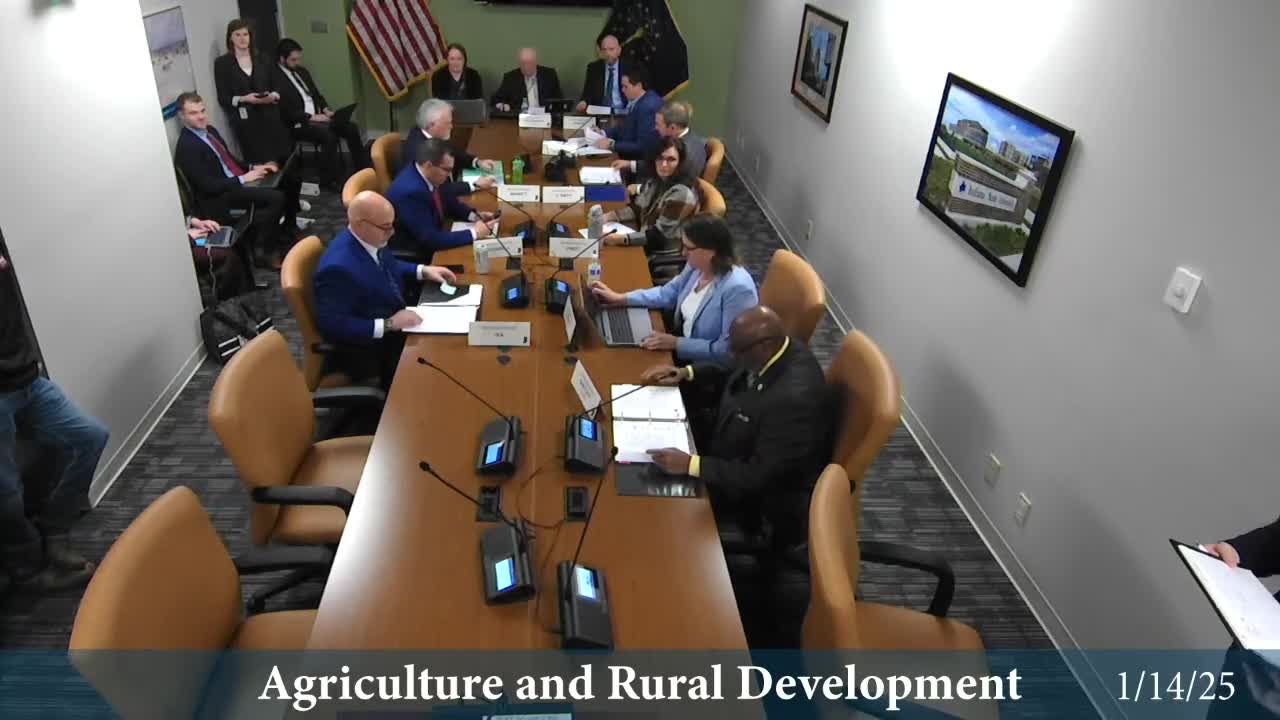
House members and agricultural groups on the Indiana House Agriculture Committee heard testimony in favor of House Bill 1234 on creating a framework for willing farmland owners to donate or bequeath conservation easements to protect farms from nonagricultural development.
House members and agricultural groups on the Indiana House Agriculture Committee heard testimony in favor of House Bill 1234 on creating a framework for willing farmland owners to donate or bequeath conservation easements to protect farms from nonagricultural development.
Representative Culp introduced the measure, saying, “This bill creates a framework for willing farmland owners to donate their conservation easements, if they choose to protect their farms for future generations to utilize to grow food.” He told the committee the proposal does not request state funding to purchase easements.
The bill would authorize the Indiana State Department of Agriculture (ISDA) to accept and hold agricultural conservation easements and would allow counties to establish their own conservation-easement programs. Chris Reynolds, Midwest regional director for American Farmland Trust, told the committee HB 1234 ‘‘lays the vital groundwork to give farmers and landowners the option to protect their land for future generations.’’ He said the bill would make Indiana eligible to access federal funds for easements and join other states that use similar programs.
Caitlin Smith of the Indiana Farm Bureau said the proposal ‘‘gives a nod’’ to food-security concerns by providing a voluntary tool for farmers and landowners who want assurance that land will remain in agricultural use. Quentin Hayes, legislative director for ISDA, said ISDA released an inventory in July 2023 showing roughly 345,000 acres of farmland lost between 2010 and 2022 and that ISDA could implement the program ‘‘if provided additional staffing and resources.’’ Hayes reiterated the bill itself does not appropriate state funds.
Farmers and conservation advocates described how easements work and who holds them. Toby Day of the Hoosier Environmental Council explained that an appraisal compares the value of land for agriculture with its potential commercial value, and the difference becomes the easement value; that reduces the price of land to a buyer who is limited to agricultural uses. David Harden, a sixth-generation farmer, said an easement can be useful for estate planning to keep land in agricultural use even if heirs do not farm.
Several witnesses noted existing nonstate land trusts — for example, the Benjamin Harrison Land Trust — already can and do hold easements; HB 1234 would add the state as an additional option. Witnesses and the bill author emphasized the program is voluntary for landowners and would not transfer control of private land to the state.
Committee members discussed the small makeup of the proposed oversight board and whether political diversity should be required among its members. Representative Culp said he would be open to changes as the bill moves through the process. No final committee vote on the underlying bill was recorded in the transcript segment for this item; members who testified and the department emphasized that implementation would require staff or resources if ISDA were to hold easements.
Supporters urged passage to help rural economies and make Indiana eligible for federal matching funds through programs administered by USDA and the Natural Resources Conservation Service. Opponents were not prominent in the hearing record for this item. The committee took testimony and indicated there would be opportunities for amendment and further review as the bill proceeds.