Get Full Government Meeting Transcripts, Videos, & Alerts Forever!
Get email alerts on the Farmland Protection topic
No spam. Unsubscribe anytime.
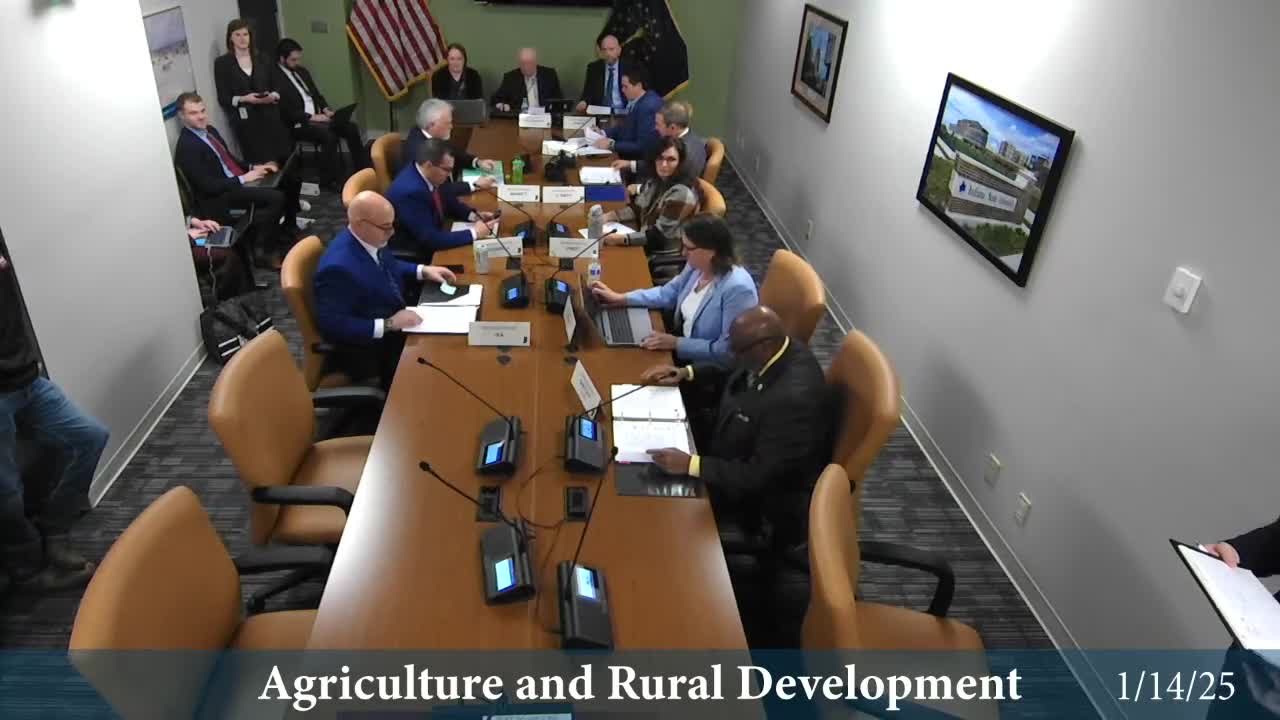
House committee advances bill to create voluntary agricultural conservation-easement program
Summary
The House Agriculture Committee advanced House Bill 1234 to establish a framework allowing landowners to donate or sell agricultural conservation easements to protect farmland. Supporters cited an ISDA inventory showing roughly 345,000 acres lost from 2010–2022; the committee voted to pass the bill as amended.
Representative Richard Culp introduced House Bill 1234 on Oct. 12 before the House Agriculture Committee, proposing a voluntary program that would let farmland owners donate or bequeath conservation easements to preserve agricultural use.
The bill would authorize the Indiana State Department of Agriculture (ISDA) to accept, hold or help facilitate agricultural conservation easements, allow counties to establish local programs, and create an Ag Conservation Easement Fund to leverage federal, state, local and philanthropic dollars. The bill, as introduced, does not request a state appropriation to purchase easements.
The legislation responds to an ISDA inventory, released in July 2023, that found Indiana lost roughly 345,000 acres of farmland between 2010 and 2022. "That report showed a staggering 345,000 acres were lost in Indiana during that 12 year time," Representative Culp said during his introduction. Supporters told the committee the loss threatens farm succession, local economies and the state’s role as a top commodity producer.
Chris Reynolds, Midwest regional director for American Farmland Trust, testified in strong support, saying the bill would give landowners more options to prevent farmland from converting to nonagricultural uses. "House Bill 1234 lays the vital groundwork to give farmers and landowners the option to protect their land for future generations," Reynolds said, noting Indiana could join the 29 states with similar programs and that federal programs and IRA funding create an opportunity to leverage matching dollars.
Caitlin Smith, representing the Indiana Farm Bureau, also supported the bill, saying the easement tool can help with succession planning and preserve productive land for crop and livestock production. "This language allows a farmer to voluntarily opt into an easement and gives insurance to that farmer that the land will continue to be utilized for production," Smith said.
Quentin Hayes, legislative director at ISDA, told the committee the department could implement the program "if we were provided additional staffing and resources," and that ISDA would coordinate implementation with a newly created protection board if the bill becomes law. Hayes and others emphasized the bill’s current language does not include an appropriation to fund acquisitions; donors or federal matching programs would be the primary funding path initially.
Testimony from farmers and conservation groups reinforced the case that easements reduce the market value of land for development and make parcels more affordable for beginning farmers. David Harden, a sixth-generation farmer from Hendricks County, described easements as an estate-planning tool that could help ensure at least some heirs or future farmers can remain on productive ground.
Committee members asked about who would hold easements, staffing needs, and whether land trusts could perform similar functions. Representative Culp and other witnesses noted existing land trusts, such as the Benjamin Harrison Land Trust, could hold easements if landowners preferred that route and that the bill’s framework is intended to make easement-holding options clearer and eligible for federal matching.
Committee debate touched on the composition of the protection board created by the bill. One member asked the author to consider language ensuring political diversity on the board; Representative Culp said he was open to changes as the bill moves through the process.
The committee moved to pass the bill as amended. Roll-call remarks recorded in committee show at least eight affirmative votes and at least two negative votes before the measure was advanced to the next step in the legislative process. The committee chair and the bill author indicated technical edits and potential amendments would be addressed before second reading.
Supporters and ISDA officials emphasized that while the bill does not include an initial appropriation, it is designed to allow landowners to pair donated or purchased easements with federal funds from USDA and other programs. Opponents or hesitant members cited staffing and oversight questions and asked for clearer statutory language on board makeup and administrative processes.
The committee’s action advances House Bill 1234 for further amendment and consideration; supporters said the program would allow Indiana to access federal matching dollars and other outside funding when landowners choose to restrict development permanently.