Get Full Government Meeting Transcripts, Videos, & Alerts Forever!
Get email alerts on the Farmland Protection topic
No spam. Unsubscribe anytime.
House committee advances bill to accept donated farmland conservation easements
Summary
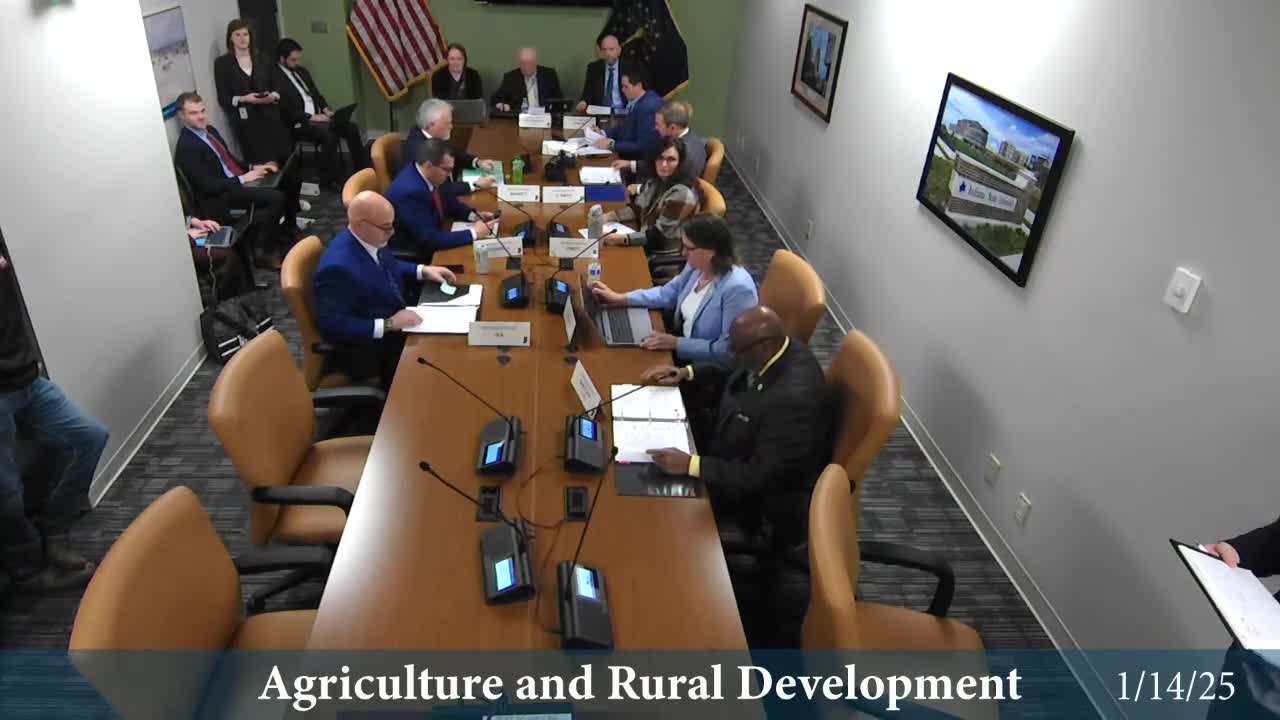
Representative Culp introduced House Bill 1234 to the Indiana House Agriculture Committee as a voluntary framework allowing farmland owners to donate or bequeath conservation easements to protect agricultural use in perpetuity. The committee voted to pass the bill as amended.
Representative Culp introduced House Bill 1234 to the Indiana House Agriculture Committee as a voluntary framework allowing farmland owners to donate or bequeath conservation easements to protect agricultural use in perpetuity. The committee voted to pass the bill as amended.
The bill would authorize the Indiana State Department of Agriculture (ISDA) to accept, purchase or hold donated agricultural conservation easements and would create an Ag Conservation Easement Fund intended to leverage federal, state, local and philanthropic dollars. Supporters said the measure is intended to keep farmland in agricultural production and to help the next generation of farmers access land.
Chris Reynolds, Midwest regional director for American Farmland Trust, told the committee he “strong[ly] support[s] House Bill 1234” and said the legislation would let Indiana join other states that use easements to slow farmland conversion. He described the bill as providing “the tools to protect their land if they believe it is the right option for them.”
The bill’s text, as discussed at the hearing, includes: - A statewide framework allowing owners to donate or bequeath conservation easements without requiring a state appropriation. - Authorization for ISDA to hold easements, and for counties to establish local farmland-protection programs. - Eligibility for owners who place easements under the program to pursue federal matching dollars, including funds administered by USDA programs and other federal sources the witnesses cited.
Supporters cited the state’s inventory of lost farmland to justify the proposal. Reynolds and Representative Culp referenced the inventory’s finding that Indiana lost roughly 345,000 acres of farmland between 2010 and 2022 — about 29,000 acres per year — and warned that, at current rates, the lifetime loss per resident would be large.
Several agricultural organizations and landowners testified in favor. Caitlin Smith, representing the Indiana Farm Bureau, said the bill gives another “toolbox” option for farmers and invoked the Farm Bureau phrase “food security is national security.” Toby Day, sustainable agriculture director for the Hoosier Environmental Council, told the committee that “80% of the land that is farmed in Indiana is rented, leased ground,” and argued easements can help with succession planning and make some parcels more affordable for beginning farmers. David Harden, who identified himself as a sixth‑generation farmer, described easements as a useful estate‑planning tool that could make it easier for a next generation to remain farming.
Quentin Hayes, legislative director for ISDA, testified that ISDA released the inventory of lost farmland in July 2023 and that the agency could implement the easement program if provided additional staffing and resources. Hayes said the inventory showed residential construction around urban areas accounted for most of the loss and that ISDA would coordinate implementation with a newly created protection board if the legislation is enacted. On the question of funding, Hayes and other witnesses emphasized the bill does not request a state appropriation in its current form; instead, it creates a structure to accept easements and pursue matching federal funds.
Committee members pressed the author on governance of the protection board created in the bill. Representative Bartlett and others raised the prospect of ensuring political balance on the small oversight board; the bill author indicated openness to amendments to address that concern. Witnesses and the author also discussed whether private land trusts would continue to hold easements — witnesses noted existing land trusts can and do hold easements and that landowners would not necessarily need to route donations through the state.
After debate the committee moved the bill to pass as amended. The committee roll call produced multiple affirmative votes and at least two members recorded “no” votes or indicated they would withhold support until further changes; the motion was carried out of committee.
The measure will proceed to second reading and may return with technical or sponsor amendments addressing board composition and implementation details. ISDA staff told the committee that acceptance and long‑term stewardship of easements would require additional agency resources if ISDA serves as easement holder.
Votes at a glance: Motion: “Move to pass as amended.” Outcome: passed out of committee. Tally: yes: 8; no: 2; abstain: 0. Several members who voted no said they might reconsider on the floor if amendments are adopted.
Ending: The bill’s next steps are second reading in the House and potential amendments to clarify board membership, staff responsibilities for ISDA and any statutory requirements for landowner applications. Proponents urged lawmakers to adopt the framework so Indiana can access federal funds and match programs used in other states to preserve farmland.