Get Full Government Meeting Transcripts, Videos, & Alerts Forever!
Get email alerts on the Climate Smart Agriculture topic
No spam. Unsubscribe anytime.
Hughes Center previews climate-smart agriculture report, farmers ask for local, short-term data and flexible practices
Summary
The Harry R. Hughes Center for Agro-Ecology previewed a Climate-Smart Agriculture report for Maryland that emphasizes short-term, farm-scale projections, flexible best-practice guidance and research priorities; stakeholders said producers need actionable, local data and less burdensome rules.
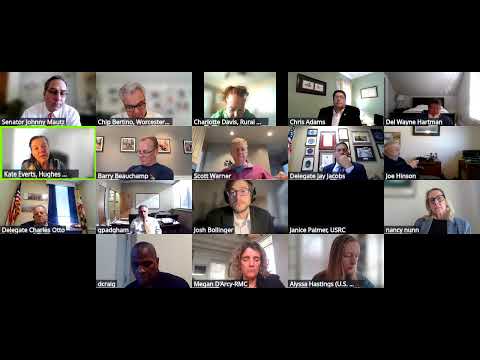
Representatives from the Harry R. Hughes Center for Agro-Ecology presented findings and stakeholder feedback from a Climate-Smart Agriculture project the center carried out for the state.
Dr. Kate Eberts, the center’s executive director, said researchers talked with farmers across Maryland—particularly on the Eastern Shore—about weather changes and operational impacts. Farmers told the team they want short-term projections and local-scale data that make practical differences in the next one to five years rather than only long-range scenarios. "They really said what they need, is, something on a shorter time frame," Eberts summarized.
The center described research recommendations across agronomy, hydrology, pest management and production systems and highlighted a stakeholder request for more flexibility in mandated best-management practices, such as cover-crop planting dates, so producers can adapt under shifting precipitation and temperature patterns.
Why it matters: Agricultural adaptation choices—planting dates, crop varieties, pest management and conservation practices—will influence farm profitability and land-use outcomes on the Eastern Shore. The Hughes Center said its forthcoming report will include science-based, fine-scale research priorities intended for policymakers and agencies.
The center asked delegation members to review the draft recommendations and to use the findings when weighing policies like solar siting or conservation programs so multiple state goals (energy, tree planting, water quality) are balanced with farm viability.