Get Full Government Meeting Transcripts, Videos, & Alerts Forever!
Get email alerts on the Hoosier Homestead topic
No spam. Unsubscribe anytime.
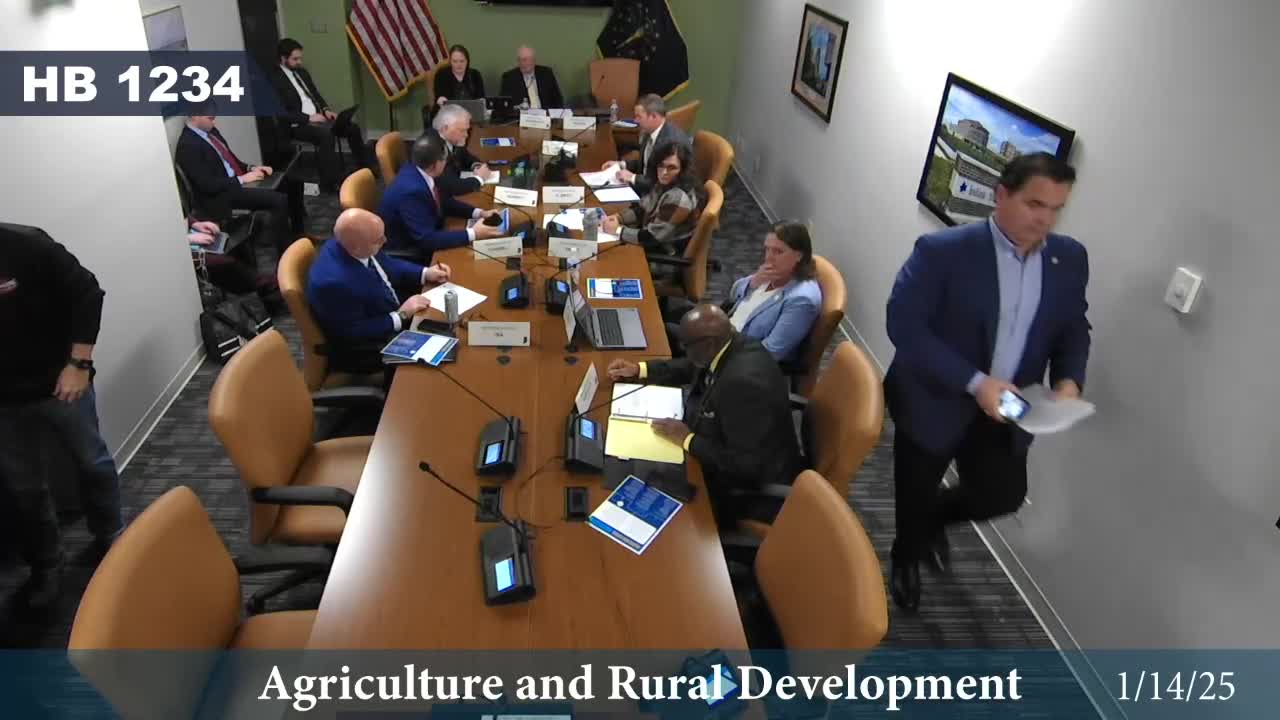
Committee hears bill to put Hoosier Homestead program into statute, allow local remonstrance on eminent domain
Summary
House Bill 1265 would codify the Hoosier Homestead Farm program, create a registry, and give qualifying long‑held family farms a local remonstrance process against fee‑simple condemnation; ISDA testified neutrally and committee indicated plans to hold the bill for technical amendments.
Representative Green introduced House Bill 1265 to codify the Hoosier Homestead Farm program and to provide a limited local remonstrance process for farms designated as Hoosier Homestead Farms.
Under the bill, the Hoosier Homestead Farm Program — a long-running ceremonial award program recognizing families that have owned farms for 100, 150 or 200 years — would be placed into statute, ISDA would maintain an electronic registry of qualifying homestead farms, and a remonstrance process would allow a homestead farm to petition a local legislative body before a fee‑simple taking by eminent domain is finalized. Representative Green said the measure is intended to "give Hoosier Homestead Families a voice to push back against potential condemnation of their heritage farm" while preserving the public body's ability to acquire land where there is "no feasible and prudent alternative."
Representative Green cited the ISDA inventory showing 345,682 acres lost between 2010 and 2022 as part of the broader rationale for strengthening protections for long‑standing family farms. Linda Norton, an eighth‑generation farmer, and Jason Abel, a fourth‑generation farmer and county commissioner, testified in support of codifying the program and the remonstrance process.
Quentin Hayes, legislative director for ISDA, testified neutral on HB1265 and described the current Hoosier Homestead Award as a ceremonial program instituted in 1976. Hayes said the ISDA application requires documentation showing continuous family ownership and suggested legislative language changes the agency would like to see — for example, adding a requirement that property taxes be current and making the application process explicit in statute. Hayes said the statute should define which parcel(s) of a homestead would receive remonstrance protections.
Committee discussion focused on technical edits, whether the protection should be limited to fee‑simple takings (not easements or voluntary sales), and the appropriate statutory language to reflect the award's administrative history. Representative Green and ISDA staff said they would work on technical amendments; the chair indicated the bill would be held for further work and placed on a future agenda for the committee.
Why it matters: supporters said placing the Hoosier Homestead Program into statute and adding a local remonstrance step would provide an added layer of review when long‑held family farms face eminent domain, while leaving condemnation authority intact when legally required. ISDA recommended clarifications to the application and eligibility process and the precise scope of remonstrance protections.
Next steps: the author and ISDA will draft technical amendments for committee consideration at a later meeting.