Get Full Government Meeting Transcripts, Videos, & Alerts Forever!
Get email alerts on the Farmland Protection topic
No spam. Unsubscribe anytime.
Committee hears broad support for House Bill 1234 to create farmland conservation-easement framework
Summary
Lawmakers and agricultural groups told the House Agriculture Committee that House Bill 1234 would create a voluntary framework to accept donated or purchased agricultural conservation easements, enable county programs, and help landowners access federal matching funds; state implementation would require staffing if ISDA holds easements.
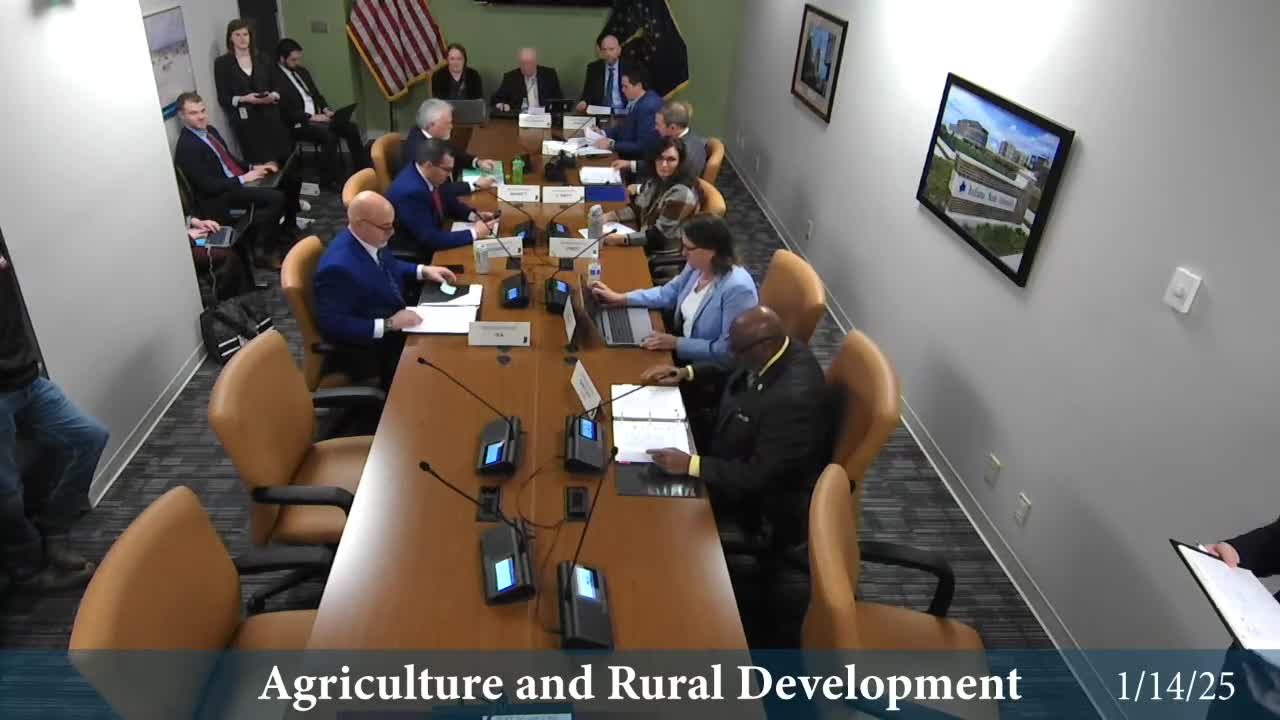
House Bill 1234, a measure to establish an agricultural conservation-easement program, drew broad support from farmers, conservation groups and agricultural organizations at a hearing of the Indiana House Agriculture Committee.
The bill, introduced to the committee by Representative Culp, would create a framework for willing farmland owners to donate or bequeath conservation easements that keep land in agricultural use. “A farmland protection program will be created,” Representative Culp said in introducing the bill, describing the proposal as a voluntary tool to help landowners protect family farms for future generations.
The bill’s backers said Indiana has data showing substantial farmland loss and that HB 1234 would help landowners leverage federal and private matching funds. Chris Reynolds, Midwest regional director for American Farmland Trust, cited the Indiana inventory of lost farmland and said the bill “lays the vital groundwork to give farmers and landowners the option to protect their land for future generations.” He said the state’s lost-acreage report showed 345,000 acres lost between 2010 and 2022 and that similar state programs allow landowners to retain ownership while removing development rights.
Indiana Farm Bureau’s Caitlin Smith said the bill “gives a nod” to the concept that food security is national security and described the proposal as an additional voluntary tool for landowners who want to permanently protect production ground. Several farmers and conservation advocates told the committee easements reduce the market value of development rights and so can make land affordable to beginning farmers and better preserve agricultural uses.
Quentin Hayes, legislative director for the Indiana State Department of Agriculture (ISDA), said ISDA would implement the program and coordinate a protection board if the bill becomes law, but that implementation would require additional staffing and resources. “We would be responsible for assisting counties with acquiring their own easements. We are confident in being able to implement this program if we were provided additional staffing and resources,” Hayes said.
Witnesses and committee members repeatedly emphasized the voluntary nature of the bill: it does not itself create a state appropriation for purchasing easements, nor does it force landowners to participate. Representative Culp and others said land trusts already operate in Indiana and could hold easements if landowners prefer that route rather than a state-held easement.
Supporters cited additional statistics during testimony: testimony to the committee noted about 18,000,000 acres of farmland in Indiana, that 73% of that acreage is classified as productive/versatile, and warned that Indiana could lose another 602,000 acres by 2040 absent action. Witnesses also referenced federal funding opportunities through the farm bill, the Internal Revenue Act–related investments, and NRCS programs as potential matches for donated or purchased easements.
Committee members asked technical and governance questions about the proposed protection board and whether membership should ensure political balance; Representative Culp indicated openness to future amendments on board composition. Several members also discussed appraisal methodology: the conservation-easement value is typically the difference between the market value for development and value as farmland.
The committee took a motion to pass as amended during the meeting; members voiced support and at least two members announced they would vote no at that time, citing concerns raised during the hearing and the need to see amendment language. The transcript records a motion (“Move to pass as amended.”) and subsequent recorded voice votes by several members, but the transcript excerpt provided does not include a verified roll-call tally for the committee on final passage in the committee. The bill’s authors and witnesses said technical amendments were expected as the bill moved forward.
Why it matters: supporters and witnesses said the bill would create a permanent, voluntary option for landowners who want to restrict development and protect farmland, potentially helping beginning farmers and enabling Indiana to access matching federal and philanthropic funds for conservation easements. Opponents and some committee members pressed for clarity about staffing, program governance and whether statutory language or administrative rules should be amended before final approval.
The committee did not finalize all technical amendments in the hearing. Representative Culp and ISDA staff indicated follow-up work on staffing details and board composition would continue as the bill moves through the process.