Get Full Government Meeting Transcripts, Videos, & Alerts Forever!
Get email alerts on the Agriculture Land Protection topic
No spam. Unsubscribe anytime.
Committee advances bill to create voluntary agricultural conservation easement program
Summary
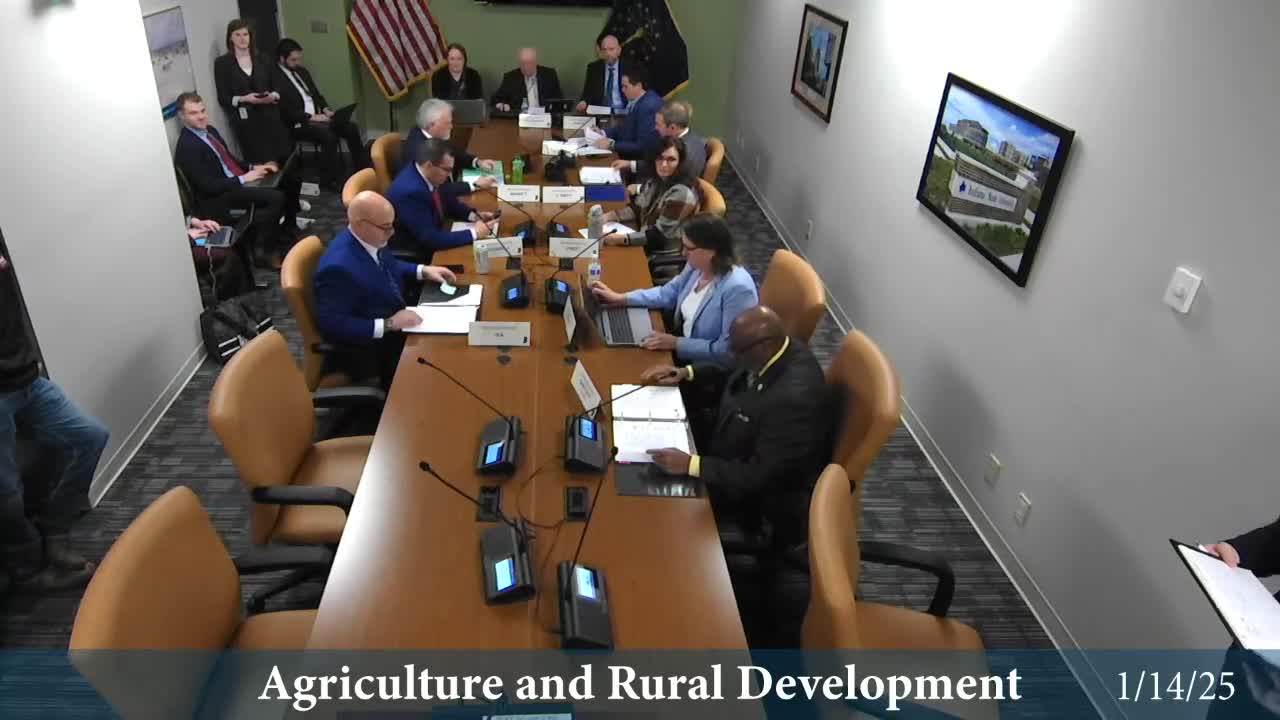
Representative Curt Culp presented House Bill 1234 to the House Agriculture Committee and the panel voted to advance the measure after testimony from farmers, conservation groups and the Indiana State Department of Agriculture.
Representative Curt Culp presented House Bill 1234 to the House Agriculture Committee and the panel voted to advance the measure after testimony from farmers, conservation groups and the Indiana State Department of Agriculture. The legislation would create a framework allowing willing farmland owners to donate or convey agricultural conservation easements and permit the Indiana State Department of Agriculture (ISDA) or qualified land trusts to hold those easements.
The bill’s backers told the committee the measure is a voluntary tool to stem farmland loss. "House Bill 1234 lays the vital groundwork to give farmers and landowners the option to protect their land for future generations," said Chris Reynolds, Midwest regional director for American Farmland Trust. Witnesses cited an ISDA inventory that found roughly 345,000 acres of Indiana farmland lost between 2010 and 2022; one speaker later referenced a more specific figure of 345,682 acres.
Under the bill, the state would not purchase easements with a new appropriation; rather, the program would enable owners to donate conservation easements or to apply for federal or other matching dollars that could be used to buy easements. Testimony explained how appraisals would treat a parcel’s full agricultural value and a separate commercial-development value; the difference between those appraisals would determine the conservation-easement value. Supporters said that federal programs administered by USDA and the Natural Resources Conservation Service, plus IRA and farm-bill funding, create opportunities but that Indiana needs a statutory framework to be eligible for matching or complementary funds.
Multiple groups and farmers testified in support. Caitlin Smith, representing the Indiana Farm Bureau, said the bill "gives a nod" to food-security concerns and provides another tool for voluntary land protection. Toby Day of the Hoosier Environmental Council said placing an easement effectively sells development rights while allowing the owner to continue farming and can lower the purchase price for beginning farmers. Farmer David Harden described the easement as a useful estate-planning tool to keep land available for future generations.
Quentin Hayes, ISDA legislative director, said ISDA would administer the program in coordination with a protection board if enacted but noted the agency would need "additional staffing and resources" to accept and manage easements directly; counties and existing land trusts could also hold easements. Hayes told the committee the 2010–2022 inventory "was primarily due to increased residential construction around urban areas." He said ISDA would assist counties that wish to establish local programs.
Committee members discussed the bill’s governance language and the composition of the protection board; the bill’s author said he was open to changes, including provisions that would ensure political balance on the board. After discussion, a motion "to pass as amended" was moved and the committee recorded a majority vote to advance the bill. The committee chair said the bill will proceed through the committee process toward second reading.
Votes at a glance: motion to pass House Bill 1234 as amended — outcome: approved in committee (recorded roll call on the transcript: several members voted yes and two members voiced no votes during the roll call; full committee roll-call names and votes are recorded in the committee minutes).