Get Full Government Meeting Transcripts, Videos, & Alerts Forever!
Get email alerts on the Agriculture Farmland Protection topic
No spam. Unsubscribe anytime.
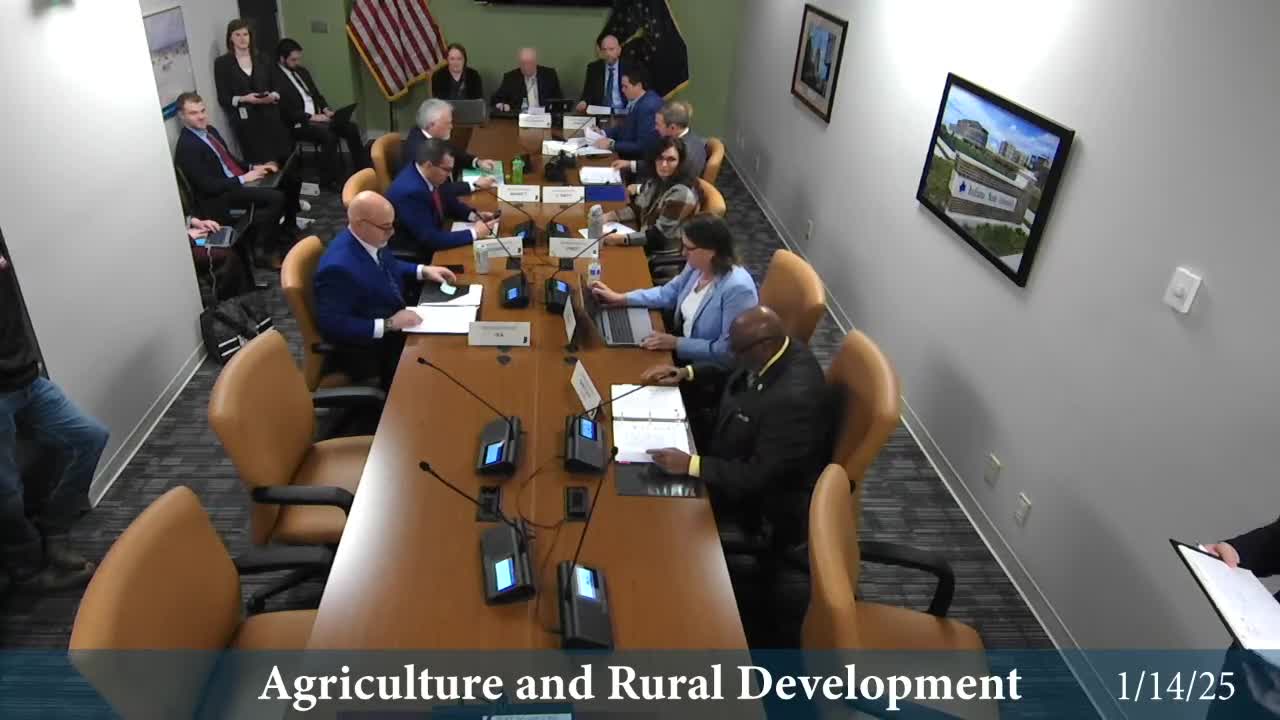
House panel advances bill to let landowners donate agricultural conservation easements
Summary
The House Agriculture Committee voted to advance House Bill 1234, which would create a voluntary program allowing farmland owners to donate or bequeath conservation easements and permit the Indiana State Department of Agriculture or local land trusts to hold those easements; the bill requests no state appropriation.
Representative Culp introduced House Bill 1234 to the House Agriculture Committee, outlining a voluntary program to allow farmland owners to donate or bequeath conservation easements that would keep land in agricultural production for future generations.
The bill would authorize the Indiana State Department of Agriculture (ISDA) to accept and hold conservation easements, allow counties to establish their own farmland-protection programs, and make participating landowners eligible to apply for federal matching dollars. Representative Culp said the proposal requests no state funding to purchase easements and would instead create a framework to enable donations.
Chris Reynolds, Midwest regional director for American Farmland Trust, told the committee he strongly supports the measure. "House Bill 1234 lays the vital groundwork to give farmers and landowners the option to protect their land for future generations," Reynolds said. He cited the state's inventory showing a loss of 345,000 acres of farmland between 2010 and 2022 and said similar programs help leverage federal funds.
Quentin Hayes, legislative director for ISDA, testified that ISDA would implement the program in coordination with a newly created protection board and could assist counties pursuing their own easement acquisitions if the legislature provides additional staffing and resources. "If House Bill 1234 were enacted, ISDA would be responsible for implementing the conservation easement program in coordination with the newly created protection board," Hayes said. He later clarified to committee members that implementation without appropriation would require ISDA to obtain additional resources or rely on private land trusts.
Other witnesses who spoke in support included Caitlin Smith of the Indiana Farm Bureau, farmer David Harden, and Toby Day of the Hoosier Environmental Council. Testimony described easements as a way for landowners to preserve agricultural use while retaining ownership and some equity and suggested easements could help beginning farmers by lowering purchase prices for restricted parcels.
Representative Culp and witnesses cited the state's lost-farmland inventory: 345,000 acres lost from 2010 to 2022 (about 29,000 acres per year). The inventory figure and testimony were used to argue for a voluntary easement program that could leverage federal programs through USDA and the Natural Resources Conservation Service.
On a committee motion to pass the bill as amended, the committee recorded predominantly affirmative votes and two recorded negative votes. The motion to advance House Bill 1234 passed in committee.
The bill as presented does not appropriate state funds to buy easements; proponents said allowing ISDA and local land trusts to hold donated easements would make landowners eligible to pursue federal and philanthropic matching funds. Proponents also described the valuation method used for easements: appraisers estimate the full market value and then the reduced value limited to agricultural uses; the difference represents the easement value.
The committee discussion included questions about the makeup of the protection board established by the bill and whether the board should include political-party diversity. Representative Culp said he was open to amendments on board composition during later stages of the legislative process.
Next steps: the bill will continue through the legislative process with opportunities for technical and chairman's amendments before second reading.