Get Full Government Meeting Transcripts, Videos, & Alerts Forever!
Get email alerts on the Government And Regulatory Reform topic
No spam. Unsubscribe anytime.
Committee approves bill creating framework for donated farmland conservation easements
Summary
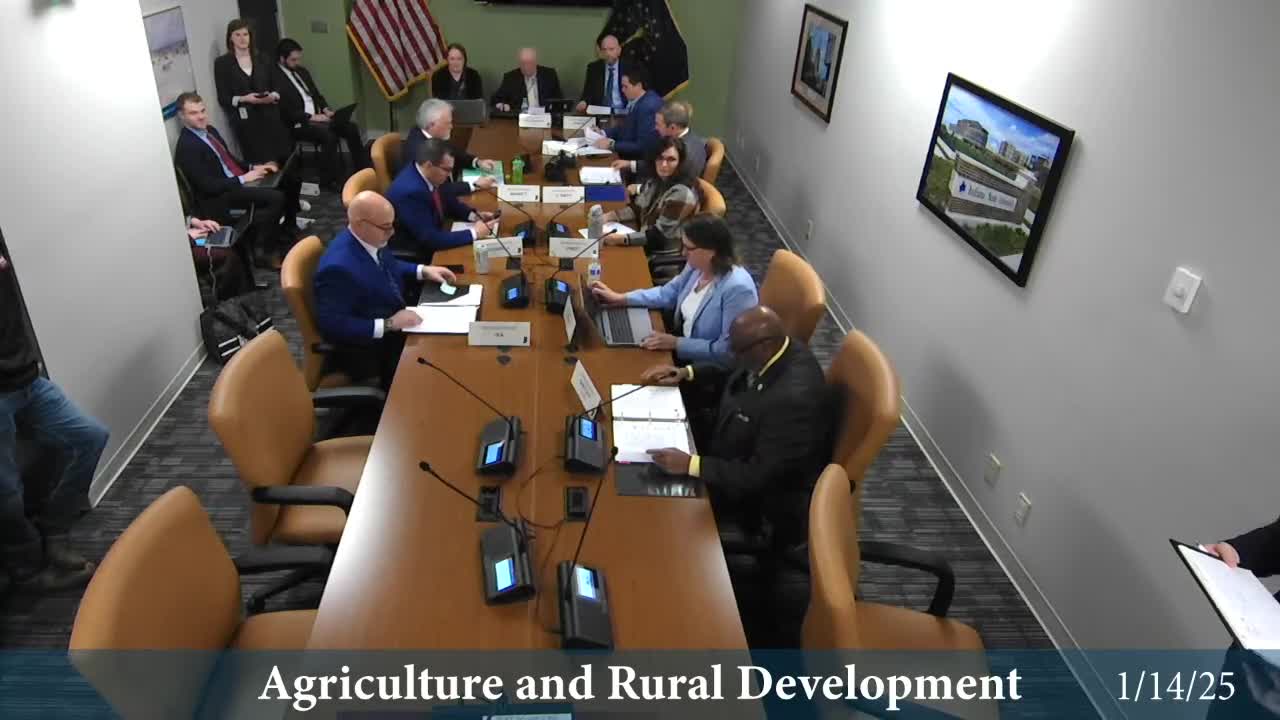
The Indiana House Agriculture Committee voted to pass House Bill 1234 as amended after testimony from farmers, conservation groups and state agriculture officials.
The Indiana House Agriculture Committee voted to pass House Bill 1234 as amended after testimony from farmers, conservation groups and state agriculture officials.
House Bill 1234 would create an agricultural land protection program to accept donated or bequeathed conservation easements on farmland, allow the Indiana State Department of Agriculture (ISDA) to hold easements, and authorize counties to establish their own farmland protection programs. The bill does not include a state appropriation to purchase easements; authors and witnesses said the measure is intended to make willing landowners eligible to seek federal and private matching funds.
Representative Culp, the bill’s sponsor, said the measure responds to an inventory of lost farmland and would “give farmers and landowners the option to protect their land for future generations.” He described the bill as a voluntary framework rather than a state purchase program and noted that other states use matching funds to leverage federal dollars.
Chris Reynolds, Midwest regional director for American Farmland Trust, told the committee the bill would bring Indiana into alignment with other states that use conservation easements to limit nonagricultural development and to make properties eligible for federal programs. “House Bill 1234 lays the vital groundwork to give farmers and landowners the option to protect their land for future generations,” Reynolds said.
Caitlin Smith, representing the Indiana Farm Bureau, said the bill provides an additional tool for estate and succession planning and stressed that participation would be voluntary. “This language allows a farmer to voluntarily opt into an easement and gives insurance to that farmer that the land will continue to be utilized for production,” she said.
Quentin Hayes, legislative director for the Indiana State Department of Agriculture, said ISDA could implement and administer the program but would need additional staffing and resources to do so. “If House Bill 1234 were enacted, ISDA would be responsible for implementing the conservation easement program in coordination with the newly created protection board,” Hayes said, adding the department could assist counties acquiring their own easements if provided resources.
Testifying as a farmer, David Harden said the program would help multigenerational farms with estate planning by providing an option that preserves agricultural use and lowers price pressure that accompanies development. Toby Day of the Hoosier Environmental Council described how easements can lower the purchase price for beginning farmers by “selling” development rights while the owner retains possession and farming use.
Supporters cited ISDA’s inventory of lost farmland, released in July 2023, which showed roughly 345,000 acres lost statewide between 2010 and 2022 — about 29,000 acres per year — as the evidence driving the measure. Witnesses and the sponsor emphasized the bill’s voluntary nature and its intent to leverage federal farm bill and IRA funding and private philanthropic dollars. They also described standard appraisal practice: valuing property both for agricultural use and for commercial development and calculating the easement value as the difference.
Committee members asked whether ISDA could operate the program without an appropriation; Hayes and the sponsor said the bill does not include state funding and that land trusts could serve as an alternative holder of easements. Representative Bartlett and others pressed on the composition of the proposed oversight board; the sponsor said he was open to amendments addressing political balance.
The committee recorded multiple members voting in favor of moving the bill forward; several members announced they would vote against the measure, citing outstanding questions. The motion on the floor was “move to pass as amended.” The roll call included recorded affirmative votes from Chairman Knoesworth, Representative Green, Representative Barrett, Representative Smith and Representative Baird, among others; at least two members announced they would vote no. The committee’s recorded tally in the transcript lists named affirmative responses from six members and at least two members stating they would vote no.
The bill now moves toward second reading in the House, where members said additional technical amendments — including board composition language and implementation details — may be offered.
Ending: Supporters said the program would be a voluntary, low-cost way to allow landowners to protect farmland and to leverage federal and private dollars; staff and ISDA testified implementation would require additional resources and technical work before the program could operate at scale.