Get Full Government Meeting Transcripts, Videos, & Alerts Forever!
Get email alerts on the Agriculture Conservation topic
No spam. Unsubscribe anytime.
House committee advances bill to let owners donate agricultural conservation easements
Summary
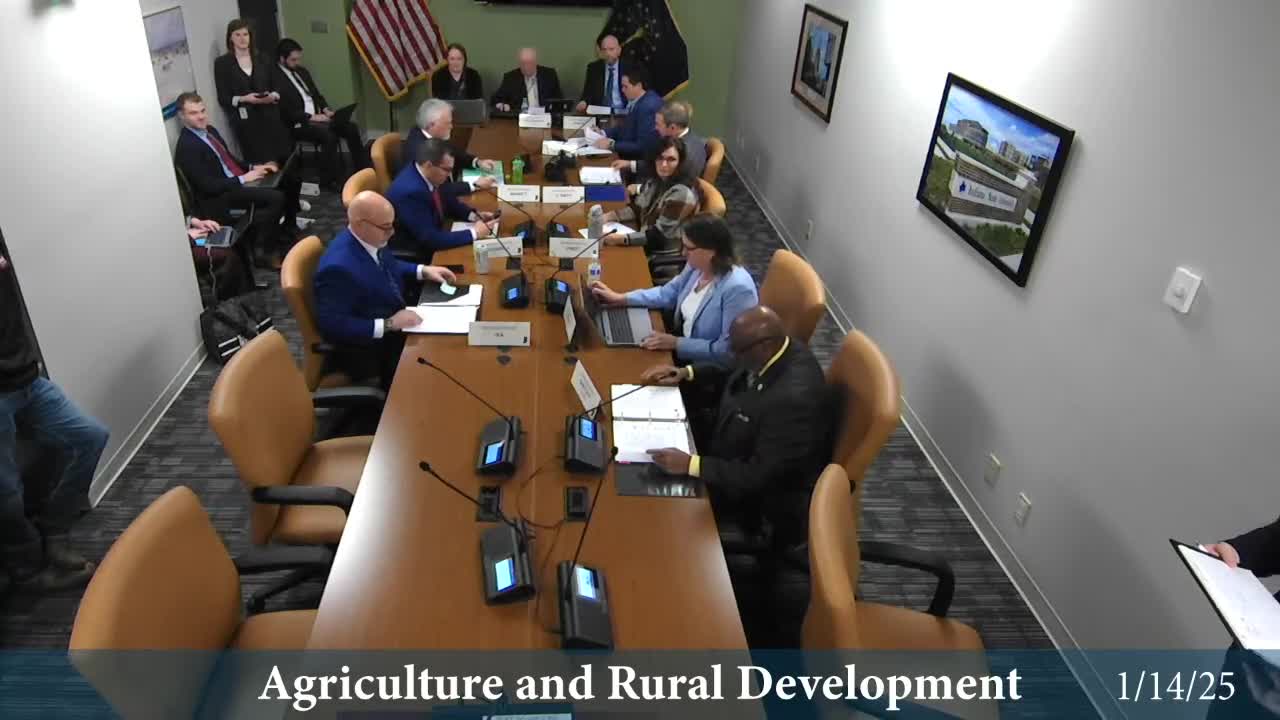
A House Agriculture Committee hearing moved House Bill 1234 forward after proponents said the bill would create a voluntary statewide framework for farmland owners to donate or bequeath conservation easements and qualify for federal matching funds; the bill does not appropriate state money.
Representative Culp introduced House Bill 1234 to the House Agriculture Committee to create a framework allowing willing farmland owners to donate or bequeath agricultural conservation easements to protect farms for future agricultural use.
The bill would authorize the Indiana State Department of Agriculture (ISDA) to accept and hold donated easements and would allow counties to establish their own local programs. "This bill creates a framework for willing farmland owners to donate their conservation easements, if they choose to protect their farms for future generations to utilize to grow food," Representative Culp said in his introduction. The bill, as introduced, requests no state appropriation to purchase easements.
The nut graf: supporters told the committee HB1234 would make Indiana eligible to leverage federal and private funding to preserve farmland amid documented statewide loss. "House Bill 1234 lays the vital groundwork to give farmers and landowners the option to protect their land for future generations," said Chris Reynolds, Midwest regional director for American Farmland Trust, who testified in support and cited the 2023 ISDA inventory that found roughly 345,000 acres of farmland lost between 2010 and 2022.
Supporters described program mechanics and potential funding pathways. Reynolds and other witnesses said appraisers would value land as farmland and also value it at highest-and-best-use for development; the difference would be the conservation easement value. They said a new Ag Conservation Easement Fund could combine state, federal, local and philanthropic dollars and make owners eligible for federal programs administered by USDA and the Natural Resources Conservation Service. "This bill does not give the state control over private land. It simply provides landowners with the tools to protect their land if they believe it is the right option for them," Reynolds testified.
Quentin Hayes, legislative director for ISDA, testified the department could implement the program but would need additional staffing and resources if the legislature did not appropriate funds. "If House Bill 1234 were enacted, ISDA would be responsible for implementing the conservation easement program in coordination with the newly created protection board," Hayes told the committee and said the agency could assist counties in acquiring easements.
Other witnesses included representatives of the Indiana Farm Bureau, the Hoosier Environmental Council and farmers who described estate-planning and succession benefits to families. "This bill could help Hoosier farmers stay on their land and stay productive," said David Harden, a sixth-generation farmer who testified in support.
Committee members discussed board composition and potential political balance for appointments. The bill's author said he was open to amendments to address political balance on the proposed oversight board and that the legislation's immediate goal was to create the framework rather than secure funding.
The committee moved to pass the bill as amended; members recorded a majority of affirmative votes during the roll call, with several members announcing they would vote no and offering explanations on the record. The transcript shows multiple committee members saying "yes" or "aye" during the roll call and at least two members announcing "no" votes with brief explanations.
Ending: The committee advanced HB1234 to the next stage with the understanding that staffing, board composition and technical language could be modified in later amendments. Proponents said the framework would allow landowners to access federal matching funds, while opponents pressed for clearer detail on oversight and the need (or not) for a state appropriation.