Get Full Government Meeting Transcripts, Videos, & Alerts Forever!
Get email alerts on the Farmland Protection topic
No spam. Unsubscribe anytime.
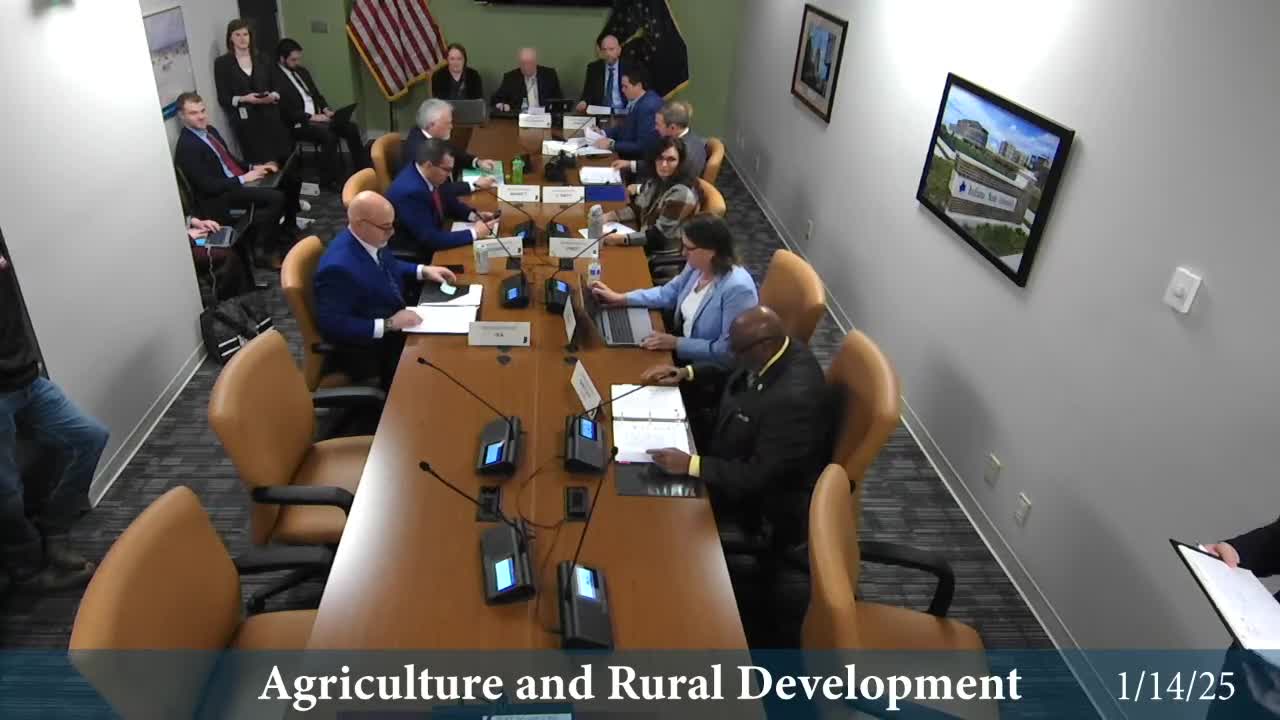
Committee backs framework for voluntary farmland conservation easements; program would not include state purchase funds
Summary
Representative Culp presented House Bill 1234 on behalf of landowners seeking a voluntary tool to protect farmland.
Representative Culp presented House Bill 1234 on behalf of landowners seeking a voluntary tool to protect farmland.
Representative Culp said, “This bill creates a framework for willing farmland owners to donate their conservation easements, if they choose to protect their farms for future generations to utilize to grow food.”
The bill would establish an agricultural conservation easement program in which landowners could donate or bequeath easements; the Indiana State Department of Agriculture (ISDA) would be authorized to accept and hold easements, and counties could set up their own local programs. The bill, as introduced, does not include a state appropriation to purchase easements.
Chris Reynolds, Midwest regional director for American Farmland Trust, told the committee HB 1234 “lays the vital groundwork to give farmers and landowners the option to protect their land for future generations” and said the bill would allow Indiana to access federal and philanthropic funds that are currently available for easement acquisition. Reynolds stated that about 18 million acres in Indiana are farmland and that an inventory found roughly 345,000 acres were lost between 2010 and 2022.
Quentin Hayes, legislative director for the Indiana State Department of Agriculture, said ISDA could implement and administer the program but would need additional staffing and resources if the legislature chose to fund that activity. “If House Bill 1234 were enacted, ISDA would be responsible for implementing the conservation easement program in coordination with the newly created protection board,” Hayes said, adding, “We are confident in being able to implement this program if we were provided additional staffing and resources.”
Testimony from producers and conservation advocates emphasized succession planning and affordability for beginning farmers. David Harden, a sixth-generation farmer from Hendricks County, said easements can help estate planning so a farm can remain in agricultural use even if not all heirs farm. Toby Day, sustainable agriculture director for the Hoosier Environmental Council, described easements as the sale of development rights that can lower the purchase price for beginning farmers and preserve agricultural use.
The committee also discussed how easements are valued: an appraiser estimates a parcel’s value for agricultural use and for commercial development; the difference is the value of the conservation easement. Supporters noted that states with matching programs have used state funds to leverage federal dollars; HB 1234 would make owners eligible to apply for federal programs but would not itself provide matching state purchase funds.
After questions and discussion, the committee voted to pass HB 1234 as amended in committee. Recorded votes included Chairman Knoesworth (aye), Representative Green (yes), Representative Barrett (yes), Representative Smith (yes), Representative Baird (aye) and Representative Criswell (yes); multiple other members recorded yes votes and two members recorded no votes. The motion to pass as amended carried in committee.
Supporters urged the committee to advance the bill to allow Indiana to join other states that use easements to stem farmland loss, while some members asked for future technical changes to the board makeup and potential language to ensure bipartisan representation on any oversight board.
Implementation will depend on legislative action on funding and any amendments made on second reading; ISDA and testimony witnesses emphasized federal funding opportunities through USDA programs and IRA-related resources could be leveraged if matching funds or administrative capacity were available.
The committee record shows robust testimony from conservation organizations, farm groups and producers, and the bill will move forward in the House process for further consideration.