Get Full Government Meeting Transcripts, Videos, & Alerts Forever!
Get email alerts on the Agriculture Farmland Conservation topic
No spam. Unsubscribe anytime.
Committee advances bill to let Hoosier landowners donate agricultural conservation easements
Summary
The Indiana House Agriculture Committee advanced House Bill 1234, which would create a voluntary framework allowing farmland owners to donate or bequeath conservation easements and permit the Indiana State Department of Agriculture or local land trusts to hold those easements; the bill does not include a state appropriation.
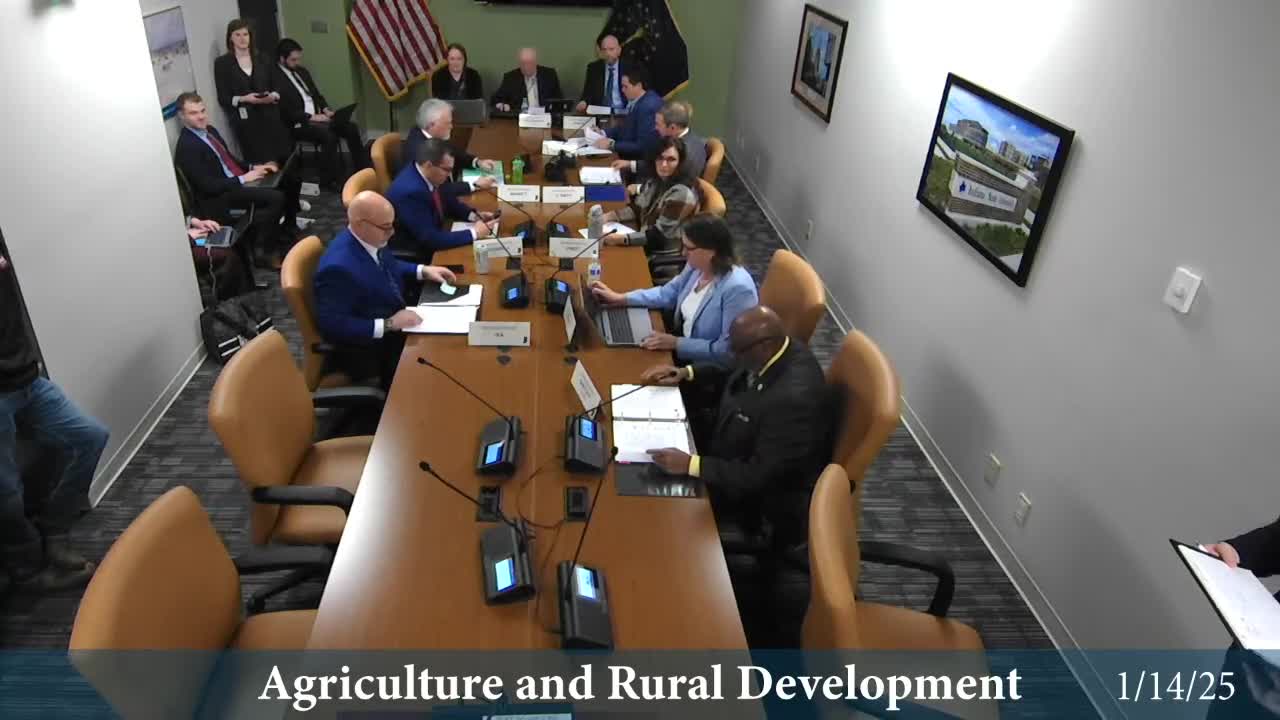
Representative Culp, the bill’s sponsor, told the House Agriculture Committee on May 20 that House Bill 1234 would create a framework for willing farmland owners to donate or bequeath conservation easements to protect farms for future agricultural use.
The bill creates an agricultural land protection program that would authorize the Indiana State Department of Agriculture (ISDA) to accept donations of conservation easements, allow counties to establish local programs, and make easement holders eligible to apply for federal matching funds. “There's no state funding associated with this. We're not asking for an appropriation to purchase those easements,” Representative Culp said.
Why it matters: Committee members were shown state data documenting rapid farmland loss. Quentin Hayes, legislative director for ISDA, and witnesses from American Farmland Trust, Indiana Farm Bureau and the Hoosier Environmental Council said the state inventory released in 2023 found roughly 345,000 acres of farmland lost between 2010 and 2022 — a figure witnesses described as about 29,000 acres a year. Chris Reynolds, Midwest regional director for American Farmland Trust, said the loss threatens Indiana’s capacity to produce commodity crops and that other states combine public and private funds to preserve farmland.
Supporters framed the bill as voluntary, a tool for estate planning and farmland succession. Caitlin Smith of the Indiana Farm Bureau said HB 1234 “gives a farmer the option to voluntarily opt into an easement and gives assurance that the land will continue to be utilized for production.” David Harden, a sixth‑generation farmer, said an easement could help families pass land to a next generation or provide value to nonfarming heirs.
ISDA’s Quentin Hayes described the department’s likely role if the program is enacted: receive and hold easements, coordinate with a protection board, and assist counties seeking easements. Hayes said ISDA could implement the program “if provided additional staffing and resources.” When asked how implementation would proceed without state funding, Hayes and Representative Culp pointed to alternatives such as established local land trusts that already hold easements.
Several witnesses summarized how easements work and the financial mechanics. Chris Reynolds described appraisals that value land both as farmland and for commercial development; the difference between those values is the easement value. Toby Day of the Hoosier Environmental Council said putting an easement on land reduces its market value by restricting development rights and can lower the purchase price for beginning farmers.
Committee action: A motion to pass HB 1234 as amended was made and the committee voted to advance the bill. Members who were called during the roll call and recorded affirmative responses included Chairman Knoesworth, Representative Green, Representative Barrett, Representative Smith, Representative Baird and Representative Criswell; at least two members announced they would vote no and spoke to their concerns on the record. Committee members indicated amendments on board composition and other technical details would be available in a forthcoming chairman’s amendment before second reading.
What’s next: Supporters said the bill is intended to make Indiana eligible for federal matching programs and to expand voluntary tools for farmland protection; opponents asked for clarifications about board makeup and staffing. Representative Culp and ISDA staff said technical and staffing questions would be addressed as the bill moves through the committee process.