Get Full Government Meeting Transcripts, Videos, & Alerts Forever!
Get email alerts on the Agriculture Farmland Protection topic
No spam. Unsubscribe anytime.
Committee hears bill to let landowners donate agricultural conservation easements
Summary
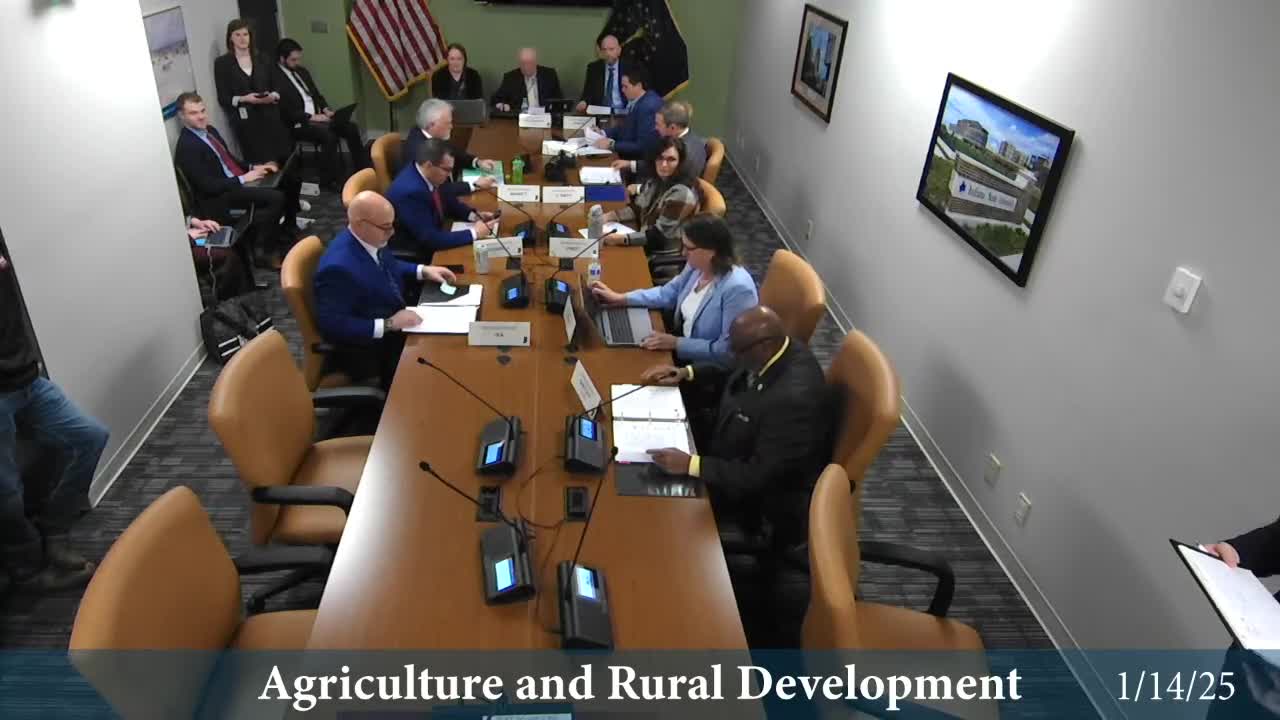
At a House Agriculture Committee hearing, lawmakers heard testimony on House Bill 1234, which would create a voluntary state framework allowing farmland owners to donate or bequeath agricultural conservation easements and permit the Indiana State Department of Agriculture or local land trusts to hold those easements.
At a House Agriculture Committee hearing, lawmakers heard testimony on House Bill 1234, which would create a voluntary state framework allowing farmland owners to donate or bequeath agricultural conservation easements and permit the Indiana State Department of Agriculture (ISDA) or local land trusts to hold those easements.
Supporters told the committee the proposal would give landowners another tool to preserve farmland threatened by development. "House Bill 1234 lays the vital groundwork to give farmers and landowners the option to protect their land for future generations," said Chris Reynolds, Midwest regional director for American Farmland Trust. He and other witnesses cited the state's recently released Inventory of Lost Farmland showing 345,000 acres lost between 2010 and 2022.
The bill would establish an agricultural conservation easement program and an Ag Conservation Easement Fund to leverage federal, local and philanthropic dollars; it does not request a state appropriation to purchase easements. "This bill does not give the state control over private land," Reynolds said. Caitlin Smith of the Indiana Farm Bureau told the committee the measure is voluntary and called preservation of productive acreage "food security is national security."
Quentin Hayes, legislative director for ISDA, said the agency would implement the program and assist counties if the bill becomes law but acknowledged that ISDA would need additional staffing and resources to accept and manage easements. "If House Bill 1234 were enacted, ISDA would be responsible for implementing the conservation easement program in coordination with the newly created protection board," Hayes said. He told the committee ISDA could carry out the work if provided necessary staffing and support.
Witnesses and stakeholders described how easements are valued: appraisers compare the land's agricultural value to its commercial or development value; the difference is the easement value. Supporters said federal programs administered by USDA and the Natural Resources Conservation Service, as well as Inflation Reduction Act funds, create opportunities for state matching programs. "Indiana needs some matching funds to take advantage of these unprecedented opportunities," Reynolds said.
Farmers who testified said easements can be used for succession planning and to keep land available and affordable for future farmers. "If one or more of my children want to come back, something like this . . . would be a useful tool for our estate planning," said David Harden, who identified himself as a sixth-generation farmer.
Opponents or skeptical committee members raised questions about board composition and the role of the director of ISDA on any appointed protection board. The bill's author and other members indicated they are open to technical changes and amendments as the measure moves through the process.
The committee discussion included examples of existing local land trusts such as the Benjamin Harrison Land Trust and noted that counties could create their own programs under the bill. Supporters said states with similar programs have leveraged substantial outside funding and that easements can reduce the market price of land by removing development rights, making farmland more affordable to beginning farmers.
Votes recorded later in the hearing show a motion to pass as amended carried in committee (see actions). The bill will proceed through the legislative process and could be amended further on second reading or in subsequent committee work.