Get Full Government Meeting Transcripts, Videos, & Alerts Forever!
Get email alerts on the Farmland Conservation Easements topic
No spam. Unsubscribe anytime.
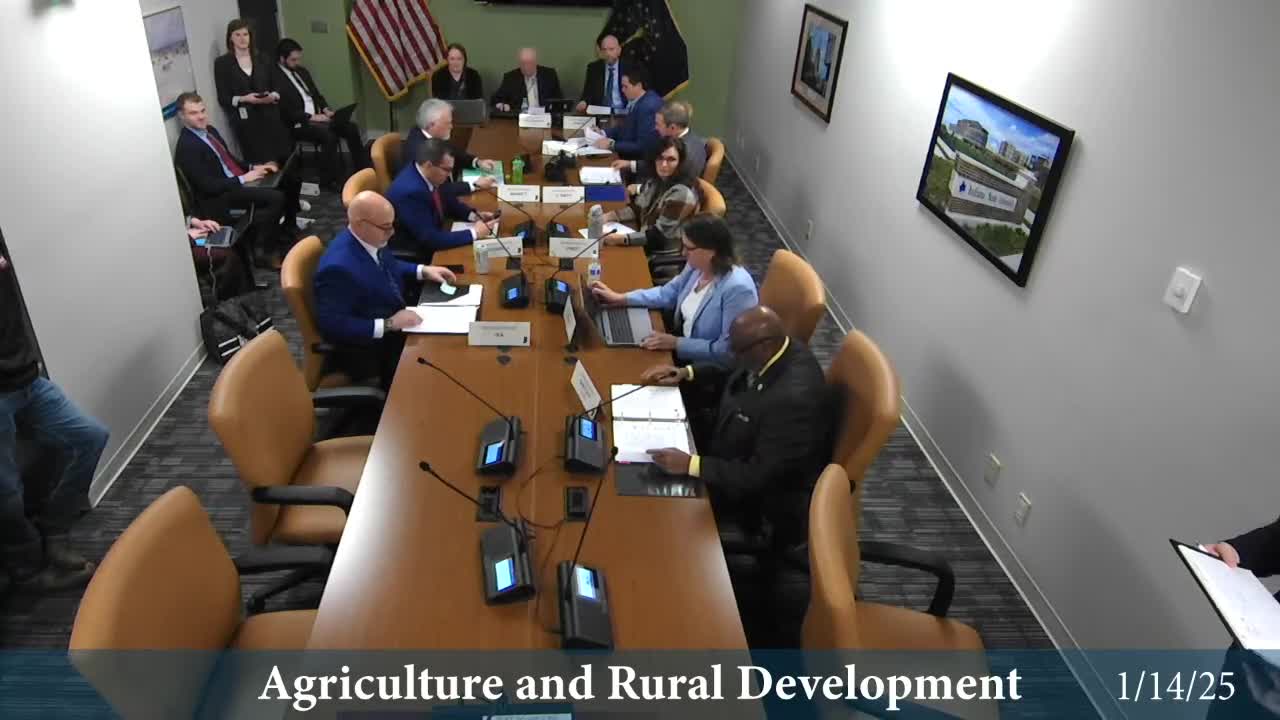
Committee advances farmland conservation easement program; homestead protection bill held for amendment
Summary
The House Agriculture and Rural Development Committee heard testimony for House Bill 1234 to create an agricultural conservation easement program and fund, and advanced the bill; House Bill 1265, which would codify the Hoosier Homestead program and add a remonstrance step in eminent-domain cases, was held for amendment and not voted on.
Representative Culp introduced House Bill 1234, which would create an agricultural land protection program and allow willing farmland owners to donate or convey conservation easements to the Indiana State Department of Agriculture or to qualified land trusts. "This bill creates a framework for willing farmland owners to donate their conservation easements, if they choose to protect their farms for future generations to utilize to grow food," Culp told the committee.
The committee heard support testimony from conservation and farm groups. Chris Reynolds, Midwest regional director for American Farmland Trust, said HB 1234 would allow Indiana to "accept, to purchase or accept donations of Ag conservation easements" and noted similar programs already operate in 29 other states. "This bill simply provides landowners with the tools to protect their land if they believe it is the right option for them," Reynolds said.
Caitlin Smith of the Indiana Farm Bureau urged the committee to adopt the bill, calling it "another tool in the toolbox to help preserve and permanently protect ag land utilized for crop and livestock production across the state." Quentin Hayes, legislative director for the Indiana State Department of Agriculture (ISDA), testified the department released an inventory in July 2023 showing roughly 345,000 acres lost between 2010 and 2022 and said ISDA could implement the program "if we were provided some additional staffing and resources." Hayes added the bill as drafted does not include a state appropriation.
Farmers and conservation advocates described how conservation easements reduce a parcel's development value but keep it available for production and succession planning. Farmer David Harden said an easement could help families preserve a farm for the next generation, and Toby Day of the Hoosier Environmental Council explained that "when you put a conservation easement on that land, you're pretty much selling off the development rights to that land. The land owner still retains possession of that land. They can still farm it… the conservation easement stays with it throughout the life of the parcel."
Representative Greene then presented House Bill 1265 to place the Hoosier Homestead program into statute and to allow a limited remonstrance process where a Hoosier Homestead-designated family could ask a local legislative body to review a fee-simple taking by eminent domain. Greene said the bill would "give Hoosier Homestead families a voice to push back against potential condemnation of their heritage farm" and noted the inventory of lost farmland when describing the bill's context.
ISDA testified neutral on HB 1265, describing the Hoosier Homestead Award program as ceremonial (instituted in 1976) and recommending technical statutory language, including application requirements and that tax payments be current. Several Hoosier families and county officials spoke in support of statutory recognition for the program as a measure to preserve agricultural heritage.
Committee action: The committee moved to pass HB 1234 as amended at the meeting; a roll call produced several recorded affirmative responses and some members expressed reservations on the record. The transcript records a motion to "pass as amended" and multiple affirmative votes, and committee members explained that some technical and membership concerns (for the implementing board) could be resolved on second reading. HB 1265 was not voted on; Representative Greene and ISDA staff agreed to technical changes and the bill was held until a future meeting so amendments can be drafted.
Why it matters: Committee members and witnesses framed the bills as next steps after ISDA's July 2023 inventory showing about 345,000 acres of lost farmland from 2010 to 2022—roughly 29,000 acres per year at that rate—and as tools to help preserve agricultural land, support succession planning and position Indiana to leverage federal conservation funding. Proponents said an Indiana easement program could make landowners eligible for federal purchase funds and private matching funds without requiring an immediate state appropriation.
Votes at a glance
- House Bill 1234 (agricultural conservation easement program): Motion to "pass as amended" moved and called; committee recorded multiple affirmative votes and the motion advanced. The bill includes a framework to accept donations or conveyances of conservation easements, authorizes the Indiana State Department of Agriculture to hold easements, and allows counties to establish local programs. The bill as presented does not include a required state appropriation; ISDA testified it would need staffing/resources to implement if the legislature does not appropriate funds.
- House Bill 1265 (Hoosier Homestead Farm statute and remonstrance): Held for amendment; no committee vote. The bill would codify the Hoosier Homestead Award program, require ISDA to maintain a registry, and create a limited local-review remonstrance for a fee-simple taking by eminent domain for qualifying homestead farms. ISDA testified neutrally and offered technical clarifications the author agreed to address.
Community and fiscal context
Witnesses described opportunities to leverage federal funding (USDA/NRCS, Farm Bill, IRA) and private/philanthropic dollars to buy easements if a state matching or facilitating program exists. Testimony repeatedly emphasized that the bill creates a framework rather than a funded program: "we're not asking for an appropriation to purchase those easements," the bill's author said. Proponents cited national and state data, including testimony that Indiana has about 18,000,000 acres of farmland and that 73% is productive, versatile and resilient farmland; they also cited American Farmland Trust research projecting possible future losses without action.
Outlook
Committee members signaled willingness to adopt technical changes on board membership and administrative details during the bill process. HB 1234 will proceed with the committee recommendation to second reading with amendments to be finalized; HB 1265 will be revised and returned for future consideration.