Get Full Government Meeting Transcripts, Videos, & Alerts Forever!
Get email alerts on the Agriculture And Rural Development topic
No spam. Unsubscribe anytime.
House committee advances bill letting landowners donate farmland conservation easements
Summary
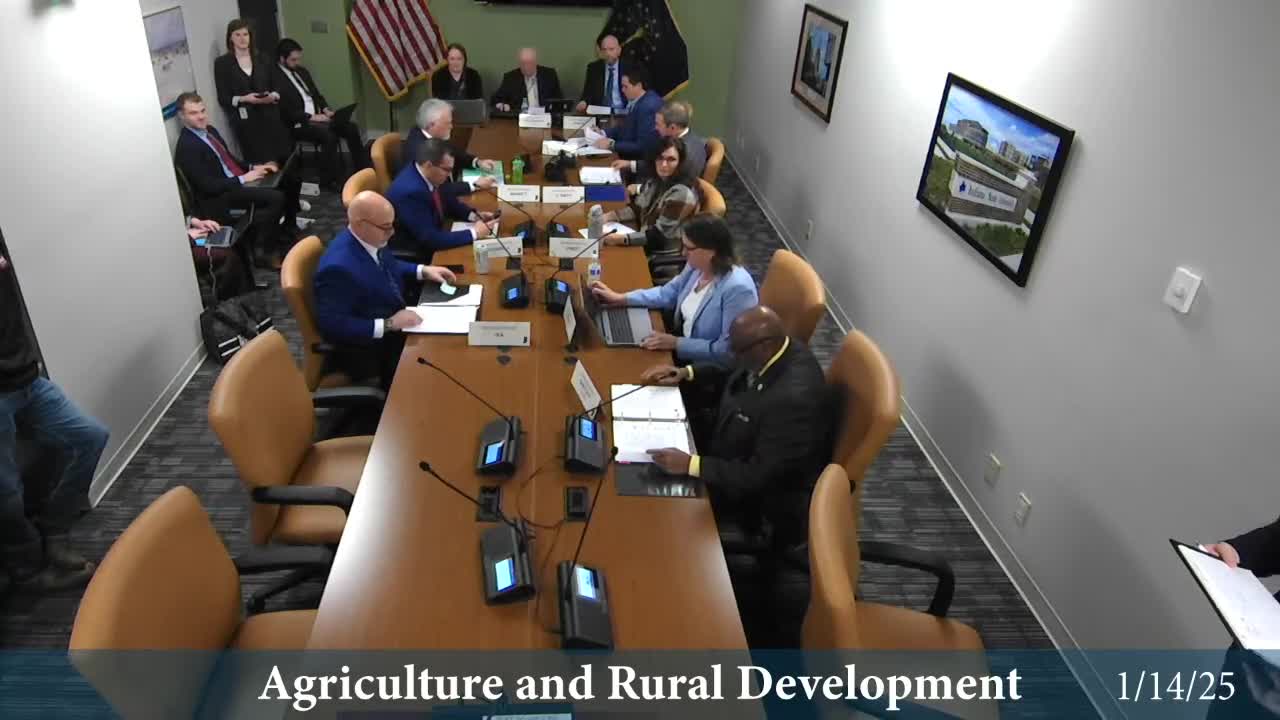
Representative Culp introduced House Bill 1234 to the Indiana House Agriculture and Rural Development Committee, saying the bill "creates a framework for willing farmland owners to donate their conservation easements" to protect farms for future generations.
Representative Culp introduced House Bill 1234 to the Indiana House Agriculture and Rural Development Committee, saying the bill "creates a framework for willing farmland owners to donate their conservation easements" to protect farms for future generations.
The bill would establish an agricultural land protection program and an Ag Conservation Easement Fund to allow landowners to donate or bequeath conservation easements. Representative Culp said the proposal requests no state appropriation and would instead create eligibility for landowners to apply for federal matching funds for easement purchases.
The proposal drew broad support from conservation and agricultural groups. Chris Reynolds, Midwest regional director for American Farmland Trust, told the committee HB 1234 "lays the vital groundwork to give farmers and landowners the option to protect their land for future generations." He and other presenters cited the 2023 ISDA inventory of lost farmland showing roughly 345,000 acres lost from 2010 to 2022; one witness later cited that inventory at 345,682 acres. Reynolds said similar state programs have helped leverage federal and private funds to preserve farmland and warned that continued loss could make land less affordable for the next generation of farmers.
Caitlin Smith, representing the Indiana Farm Bureau, said the bill "gives a nod to" the idea that "food security is national security" and described the measure as a voluntary tool that allows a farmer to opt into an easement while retaining ownership and equity.
Quentin Hayes, legislative director at the Indiana State Department of Agriculture (ISDA), described the department's role under the bill. "If House Bill 1234 were enacted, ISDA would be responsible for implementing the conservation easement program in coordination with the newly created protection board," Hayes said, and added ISDA could implement the program if provided additional staffing and resources.
Testimony described how conservation easements are valued: an appraiser places a value on a property for continuing farmland use and a separate value for commercial development; the difference is the easement value. Toby Day, sustainable agriculture director for the Hoosier Environmental Council, described easements as "selling off the development rights to that land" while preserving agricultural use, and said easements can lower purchase prices for beginning farmers by reducing development value.
Farmers who testified said the measure would help with intergenerational succession and estate planning. David Harden, a sixth-generation farmer, told the committee that an easement could let a family keep land in agricultural use while providing value to nonfarming heirs.
Representative Culp and witnesses cited federal opportunities—USDA programs and funding created by recent federal legislation—that states can use to leverage easement purchases, and several presenters noted that other states match federal funds. Witnesses also said counties or private land trusts could hold easements if landowners prefer not to use the state program.
The committee approved a motion to pass House Bill 1234 as amended and sent the measure to second reading. Committee members voted in favor; recorded yes votes in the transcript include Chairman Aylesworth, Representative Green, Representative Barrett, Representative Smith, Representative Baird and Representative Criswell; the transcript also records multiple additional yes votes and two recorded no votes during the roll call. The legislation will continue through the House process and could be amended further on second reading.
Background: witnesses cited the ISDA inventory of lost farmland (2010–2022) and pointed to research from American Farmland Trust showing that state easement programs have leveraged federal and private investment in other states. Proponents emphasized that the bill is voluntary, does not itself appropriate state funds, and is designed to make landowners eligible for outside matching dollars if programs are funded elsewhere.
Next steps: the committee advanced the bill; timing and any fiscal decisions will depend on amendments and subsequent House action.