Get Full Government Meeting Transcripts, Videos, & Alerts Forever!
Get email alerts on the Housing topic
No spam. Unsubscribe anytime.
Planning Commission recommends ADU ordinance changes to align with new state law
Summary
The commission recommended a zoning code amendment to align Lake Forest's accessory dwelling unit (ADU) rules with AB 2533 and SB 1211, clarifying legalization of certain unpermitted units and parking requirements for ADU conversions.
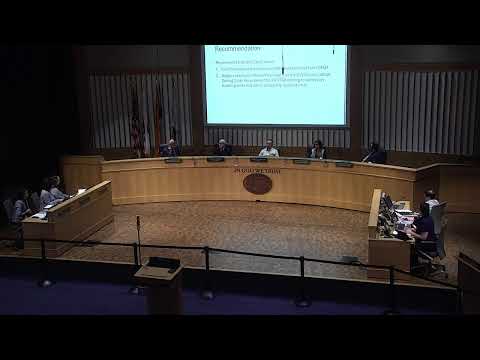
The Lake Forest City Planning Commission on Jan. 9, 2025, recommended that the City Council adopt a zoning-code amendment updating local rules for accessory dwelling units (ADUs) and junior ADUs to conform with recent state legislation.
Staff member Amy Stoneich presented the non-urgency ordinance and noted the City Council already adopted an urgency ordinance aligning the city's regulations with the state changes effective Jan. 1, 2025, while the non-urgency ordinance proceeds through the public hearing process. Stoneich identified the state bills by name and said they provide updates to ADU regulations: AB 2533 and SB 1211. She explained one of the new provisions prevents cities from denying legalization permits for unpermitted ADUs or junior ADUs constructed before Jan. 1, 2020, provided the units meet health-and-safety standards. Stoneich also summarized changes relating to replacement parking and multifamily ADU conversions.
"On an existing multifamily dwelling, [the law] permits up to eight detached ADUs or as many as there are primary dwelling units on the lot, whichever is less," Stoneich said. She said the new state rules prohibit cities from requiring replacement of off-street parking spaces when a carport, garage or covered parking is demolished or converted for an ADU; this prohibition now extends to uncovered parking spaces as well for multifamily dwellings. Stoneich told the commission the proposed local ordinance keeps some limited local standards previously adopted by the city where state law permits it, such as separate utility connections in some cases, and that the ordinance is statutorily exempt from CEQA.
Commission discussion included a question about enforcement and legalization of older, unpermitted ADUs: a commissioner asked what evidence is required to show the construction date for a unit seeking legalization. Stoneich said the process requires an application for a permit and an inspection; building inspectors must determine whether a unit meets current building-code standards before the city can legalize it. The transcript records an expression of strong disagreement with the state's parking provisions from an unnamed commissioner, but that comment was not attributed to a specific commissioner in the record.
Following discussion, a commissioner moved to recommend the ordinance and the commission voted to forward the zoning-code amendment and a CEQA exemption finding to the City Council. The motion passed unanimously.
The commission's recommendation now goes to the City Council for final adoption. The staff report and ordinance text will be part of that council hearing; the commission did not specify a council hearing date in its action.