
St. Mary's County holds public hearing on code changes for property remediation, civil penalties and ethics disclosures
Get AI-powered insights, summaries, and transcripts
Subscribe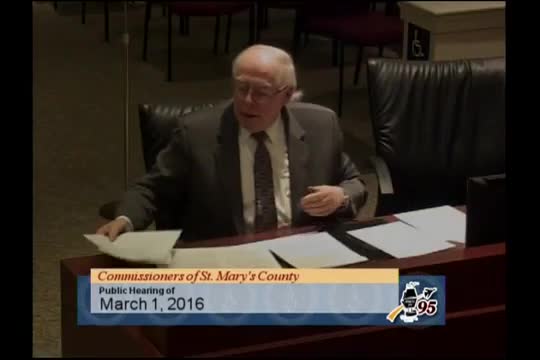
Summary
St. Mary's County commissioners held a public hearing in which County Attorney George Sprawley outlined three proposed amendments to the county code: (1) authority for voluntary property maintenance remediation agreements reimbursed through amortized property tax payments, (2) consolidation of scattered civil-infraction penalty provisions into a single civil-infraction framework, and (3) narrower financial-disclosure and conflict-of-interest rules for many volunteer boards.
St. Mary's County commissioners held a public hearing in which County Attorney George Sprawley outlined three proposed amendments to the county code: (1) authority for voluntary property maintenance remediation agreements reimbursed through amortized property tax payments, (2) consolidation of scattered civil-infraction penalty provisions into a single civil-infraction framework, and (3) narrower financial-disclosure and conflict-of-interest rules for many volunteer boards. No members of the public spoke at the hearing, and no final votes were taken.
Sprawley said the first proposal would allow — but not require — the county to contract with a willing property owner to perform maintenance or remediation work and recover costs through an amortized addition to property taxes. "Such an agreement on the part of the property owner would be purely voluntary. There's no compulsion involved," Sprawley said, adding that the Department of Land Use and Growth Management would typically handle investigations and negotiations on these cases.
The second proposal would repeal multiple, scattered penalty provisions in the county code and replace them with a single penalty structure that follows state processing of civil infractions. Sprawley recommended using civil infractions rather than misdemeanor charges and noted that "a civil infraction under state law is punishable by a fine not to exceed $1,000." He also provided historical enforcement data for context: the county's code enforcement division issued 64 citations in 2015, 27 of which went to court, and land-use staff issued 25 citations, seven of which proceeded to court.
On the ethics and disclosure changes, Sprawley described research showing that volunteer advisory boards generally are not required to file financial-disclosure statements unless a conflict of interest appears. He recommended exempting many strictly advisory volunteer boards from routine filing while retaining filing requirements for "legal authority" boards such as the Planning Commission and Board of Appeals. Sprawley also proposed adding a sentence to the ethics ordinance to address so-called triangular relationships — situations in which an official does not directly hold a financial interest in an applicant but might share a business relationship with the applicant that could confer a financial benefit. He said the added language should focus on circumstances "where the applicant can confer a financial benefit on the official or employee." Sprawley said he discussed draft language with a letter-writer, identified in the record as Mr. Mitchell, and referenced a July 6 letter from the St. Mary's County Ethics Commission included in commissioners' materials.
Commissioners questioned and discussed the proposal during the hearing. Some commissioners urged caution about expanding disclosure requirements, saying broad language could discourage volunteers and lead to unnecessary inquiries; others said a narrowed clarification would provide helpful guidance. No formal action or vote occurred; commissioners and staff indicated the language could be narrowed further and returned for future consideration.
The board announced a 10-day public-comment period following the hearing. The announcement listed a postal address (Commissioners of St. Mary's County, P.O. Box 653, Leonardtown, MD 20650) and the email address shown in the record. The public hearing was then closed.
What's next: Staff will refine the proposed ethics language in light of comments and the submitted letter(s), and the commissioners will consider revised ordinance language at a future meeting where formal votes would be scheduled.