Board hears equity initiative update and student discipline report; public commenters clash over equity language
Summary
The Nevada Joint Union High School District board on Jan. 15 received an update on the district’s equity initiative and a separate student-discipline report that district leaders said are linked to improving school safety and culture.
The Nevada Joint Union High School District board on Jan. 15 received an update on the district’s equity initiative and a separate student-discipline report that district leaders said are linked to improving school safety and culture.
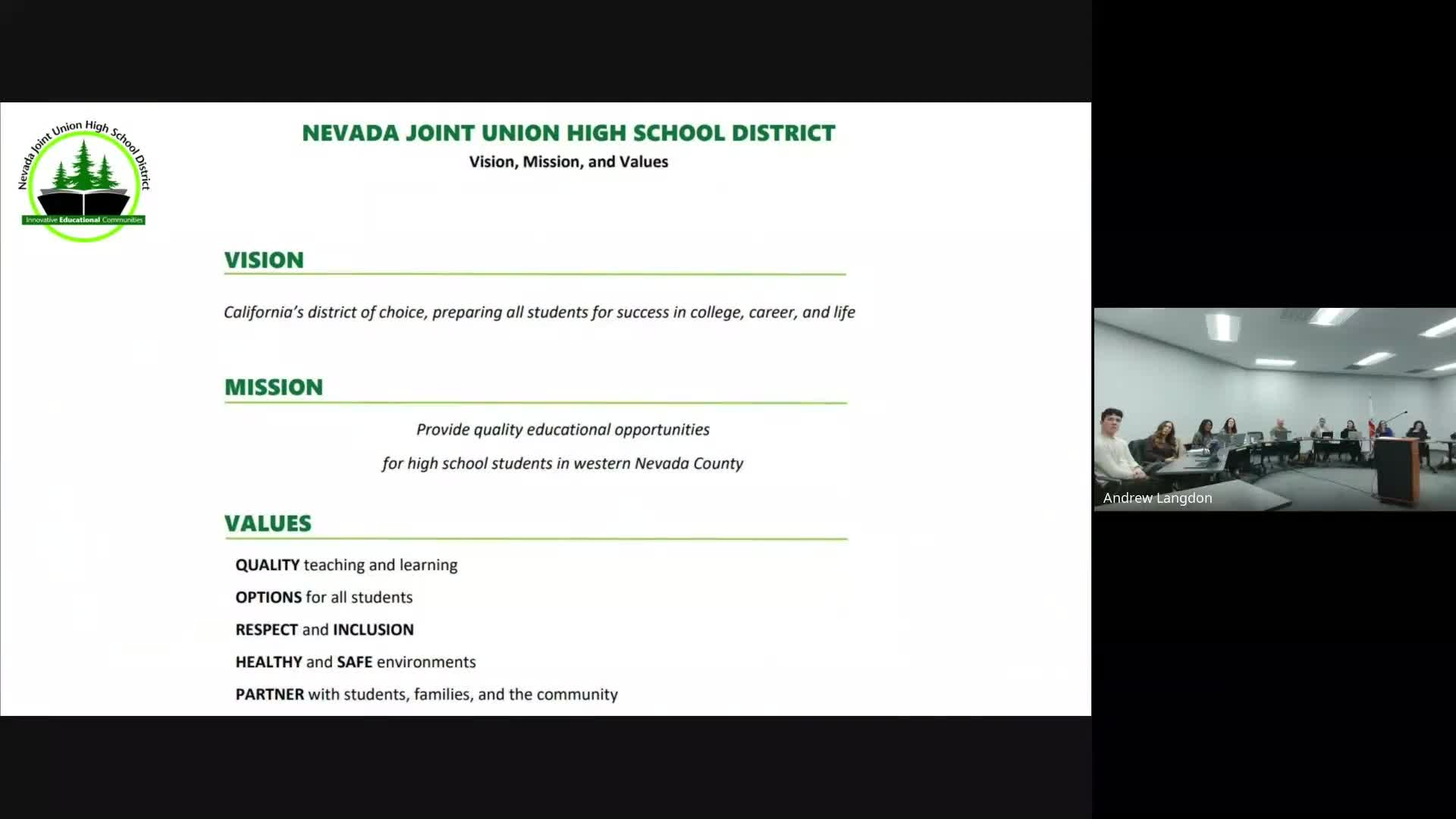
Superintendent Andrew Frisella reviewed the district’s strategic goals and described actions under the equity initiative, including management and union leadership training, ethnic-studies training for social science teachers, a land‑acknowledgment policy, a student mural competition and “Healthy Schools” outreach. Frisella said district leaders changed training delivery from several virtual half-days to multiple in‑person sessions after managers reported some material did not land well remotely. He said the training emphasizes technical vs. adaptive leadership, emotional intelligence and a shared language to handle sensitive campus incidents.
Assistant Superintendent Aurora Thompson presented 2023–24 discipline and expulsion statistics. Thompson said suspensions rose after 2021–22; violent incidents (no injury) accounted for the largest share of suspensions districtwide last year, followed by drug-related incidents. She said Silver Springs had the highest suspension and expulsion rates and Bear River’s incidents were more often drug-related. Thompson noted data-quality issues in past reporting — including duplicate records — and said staff has corrected errors and improved vetting of the information before state submission.
Thompson summarized changes to district practices: the discipline matrix was revised to remove “disruption/defiance” as a suspension reason in line with Education Code changes; staff calibrated discipline and expulsion packet procedures across sites to reduce inconsistent outcomes; and the RAISE restorative program at Silver Springs (student‑led restorative circles) was presented as an alternative to suspension for eligible students. Thompson said the district is prioritizing improved documentation of interventions and consistent processes so decisions are defensible and equitable.
Public comment reflected sharp differences of opinion about equity work. Student Thomas Gruber described recent racially charged incidents at Nevada Union — he urged the new board to prioritize student safety and to preserve anti‑racism and nondiscrimination policies. Several long‑time community speakers — Nancy Mitchell (retired teacher), Judy Wood and others — criticized the district’s use of the word “equity,” saying it emphasizes group outcomes rather than individual opportunity; they asked trustees to focus on reading and math interventions and academic results. Judy Wood cited Board Policy 0415 and asked why the district collects race and ethnicity data rather than focusing on individual students who need reading help. Trustees did not take action on policy changes at the meeting; Frisella reiterated the district’s stated intent that policy language focuses on access and removing barriers so students can reach their highest potential.
Board discussion and staff responses Trustees pressed for more data and clarification. Trustee Clark asked whether suspension definitions differ by district and Thompson said districts vary and that some peers already prioritize interventions rather than suspension; she pointed to the change in Education Code that removed disruption/defiance as a suspension cause as a factor in cross‑district comparison. Several trustees commended the student presenters from Silver Springs and emphasized the need to pair equity work with measurable academic supports.
No formal board action was taken on policy at the meeting; trustees received the reports and directed continued work on training, discipline calibration and data quality.
Why it matters: The equity initiative and discipline data tie to school safety, student wellbeing and state monitoring. Thompson noted the state tracks discipline by special populations and said disparities can trigger differentiated assistance. Public commenters demanded more emphasis on basic literacy and math remediation, while students asked the board to protect programs that support marginalized students.
Ending: Trustees asked staff to return with continued progress updates, written materials clarifying the equity initiative, and documentation of discipline‑matrix changes and the RAISE program’s role in alternatives to suspension.