Get Full Government Meeting Transcripts, Videos, & Alerts Forever!
Get email alerts on the Enrollment topic
No spam. Unsubscribe anytime.
Lewisburg Area SD reports stable enrollment, flags rising cyber‑charter costs and staffing priorities
Summary
The Lewisburg Area School District received its annual enrollment and staffing projection during the board meeting, where administrators reported stable in‑district enrollment but rising charges for students attending cyber charter schools.
The Lewisburg Area School District received its annual enrollment and staffing projection during the board meeting, where administrators reported stable in‑district enrollment but rising charges for students attending cyber charter schools.
In the presentation, Ben (administrator) told the board the district educates about 87.7% of students who live inside its boundaries and that eSchool enrollment, which peaked during the pandemic, has declined to 16 students this year. He added that out‑of‑district placements have also fallen in recent years.
Ben said the district is required to submit Dec. 1 enrollments to the Pennsylvania Department of Education (PDE) and also tracks monthly enrollment for internal planning. "Our in school enrollment has been relatively stable across time," he said, adding that the district uses both local counts and PDE projections when planning staffing and budgets.
Nut graf: The presentation underscored that while student counts are steady, the district faces a substantial and variable charge from the state for students who attend cyber charter schools: those charges are deducted from the district's basic education subsidy and do not come into district coffers.
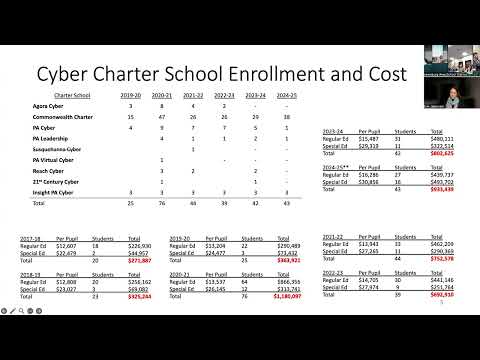
Ben reviewed cyber charter figures on a slide showing per‑pupil state charge rates and multiyear counts. He noted two statewide per‑pupil rates shown on the chart — "12,607" for the regular rate and "22,479" for the special‑education component — and explained the state sets those amounts by formula. Ben told the board the district paid more than $800,000 for cyber charter costs in the most recent full year shown on the slide and said the current school‑year total could "be better than $933,439," a projection he described as subject to fluctuation as final enrollments settle.
Kyle (staff member) explained how the rates are calculated: the regular rate is selected expenditures divided by average daily membership and the special‑education portion is calculated separately and added to the regular rate. Ben and Kyle emphasized the charge is set by the state and is deducted from the district's basic education subsidy.
The presentation also noted a trend of students taking early college through Commonwealth University, which reduced high‑school headcounts by 41 students last year and 50 students this year. Ben said that reduction can affect course enrollments and elective sequences.
On staffing, Ben reviewed district personnel counts across buildings and said the district has added some positions to meet program needs. He said the district now has two speech therapists on staff after previously contracting for that service, shares related‑arts teachers across buildings, and contracts for school‑psychologist evaluations when needed. He identified several positions for board consideration in upcoming budgeting and staffing conversations, including a board‑certified behavior analyst (BCBA), a middle‑school assistant principal, and a literacy coach, and reminded the board that salary and benefits are the largest operating cost.
Clarifying details from the presentation included an approximately 87.7% in‑district residency rate, 16 students in the district eSchool, state per‑pupil charge figures displayed at 12,607 and 22,479, and the slide projection that cyber‑charter charges for the current year could approach $933,439. Ben noted PDE projections generally aligned closely with the district's actuals but cautioned such projections are subject to change due to family choices, retention/acceleration, and housing availability.
The presentation concluded with an invitation to board members to review the materials and to continue discussion as budgeting and staffing decisions move forward.