Get Full Government Meeting Transcripts, Videos, & Alerts Forever!
Get email alerts on the Udo Landscaping Buffers topic
No spam. Unsubscribe anytime.
Council committee weighs major changes to landscaping, buffers and admin authority in draft UDO
Summary
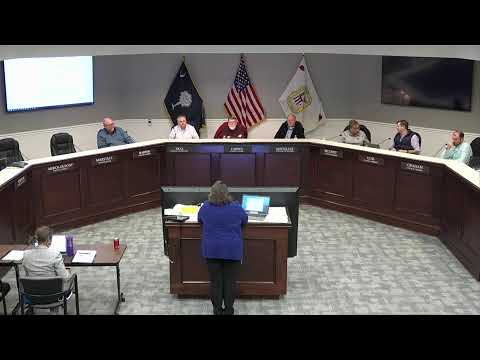
Allison Harden, a county planning staff member, presented proposed changes to chapters 4 and 8 of Lancaster County’s draft Unified Development Ordinance, outlining new landscaping, buffer and screening standards and raising questions about administrative discretion, buffer dimensions and impacts on small redevelopment projects.
Allison Harden, a county planning staff member, presented proposed changes to chapters 4 and 8 of Lancaster County’s draft Unified Development Ordinance (UDO) in a Committee of the Whole meeting, walking the council through landscaping applicability, buffer types, phased compliance thresholds and proposed administrative discretion.
The presentation and discussion focused on where landscaping and screening rules would apply, how buffers would be sized and planted, exceptions for single-family lots and railroad rights-of-way, and how the UDO would tie certain requirements to other regulatory programs such as stormwater and FEMA substantial‑damage rules. Harden said the chapter “clarifies and generally expands the number of landscaping and screening requirements” and that the new rules aim to preserve tree canopy and protect the county’s rural character.
Why it matters: the landscaping and buffer rules determine what new and changing development must plant or build along property lines and rights-of-way; they affect the appearance of highway corridors, the viability of small redevelopment projects and the safety and maintenance of stormwater and utility corridors.
Most of the debate centered on three areas: (1) where and when landscaping rules apply, (2) the technical specifications for buffer types and berms, and (3) how much discretion the UDO gives to an “administrator” to require additional measures.
Applicability and phased compliance Harden said the draft makes landscaping rules depend on zoning district and the extent of proposed changes. Single-family detached and duplex lots outside larger developments would remain exempt. For phased compliance, the draft proposes that parking and building expansions under a 50% threshold would require landscaping only for the new area, while expansions of 50% or more would trigger full-site compliance. Harden tied the 50% threshold to FEMA substantial‑damage rules, saying: “In addition it's tied to the FEMA regulations and if you're 50% or more damaged then you have to bring the entire property in the building code as well.”
Buffer types and numeric standards The draft defines three buffer types with explicit minimum dimensions and planting counts. Harden summarized the standards, for example: type A buffers require a minimum depth of 10 feet and a planting mix including canopy and understory trees and shrubs; type B offers two options (a wider 20‑foot planting option or a shorter 10‑foot option with denser plantings); and type C requires the densest, year‑round screen with minimum depths ranging from about 30 to 40 feet depending on the planting mix and with wall or berm options. She also listed berm and fence specifications: a berm minimum crown width of 8 feet and minimum height 3 feet (maximum 6 feet), and slope limits (no steeper than 3:1 for berms 4 feet or less, and 4:1 for taller berms). For evergreen shrub screens Harden read the planting standard aloud: shrubs must be at least 36 inches tall with 24 inches spread at planting and spaced no more than 5 feet on center.
Exemptions and special cases Harden said the draft keeps exemptions for single‑lot homes and certain minor/family subdivisions (section 103) and exempts parcels directly adjacent to railroad rights‑of‑way from buffer requirements at the railroad boundary. She also said stormwater basins and ground‑mounted mechanical equipment would be required to be screened from public rights‑of‑way in many cases.
Administrator discretion and appeals A recurrent issue was language that permits additional plantings or best management practices (BMPs) “as determined by the administrator.” Council member Mr. Harper said he objected to open‑ended authority, arguing it creates a “moving target.” Harden responded by explaining the county’s use of the term administrator and how the role is implemented: “The administrator title is a multiple person title. In this zoning code and in the previous zoning code the administrator was not just the zoning administrator; it is also the planning director where it's applicable, the stormwater manager where it's applicable, the public works director where it's applicable.”
Several council members asked staff to tighten the language so any additional planting or BMP requirement ties explicitly to other UDO sections (for example the stormwater chapter) rather than leaving sole discretion to an administrator. Harden agreed to clarify cross‑references and to note that administrative determinations remain appealable to the Board of Zoning Appeals.
Materials and HCO rules The draft would restrict materials allowed to meet buffer fence requirements in the Highway Corridor Overlay (HCO). Harden summarized committee direction to remove treated or stained wood as an acceptable material to meet buffer screening and to add “solid vinyl” and aluminum and to retain other composite materials with administrator approval. The draft would also continue to prohibit chain‑link fencing in the HCO except for sports fields and recreational complexes; staff and council discussed allowing higher‑quality security fencing options in other locations.
Restricted uses and hazardous materials Harden described “restricted” industrial and storage uses—those subject to reporting under the Emergency Planning and Community Right‑to‑Know Act (SARA Title III) or that store large quantities of hazardous materials—and said the draft would require a perimeter type‑C buffer and site plan delineation for those uses. She cited prior discussions about asphalt plants and said the quantity of on‑site fuel had been the basis for treating some operations as restricted.
Process, schedule and next steps Council members discussed how to finish review of the UDO modules. Harden offered to accept written comments and consolidate them for the council; she proposed a schedule for iterative review. During the meeting members agreed to a timeline for comment submittals (sample dates presented by staff included staggered submission deadlines for chapters 4–8, with staff returning consolidated responses ahead of workshop sessions). Harden said she would compile members’ comments and supply consolidated responses and that the planning commission subcommittee would continue its parallel review. Harden told members she would circulate an editable Word document and accept comments by multiple methods; county staff later advised that shared collaborative documents accessible to the whole council would raise public‑meeting/FOIA concerns, so Harden said she would collect comments directly and present compiled material publicly.
Votes at the meeting The committee approved the meeting agenda unanimously at the start of the session; the approval was moved by Miss McGriff and seconded by Mister Luis and recorded as 7‑0. The committee later approved a motion to adjourn (moved by Mister Luis, seconded by Brian) that concluded the meeting.
What’s next Staff will revise the landscaping chapter language to clarify links to stormwater requirements, to tighten references to which administrator(s) exercise review authority, and to reconsider the practical impacts of type‑C buffers and berm requirements on small redevelopment parcels. Council members asked staff to return consolidated comments and proposed wording changes before the next workshop with the consultants.
(Reporting note: this article summarizes remarks and proposals recorded in the February committee meeting; it does not assert final policy. Where the transcript did not provide a precise vote tally for the adjourn motion the article reports the motion and that the chair called the meeting adjourned.)