Get Full Government Meeting Transcripts, Videos, & Alerts Forever!
Get email alerts on the Wastewater Septic To Sewer topic
No spam. Unsubscribe anytime.
High Springs discusses County Road 236 sewer extension, grant funding and costs for about 20 homes
Summary
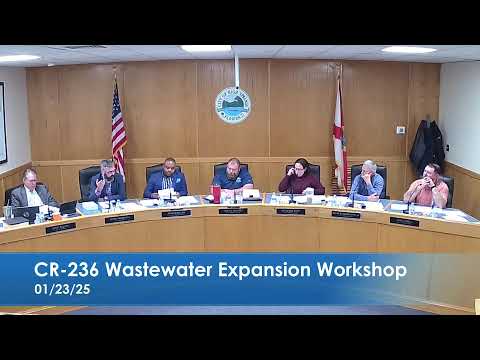
City commissioners held a workshop on the County Road 236 wastewater extension, hearing consultants explain state BMAP and House Bill 1379 mandates, grant funding including state ARPA money, a single bid of $1,655,990.30, and options for residents on impact and connection fees affecting about 20–22 homes.
High Springs commissioners on Monday reviewed the County Road 236 wastewater extension and septic-phase-out project, hearing consultants describe why the work is part of the Santa Fe River Basin Management Action Plan (BMAP), how House Bill 1379 affects septic installations in priority focus areas, and how state and federal grant money would pay most construction costs while leaving questions about resident impact fees and long-term utility bills.
Consultants from Mittauer Engineering told the commission the County Road 236 area lies inside the Santa Fe River BMAP and a narrower "priority focus area," meaning nitrogen reductions are a state priority. "The BMAP calls out specific nutrient reduction milestones for each community," said Greg Lang, a consultant with Mittauer, adding that projects such as the infiltrative wetlands, plant expansion and the 236 sewer extension all contribute toward meeting those milestones.
The consultants and staff also discussed House Bill 1379, the 2023 state law that took effect Jan. 1, 2024, and which restricts new conventional septic systems in BMAP areas and requires connection to sewer when available. "If sewer's available, you hook up; if it's not, you must install an enhanced nutrient-reducing septic system for parcels of one acre or less," said John Petrovich, a consultant on the project, describing the statute's effect in the project area.
Why the grant exists and how it was assembled
Consultants said the City originally pursued a smaller grant and later secured additional funding to cover a higher construction cost. City packets and staff indicate the project’s total funding package is about $1.9 million after an additional $1.1 million was obtained; consultants said the low construction bid received in 2023 was $1,655,990.30. Consultants said the state contributed some of its federal ARPA funds to the project, and those funds must be expended by 2026.
City staff and consultants told the commission the grant is intended to cover construction and typical restoration (driveways, roads) to the prior condition. "These grants allow for the restoration of roads, driveways, whatever is affected," Lang said, but he added that restoration means returning an area to its prior condition, not upgrading it.
Costs, billing and what residents may owe
Commissioners and residents pressed staff about what individual homeowners would pay. Consultants and staff said the grant is expected to cover connection costs in many cases, while the city’s existing impact fee (discussed in the workshop as $2,120) would remain the charge most commonly borne by residents unless the commission elects to waive it. One staff member told the commission the connection-fee amount residents were being quoted with the grant was about $4,240 and that the grant would cover larger hookup costs; the impact fee could be spread over 36 months, which staff estimated equates to roughly $59 per month if collected and financed over three years.
Residents said the difference between paying an impact fee and paying full hookup costs is significant. "It is absolutely critical that we begin to do the best thing possible for our beautiful natural resources," said Patricia Grunder, a resident who identified herself as the mayor’s mother, urging commissioners to move the project forward.
Procurement and schedule issues
Consultants told the commission that only one bid was received when the project was advertised in 2023 and that the low bidder’s price has been held since then without a formal notice to proceed. "He has been holding it, which is unusual," Lang said. Commissioners asked what would happen if the contractor later sought a large change order; consultants said any change would need to be justified and approved before the city issued a notice to proceed.
Project scope and tie-ins
Staff and consultants said the 236 work is a sewer extension and includes a pump station; the project is intended to connect roughly 20–22 homes on three roads, and engineers will confirm the point of connection (consultants noted Camp Kalakwa/Camp Coakla as a potential nearby connection). City staff confirmed that portions of the downstream network are 6-inch mains and that the nearest 12-inch main runs toward the wastewater plant; staff said the 6-inch main in the area should be adequate for the project as presently scoped.
Next steps and outstanding questions
Commissioners asked that engineering plans and bid tabulations be circulated and that legal staff provide a written opinion on whether the city may or must collect the impact fee when grants cover capacity expansion. The city manager stated support for advancing the project and emphasized it aligns with the city’s prior strategic priorities to expand wastewater service.
No formal acceptance of the grant or award of contract occurred at the workshop; commissioners held the meeting as a discussion and public comment opportunity and indicated the project would return to a future agenda for formal action.
The project underscores the state’s push in BMAP areas to reduce nitrogen loads to springs and is tied to the city’s broader advanced-waste-treatment and infiltrative wetlands work at the wastewater plant.