Get Full Government Meeting Transcripts, Videos, & Alerts Forever!
Get email alerts on the Land Use Development topic
No spam. Unsubscribe anytime.
Residents press council over Fairway Cliffs development, council amends townhome count
Summary
Developers presented a revised Fairway Cliffs plan without finished renderings; residents raised zoning, traffic, park and tax-incentive concerns. Council amended a related tax-exemption ordinance to increase the number of townhomes and tabled an unrelated ordinance for further study.
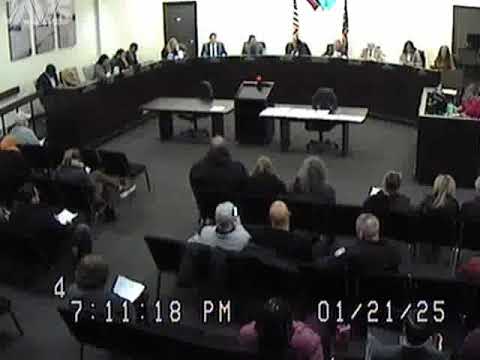
A proposal to redevelop parcels along Fairway Boulevard drew more than a dozen public comments and questioning from members of the Whitehall City Council on Jan. 21, 2025, as the administration and the developer sought approval for Community Reinvestment Area (CRA) exemptions and other incentives tied to the project.
Supporters of the neighborhood pushed back at a council meeting where the developer, Evan Rivera of Cordova Real Estate Group, described plans to build townhomes and add 2,000–2,500 square feet of ground‑floor retail to an existing office building. Rivera said the team expects to start construction in April and estimated 20 townhomes on one side of Yearling Road and matching units on the other; the townhomes he described are four‑bedroom models. Rivera told council the design has been revised repeatedly over two years because of a newly discovered gas‑line easement and parking constraints.
Council members and multiple neighbors said they did not have enough detailed drawings to evaluate the latest proposal. “This is too much change for me to try to anticipate and try to verbally and visually understand what you're saying,” Council Member Smith said during the applicant presentation, asking for updated renderings before council action. Multiple residents said they had not been informed in time and questioned why the legislation was being presented as an emergency measure.
Residents cited zoning and traffic concerns, questioned the proposed parkland trade, and criticized the tax incentives being requested. Patricia Bolster, a Fairway resident, asked what zoning allows converting single‑family lots to townhomes and warned the project would change neighborhood character. Holly Stein urged council to reject the proposed tax incentives, saying the petition submitted for the Community Authority reported “0 full‑time equivalent employees.” Joan Zagasca and other speakers called the emergency designation inappropriate and said public outreach had been limited. Amanda Waller and others raised environmental and canopy concerns for parkland that the administration says would be added as part of negotiations with a partner bank.
City staff and the applicant told council the plan has already changed several times because of a gas easement and parking limitations. City legal staff reminded council the applicant holds an earlier ordinance approval for a prior design (Ordinance 043-20-22); the new ordinance under consideration would repeal that earlier approval and add the commercial component laid out in the new submission.
On procedural actions tied to the project during the meeting, Council Member Dixon moved to amend Ordinance 10-20-25 to replace an earlier figure of 36 new townhomes with 50; the motion was seconded by Council Member Brown and passed on roll call. Elsewhere on the agenda, Council Member Elmore moved to table Ordinance 1-21-20-24 “until further notice” so staff and a committee could gather more community input; that motion was seconded and approved by roll call.
Why it matters: the measures before council would change permitted uses and offer real‑estate tax exemptions and related infrastructure agreements that can affect city revenue, project design, parkland and neighborhood traffic patterns. Neighbors said the proposed parkland sits in a floodplain and that the long‑term maintenance and safety costs would fall to the city if accepted; proponents argued the development will bring new housing and redevelopment of underused parcels.
What happens next: several council members pressed the applicant for finished renderings and clearer parking and site‑layout plans. The developer said more detailed plans and renderings would be provided within roughly 90 days. Council did not vote to approve the overall development package or final CRA agreement at the Jan. 21 meeting; the council instead voted on the amendment described above and tabled at least one separate ordinance for deeper review. Council members repeatedly asked for more time and for improved public outreach before any final votes.
Votes at the meeting affecting this topic included the amendment to Ordinance 10-20-25 (townhome count increased to 50) and the tabling of Ordinance 1-21-20-24 for further study. The administration said if the current proposal is rejected, the earlier ordinance (Ordinance 043-20-22) would remain in effect.
Developers, council and residents agreed on one practical point in the meeting: parking and an existing utility easement materially altered the options the applicant can present. Several council members told the applicant they expected a full, consistent set of renderings, site plans and parking analysis before voting on final development agreements or tax incentives.
Provenance: The discussion and public comments on Fairway Cliffs began when Mayor Michael T. Bivens called out Fairway Cliffs during his report (transcript excerpt: “I see a lot of, members that are here that are just, have signed in that are gonna speak, potentially as it relates, to the Fairway Cliffs, development.”) and continued through the developer presentation and ordinance readings later in the meeting.