Get Full Government Meeting Transcripts, Videos, & Alerts Forever!
Get email alerts on the Code Enforcement topic
No spam. Unsubscribe anytime.
Berea council hears overview of exterior-maintenance code and enforcement changes
Summary
City staff told the Berea City Council on Jan. 6 that exterior-maintenance rules set minimum standards, that the city has tightened its enforcement timeline, and that inspectors will work with residents while respecting search-and-privacy limits.
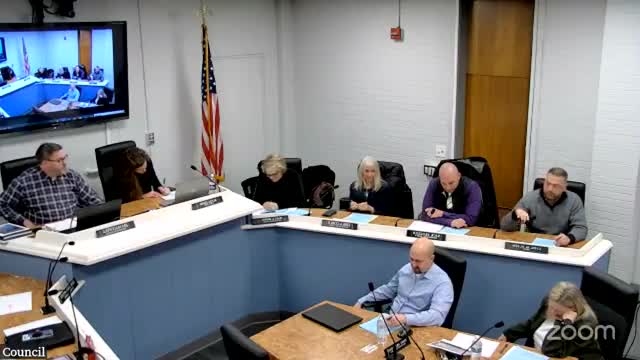
Berea City Council members heard a presentation Jan. 6 on the city’s exterior-maintenance code and recent changes in how staff handle complaints and enforcement.
The presentation, led by a city staff member identified in the meeting as Barb and introduced by the mayor, explained that the exterior-maintenance code sets minimum standards rather than aesthetic rules and that enforcement focuses on conditions that create health, safety or blight concerns. “It’s not Better Homes and Gardens… we’re just trying to enforce a minimum standard,” the mayor said while introducing the topic. Barb told council, “As long as they’re meeting the minimum standards of maintenance, we can’t and won’t do anything.”
Council members were given context for when the city can act: a public-nuisance or blighting condition must affect more than one property and typically be serious enough to pose health, safety or property-value concerns. Staff said backyards are often harder to address because they may require a warrant or owner permission to inspect. The presentation noted that when inspectors need to enter private property beyond what is visible from a public right of way, the law department obtains a search warrant.
Why this matters: the city described procedural changes intended to speed enforcement while directing staff to try to connect residents with resources. Staff said many cases involve seniors, disabled residents or people with mental-health or financial barriers that prevent them from correcting issues. To that end, the housing-resource office triages complaints and tries to link residents to grants, payment plans and other assistance before pursuing court action.
Key details explained to council: the city will now more quickly move from an initial inspection to the formal process when inspectors determine a violation exists, rather than routinely issuing long courtesy notices. Once the formal process starts, most property owners receive 30 days to remedy violations; some items constrained by weather may be deferred (for example, painting may be deferred until mid-to-late May), but items that can be done immediately should be completed right away. Staff said they have reduced routine courtesy notices because many cases did not advance after a long informal period.
City attorney involvement and prosecution: Megan Matthews of the law department prosecutes exterior-maintenance cases referred from the housing office. Staff described using organizational-liability charges when landlords hide behind LLCs; under that approach, fines can be substantially higher (staff cited fines up to $5,000 for corporate liability versus smaller amounts for individual violations). Cases that become nuisances and are abated by the city may be billed and the cost placed on the tax duplicate if not repaid.
Privacy, records and witnesses: staff warned that complaints are public records and that complainants may be asked to confirm they allowed city access if a case goes to court. Anonymous complaints can trigger inspections but cannot be the sole basis for a warrant. Council was told about Fourth Amendment limits on inspections and about the need for a judge’s authorization for certain entries.
Enforcement patterns and workload: staff estimates roughly 20–25% of active cases involve a small handful of repeat landlords; roughly half of citizen complaints are already on inspectors’ radars because inspectors run regular routes. The mayor and staff said adding a police officer assigned to exterior maintenance has helped in some cases by improving communication and presence.
Public resources and examples: staff described available loan and grant programs and gave an example of a hardship case where the city paid—staff said the roof work for an elderly resident was in the order of about $10,000. Council members asked about landlord contacts and the city said landlords must provide a local agent and that the city is starting to pursue corporate-level charges more often when appropriate.
Council questions focused on process and timelines (how cases move from complaint to inspection to court), landlord accountability, and how staff balance enforcement with assistance. The presentation closed with an invitation to residents to file complaints via the city web portal or by calling the housing-resource office; staff encouraged residents to provide contact information when possible to assist follow-up. The mayor and council thanked staff after the discussion.