Get Full Government Meeting Transcripts, Videos, & Alerts Forever!
Get email alerts on the Public Safety Privacy topic
No spam. Unsubscribe anytime.
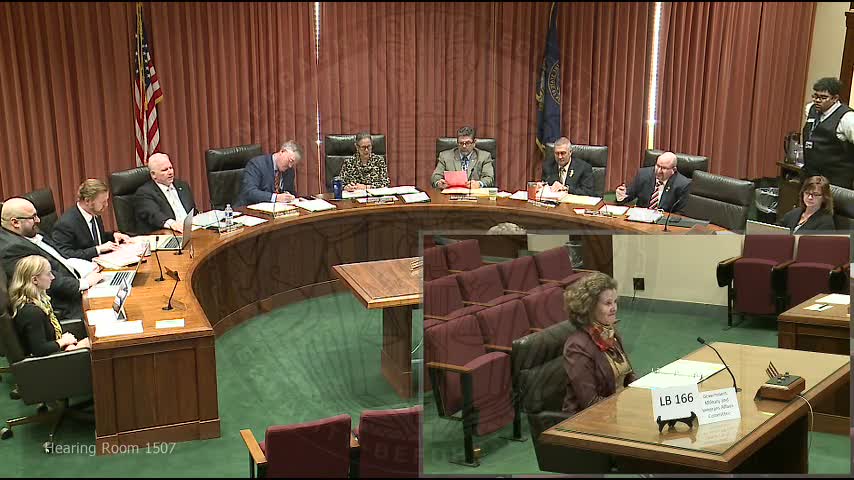
Committee hears bill to let law enforcement, judges and Guard withhold residential addresses from county online records
Summary
Sen. Jana Hughes, representing District 24, told the Government, Military and Veterans Affairs Committee she introduced LB166 to fix a loophole that leaves the residential addresses of some public-safety personnel and judges accessible through county treasurer websites even after they have requested redaction from county assessors.
Sen. Jana Hughes, representing District 24, told the Government, Military and Veterans Affairs Committee she introduced LB166 to fix a loophole that leaves the residential addresses of some public-safety personnel and judges accessible through county treasurer websites even after they have requested redaction from county assessors.
"There was an unintended loophole that exists that LB166 intends to fix," Sen. Jana Hughes said, explaining that the assessor can withhold a home address but county treasurer online links can still provide the information unless the treasurer is also required to withhold it.
Sergeant Taylor Samek of the York County Sheriff’s Office testified in support, describing how assessor-treasurer links and some treasurer search functions can reveal addresses that officers had asked to be withheld. "Without the passage of LB 166, there is a way for those with ill intentions to bring those risks to my front doorstep," Samek said, citing FBI statistics showing assaults on officers at a recent high.
Corey Steele, Nebraska state court administrator, and representatives of judicial and law-enforcement associations also supported the bill. Steele described instances in which judges received threats or were targeted and said the judicial branch has pursued Internet-scrubbing services and other protections. "It is important to us to secure judicial addresses," Steele told the committee, referring to prior efforts to add judges to confidential-address protections.
Candace Meredith of the Nebraska Association of County Officials testified in a neutral position and outlined practical issues in data flow: assessor records feed registers of deeds and treasurers and counties link platforms for property, tax and GIS functions. Meredith said those data flows would need to be coordinated if the statute is changed, and she noted that public-transparency concerns remain.
A constituent, Meg Weber, testified in the neutral lane to urge the committee to expand protections to survivors of domestic abuse. Weber described being stalked by a convicted ex-husband and said she had limited options to hide her address other than creating an LLC or a trust — options that can carry unfavorable lending consequences. "I ask today that you consider amending the current LB 166 to include domestic violence and domestic abuse survivors as a protected party," Weber said.
Committee members asked whether the redaction applies when a parcel is clicked on via GIS mapping and whether the redaction applies to joint-ownership parcels and nonresidential properties. Witnesses said the current draft protects the residential address of the property for which an application is filed and that the protection must be reapplied every five years per the statute as drafted. No formal action or vote was recorded during the hearing; Senator Hughes said she would work with the committee on any necessary amendments and could pursue additional bills to expand protections in future sessions.
The committee received multiple proponents, one neutral organization (NACO), and a constituent who requested expansion of the protected classes.