Get Full Government Meeting Transcripts, Videos, & Alerts Forever!
Get email alerts on the Property Tax Exemptions topic
No spam. Unsubscribe anytime.
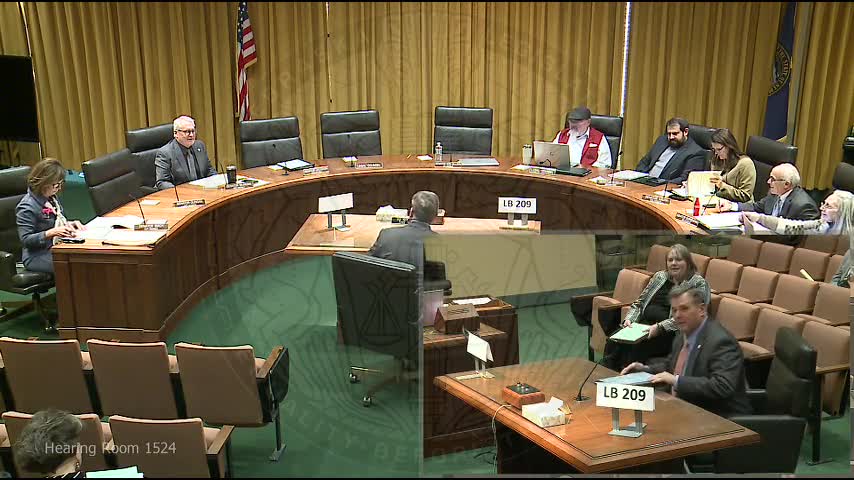
Revenue committee hears bill to clarify property-tax exemptions for nursing facilities and certain disabled veterans
Summary
Sen. Brad Von Gillern introduced LB209 to clarify how property-tax exemptions apply to nonprofit and for-profit nursing and assisted-living facilities and to specify homestead-exemption eligibility for veterans with individual unemployability. Department of Revenue and industry groups testified in support; no formal action was taken.
Senator Brad Von Gillern introduced Legislative Bill 209 at a Nebraska Legislature Revenue Committee hearing to clarify how property-tax exemptions should apply to nonprofit and for‑profit nursing and assisted‑living facilities and to specify homestead‑exemption eligibility for certain disabled veterans.
The bill would make two technical changes: first, it would distinguish clearly between nonprofit facilities, which historically have received a full property‑tax exemption, and for‑profit facilities, which under 2024 legislation receive a partial exemption tied to Medicaid occupancy. Second, it would add statutory clarity to preserve homestead exemptions for veterans who receive individual unemployability compensation from the federal Department of Veterans Affairs even though their disability rating is less than 100 percent.
Why it matters: Committee members and testifiers said ambiguities in last year’s changes have left room for county‑level interpretations that could reduce exemptions for nonprofit providers or leave some disabled veterans uncertain about eligibility. Supporters said clearer statutory language would produce uniform county implementation and protect households and providers that rely on current exemptions.
At the hearing, Von Gillern said LB209 is “simple” and intended to “provide clarity and distinguish” how exemptions are applied, noting that prior enactments left “the door” open to inconsistent county interpretations. Property Tax Administrator Sarah Scott of the Nebraska Department of Revenue testified the department has issued guidance to implement legislative intent but favors adding statutory clarity so county boards of equalization apply exemptions consistently. Scott said, “It has became clear that the documentation letters that the DOR has received ... do not differentiate” between veterans with a 100 percent rating and those receiving 100 percent compensation through individual unemployability, and that the department favors either adding the definition to statute or obtaining clearer federal documentation.
Cindy Cadyavy, senior vice president of policy for the Nebraska Health Care Association, told the committee the partial exemption enacted last year was intended as an option for for‑profit providers based on a three‑year average Medicaid occupancy and was not meant to replace longstanding full exemptions for nonprofit providers. John Cannon, executive director of the Nebraska Association of County Officials, testified in a neutral capacity that county assessors need statutory clarity and that the department’s narrow statutory construction left them little discretion.
Key clarifications and figures from testimony: Von Gillern said the fiscal note for LB209 showed no fiscal impact. Scott told the committee the department can identify some veterans receiving individual unemployability compensation but cannot determine how many of those are homeowners and therefore eligible for homestead exemptions; she characterized the affected population as unknown. Supporters asked the committee to move the bill forward to remove ambiguity that they said could otherwise lead to unintended tax assessments on nonprofit facilities.
No formal motion or vote occurred during the hearing. The committee heard proponents and a neutral testimony, closed the hearing and moved to the next bill.
The record shows testimony from the Department of Revenue, the Nebraska Health Care Association, and county officials; committee members asked clarifying questions but did not adopt any amendments during the hearing.