Get Full Government Meeting Transcripts, Videos, & Alerts Forever!
Get email alerts on the Utility Service Area Transfers topic
No spam. Unsubscribe anytime.
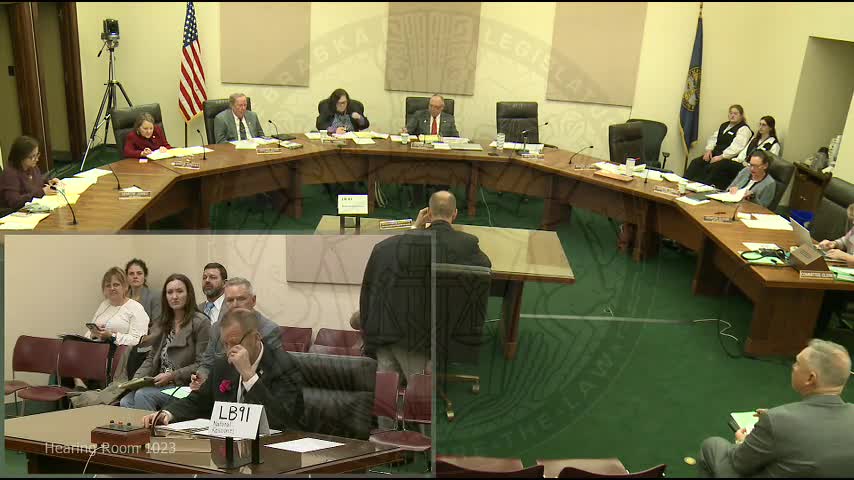
LB91 would remove statutory language that could let municipalities reclaim electric systems at no cost, sponsor says
Summary
Senator Barry DeKay said LB91 would remove language from state law that could require public power districts to surrender electric distribution systems back to municipalities at no cost and would clarify that municipalities must pay fair and reasonable value when reacquiring previously transferred infrastructure.
Senator Barry DeKay, representing District 40, told the Natural Resources Committee that LB91 would amend Neb. Rev. Stat. section 70‑6‑50.01 to remove two words that, as written, could allow a municipality to demand the return of an electric distribution system from a public power district without payment.
DeKay said the bill addresses a narrow set of circumstances in which a municipal system previously transferred its electric service area to a public power district, the district acquired and upgraded infrastructure (sometimes without debt), and later the municipality sought to reacquire that infrastructure. He described LB91 as reinforcing the existing process under section 70‑6‑50 — which requires payment of a sum that is “fair and reasonable, including reasonable severance damages” — and removing the conflicting language in 70‑6‑50.01 that could be interpreted to permit a return “without cost.”
David Jarecki, appearing for the Nebraska Rural Electric Association, testified in support and outlined the factual scenario the bill targets: if a public power district replaces poles, transformers and other infrastructure over decades, the district could end up owning an asset with little or no debt, yet the statute might be read to allow the municipality to demand the asset back at no charge. Jarecki said LB91 would clarify that a municipality seeking reacquisition must pay fair and reasonable, typically depreciated, value, and that appraisal mechanisms are available if parties cannot agree.
Witnesses discussed that the statutory situation is uncommon and would apply only when four conditions are present: the municipality previously transferred ownership to a public power district; the public power district owns and operates the system within the municipality; the district has no debt associated with the system; and the municipality seeks to reacquire the system. Jarecki and other witnesses cited an historical case involving York in 1982 that turned on valuation and inclusion of a substation, and said such litigation has been rare.
Committee members asked about typical transaction valuation and whether appraisers are used when parties cannot agree. Testimony said appraisers are used to determine fair market value when necessary. Witnesses and the League of Nebraska Municipalities characterized the bill as narrow and noted the statute’s historical context; the League said it was neutral on the change after research and consultation.
No opponents testified. The hearing record contains no committee vote on LB91; the committee closed the LB91 hearing after testimony and questions.
Key statutory references discussed during the hearing were Neb. Rev. Stat. sections 70‑6‑50 and 70‑6‑50.01 and past litigation (reported case cited in testimony as Impivity v. York) bearing on valuation disputes.
(Reported from the Natural Resources Committee public hearing; quotes and details drawn from committee transcript.)