Get Full Government Meeting Transcripts, Videos, & Alerts Forever!
Get email alerts on the Maternal Health topic
No spam. Unsubscribe anytime.
Neb. bill would let evidence-based nurse home visits bill Medicaid to expand postpartum care
Summary
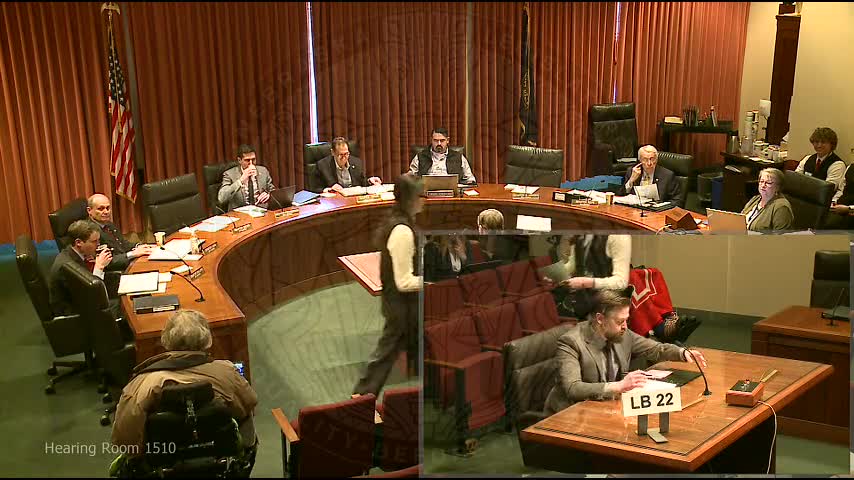
Sen. George Dungan introduced LB 22 to authorize Medicaid billing for evidence-based nurse home visiting (Family Connects) to expand postpartum supports statewide. Testimony highlighted pilot programs in Lincoln and Omaha, program outcomes, a $500,000 appropriation for pilots, federal matching rules and open fiscal questions.
Senator George Dungan introduced LB 22 to the Health and Human Services Committee to allow evidence-based nurse home visiting programs to bill Medicaid, an effort he said would expand postpartum supports now available only in parts of the state.
Supporters told the committee the Family Connects model provides 1–3 nurse home visits after discharge and produces measurable improvements in infant and maternal outcomes. Proponents urged the committee to allow targeted case management billing codes to be used for those visits so the service can grow beyond Lincoln and Omaha.
Why it matters: Committee testimony framed LB 22 as a continuation of Nebraska’s recent investments in prenatal care and as a way to secure an ongoing funding source for nurse home visiting. Proponents said federal Medicaid rules could provide a higher federal match if services are billed to the postpartum mother rather than to the child, reducing state cost. Witnesses also said pilot funding already appropriated by the Legislature will be used in Douglas County and that Lincoln Lancaster County’s Family Connects pilot has completed hundreds of visits.
Senator George Dungan, the bill’s introducer, said LB 22 “seeks to ensure there’s access to nurse home visiting postpartum care,” and highlighted the potential federal 90% match if services are billed to the mother’s postpartum eligibility. Kerry Kernen, health director for the Lincoln Lancaster County Health Department, told the committee the county has completed 925 postpartum Family Connects visits since September 2023 and is scheduling roughly 40% of eligible births. Kelly Macling of the Visiting Nurse Association in Omaha said her agency plans to implement Family Connects in Douglas County in 2025 and detailed operational experience with nurse home visitation.
Questions from committee members focused on program scope, how many visits are covered, whether managed-care organizations already furnish similar services, and how billing should be structured to obtain the higher federal match. Dungan and other witnesses repeatedly noted that Family Connects typically provides 1–3 visits within weeks of discharge and that other nurse-home models can extend longer; Dungan said the bill’s initial language allowed services up to age 3 but that the Family Connects model is far shorter and could be narrowed by amendment.
Fiscal issues and pilots: Witnesses referenced last year’s legislative appropriation of $500,000 for evidence-based nurse home visiting (Sen. Wishart’s bill included in the budget) and described that money as pilot funding that the Division of Public Health will use in Douglas County. Proponents argued Medicaid reimbursement would be a sustainable funding source to expand beyond pilots; they also disputed aspects of the fiscal note, saying the state share could be lower if the services are billed through postpartum coverage that carries a higher federal match.
What didn’t change today: The committee heard no final vote on LB 22 during the hearing and took testimony only. No formal committee action was recorded in the transcript.
Ending note: Supporters asked the committee to advance LB 22 so nurse home visiting can scale to rural areas and other communities where Family Connects is not yet available, while pointing to pilot results and national evaluations that link the model to reductions in emergency department and inpatient use for infants and improved maternal mental health.