Get Full Government Meeting Transcripts, Videos, & Alerts Forever!
Get email alerts on the Health Care Costs topic
No spam. Unsubscribe anytime.
Insurers tell lawmakers prescription drugs, hospitals and specialty care are driving premium growth
Summary
Insurer representatives told the committee that rising hospital and prescription drug costs — particularly specialty drugs — are the main drivers of premium increases and that insurers' medical loss ratio constrains how premium dollars can be used.
Representatives of PacificSource, Regence and Moda Health told the House committee on Jan. 23 that prescription drug spending and rising hospital costs are the major drivers of premium increases and that insurers have limited tools to contain those costs without broader policy changes.
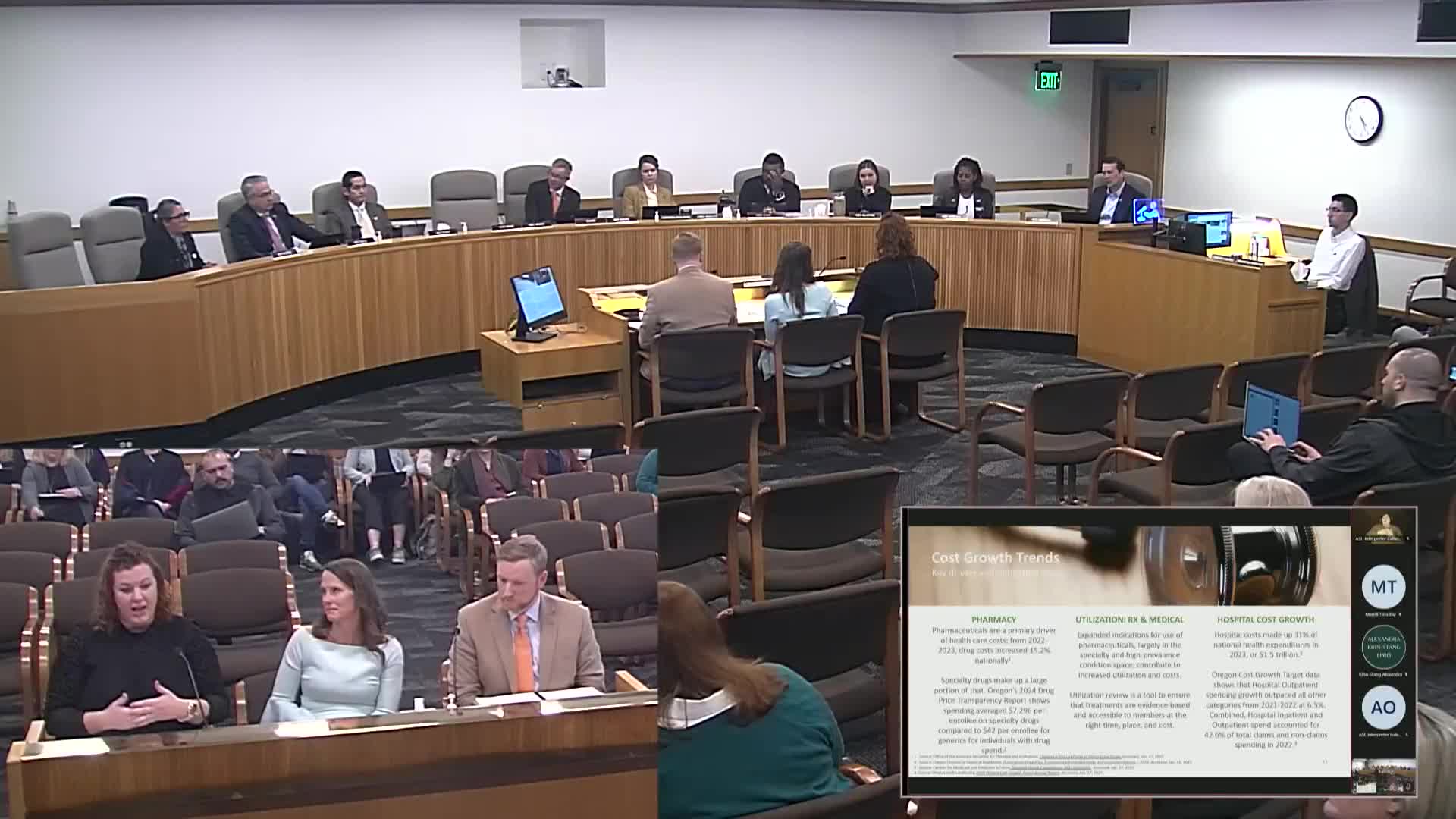
Mary Anne Cooper, director of government relations for Regence Blue Cross Blue Shield of Oregon, said drug costs grew substantially in recent years. She cited 2022–2023 national increases of about 15% in drug costs and said new drugs frequently list at high prices. Cooper said specialty drugs account for a small share of prescriptions but a large share of spend — Regence estimates average specialty‑drug spend around $7,296 per enrollee taking a specialty drug versus $42 for generics.
Cooper and other panelists said hospitals still account for the largest share of premium dollars; Regence cited national data showing hospitals account for roughly 42% of claims and non‑claims spending combined. She said hospital outpatient spending recently outpaced other categories and noted that hospitals often mark up physician‑administered drugs substantially—DHHS‑eligible hospitals’ markups can approach 300%—which directly raises insurer and member costs.
Panelists also discussed pharmacy benefit managers (PBMs). DFR staff had noted that 58 PBMs are licensed in Oregon but most of the commercial market is concentrated with roughly five large PBMs. Carriers said PBM structure and drug pricing together affect premium growth and consumer out‑of‑pocket burdens.
Why it matters: Carriers told lawmakers that, because the Affordable Care Act’s medical loss ratio requires insurers to spend 80–85% of premiums on care, premium increases largely reflect higher underlying care costs (hospitals, specialty drugs) rather than insurer profit.
Ending: Carriers urged collaboration with lawmakers on targeted policy measures to address prescription drug costs and hospital pricing; they warned that many cost drivers—particularly drug prices—are federal or market‑wide and not easily controlled at the state level.