Get Full Government Meeting Transcripts, Videos, & Alerts Forever!
Get email alerts on the School Safety topic
No spam. Unsubscribe anytime.
SDOT outlines Safe Routes to School projects, funding and outreach; council members press for better local communication
Summary
SDOT officials presented an overview of the Safe Routes to School program, funding and sample projects. Council members praised the program but urged SDOT to improve advance communication to district offices and neighbors when projects will include changes such as speed cushions.
Seattle Department of Transportation staff on Jan. 21 briefed the Transportation Committee on the Safe Routes to School program, its recent projects, funding and outreach work to increase walking and biking among students.
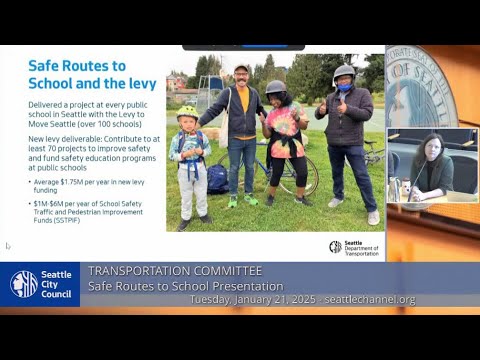
Sarah Collin, Safe Routes to School Program Manager at SDOT, told the committee the program aims to make it safer and easier for more students to walk and bike to school and that SDOT delivered at least one project to every public school during the Move Seattle levy. Collin said the new levy provides approximately $1,750,000 per year in Safe Routes funding and that the program supports infrastructure projects (crossings, traffic calming, placemaking) and programming such as walking school buses, classroom engagement and a city‑funded Let’s Go Bike Education program that teaches bike skills to students in grades 3–8, including adaptive bikes.
Collin and Ashley Reed of SDOT highlighted examples of infrastructure and programming: speed cushions and crosswalk daylighting near Greenwood Elementary (SDOT data cited a 21% reduction in speeds after installation), a school‑streets project at Genesee Hill Elementary with student art incorporated into the street, and efforts to place protected bike lanes and new shared‑use paths linking schools to parks and light rail stations.
Council members broadly praised the program and asked detailed questions about project selection and communication. Council member Gerald Strauss thanked staff but pressed SDOT on notification practices after a pair of recent projects (65th and Third) produced community confusion because the agency installed traffic calming measures that included speed cushions in addition to crossings. Strauss said residents and district offices were surprised by the scope of the work and asked how council offices should expect to be notified in advance. SDOT staff explained placement decisions follow speed and volume data and that, for 65th, staff selected speed cushions because flashing beacons provide time‑limited calming while cushions provide 24/7 speed reduction; they confirmed cushions are placed across both directions to avoid drivers bypassing them.
Vice Chair Hollingsworth and other council members thanked SDOT for recent improvements in their districts and raised questions about paint longevity for crosswalk markings, sidewalk coordination, and work near high‑risk corridors. SDOT said it coordinates with Seattle Public Schools on project selection, uses collision and speed data, and works with the city’s new sidewalk program on sidewalk priorities near schools. SDOT also said it will improve notification to council members and neighborhood stakeholders for projects where scope can affect parking or traffic patterns.
Collin said Safe Routes programming has helped double walking and biking rates to school over two decades in Seattle and that the program’s infrastructure and education components are complementary. SDOT highlighted upcoming projects including a two‑way protected bike lane in Rainier Beach connecting multiple schools and a First Avenue shared‑use path to improve walking and biking access to James Baldwin Elementary and a forthcoming light‑rail station.
—
Sources: SDOT presentation by Sarah Collin and Ashley Reed; committee discussion and Q&A, Jan. 21, 2025.